What Was Your Gateway to Adventure

This was an old TSR Hobbies catalog. I can’t recall whether this came packaged in my Holmes Basic set or in the later Moldvay set.

1977 had been a big year already, with the release of Star Wars during the past spring. The summer had been spent running around the neighborhood, shooting imaginary Storm Troopers, and debating the fate of Darth Vader.

It was around Thanksgiving when I became aware of a new animated TV Special. The Hobbit was coming to television. Now, for those of you much younger than I, you must understand that the late 70s were a much different time. We had cartoons every Saturday morning, without fail. However, aside from the annual Charlie Brown specials and perhaps Rudolph the Red-Nosed Reindeer, animated specials were almost unheard of. If you are too young to have lived through this, it’s hard to describe just how odd this was to see on network tv.

Rumors had spread through my school like wildfire. The Hobbit was something totally different. Not only was this a new animated special, but it was a story of wizards, dwarves, elves, and even a dragon! Truly, this was something not to be missed.

I don’t recall what I did wrong. Perhaps I had knocked the gravy over and into my Aunt’s lap during Thanksgiving dinner. At any rate, as luck would have it, I found myself quite grounded for the world television premier of The Hobbit.  It was devastating. I was certain that quite possibly; nothing good could come of my life from that day forward. You see, in 1977, there was no streaming, no DVRs (or VCRs for that matter). As a matter of fact, there was a great likelihood that if you missed a show on TV or even a movie in the theater, that you may never have an opportunity to see it again.

During the following week, I was forced to listen to my young friends tells stories about The Hobbit.  They would go on and on about the goblins, the spiders, and even some strange thing that they referred to as “Gollum”.  I was devastated. Within the span of one year, I had been told that I was too young to have a poster of Farrah Fawcett and now I had missed The Hobbit.

This was the cover to my first version of The Hobbit in the late 1970s.

During the fall of 1978. I came home from school one day to find a paperback book lying on my bed. It was The Hobbit; my parents had purchased me a copy of the novel. While it was certainly quite a bit larger than any book I had read thus far, I was intrigued by the maps and “strange writing” which I found just inside the front cover. I set about reading it right away.

I was hooked immediately. Shortly after finishing The Hobbit, I moved on to the Lord of the Rings trilogy. By the time that these were all finished I was a fantasy junkie, devouring any new novels that I could land my hands on. As I recall, the next up were the Lancer/Ace Conan series with the striking Frank Frazetta covers.

It was some time after that when I heard a couple of my friends talking about some new game. They had been playing this game, with the older kids who lived on the next road over. The details were sketchy but apparently there were hobbits and goblins in it and it was different from any of type of game.

The Holmes Basic D&D boxed set.

The whole thing was terribly confusing and made no sense to me at all. When I asked them about the board, they said there was no board. When I asked if there were cards, they said there were no cards. I was a skeptic, to say the least. Certainly, if a game like this existed, it would have to be listed within the pages of the J.C. Penney Christmas catalog (everything worth having as a child was.) It was not.

Then, one day, my friend and I happened to accompany my mother on a trip to Scrantom’s (a local card & stationary store in Rochester, NY). As we were checking out, I saw a curious looking box, sitting behind the counter. The box was adorned with a picture of a large dragon, sitting on a huge pile of treasure. The words “Dungeons & Dragons” were printed across the top of the box. A look to my buddy confirmed that this was the game he’d been trying to tell me about.

I received that very box for my birthday (this was the Holmes edition Dungeons & Dragons Basic set.) Like a blind man who has never seen, I immediately understood about games without boards. Suddenly, I had the ability to do more than just read fantasy stories; I could create them and watch them unfold before my eyes. The years to follow were filled with all kinds of great gaming memories.

Conclusion

That was how I was introduced to the hobby. However, sticking true to the title of this post, I’m curious about you. What was your gateway to adventure? When were you first exposed to the hobby and what was your first game? I’ve always loved hearing these type of origin stories and I find it fascinating to read about. Drop a comment below and let me know.

That’s all for now. Have a great week and thank you for stopping by. Good gaming!

For maps & plot hooks, go here.

For my Idea Chest posts, go here.

For some random tables, go here.

Want to help me to compile a list of TTRPG conventions? Click here.

Finally, for a bit about me and some general stuff, this is the spot.

Idea Chest: Lonesome Dove

I may be going out on a limb with this week’s addition to the Idea Chest but I will ask that you bear with me on this one. When I hatched the idea for this regular feature, it was out of the desire to inspire other gamemasters with franchises that had inspired me. I can honestly say that this property has influenced me both as a gamemaster and a player for over 30 years.

Lonesome Dove is a 1985 western novel by Larry McMurtry, as well as a 1989 TV miniseries starring Tommy Lee Jones and Robert Duvall. The story tells the tale of two former Texas Rangers as they lead a cattle drive from Texas to Montana.

I was 15 years old when I found the novel laying around my house. My mother had finished reading it the week prior. Much like I suspect many of you are feeling at the moment, I had almost zero interest in westerns whatsoever. However, I was three weeks into my summer break from high school and I had nothing else to read. Thinking back, I did have Boot Hill from TSR Hobbies sitting on my game shelf. I suspect I was thinking that I might stumble onto a good idea for an adventure, if I just gave it half a chance.

I realize that a western is probably even less appealing to folks today than it was in 1985. That said, I can’t stop myself from suggesting it. Even for a fantasy campaign, I think it would be worth checking out either the novel or the miniseries. Both were excellent and I feel that at the very least you’d get some solid entertainment out of the experience. Without rattling on further, here’s what I find the most useful out of exploring the franchise.

The Epic Journey

The trope of the party getting hired to guard a caravan is probably as old as “the party meets in the tavern”. However, what if the journey was the point of the whole campaign? The central cattle drive in Lonesome Dove is an excellent framework for a campaign. Much like a religious pilgrimage, a crusade, or a grand expedition, a journey of that magnitude could provide everything you need to keep your players entertained.

As a GM, this type of campaign style would give you the ability to have a somewhat linear campaign, without really railroading your party. I mean, if the whole point of the campaign is to travel from point A to point B, it does really narrow the field in terms of what you need to prep for. For instance, the party may need to choose between Caradhras or Moria but at least they wouldn’t been choosing from anything under the sun.

Environmental Challenges

Still focusing on the journey, some of the most gripping parts of the story come from environmental challenges like dust storms or dangerous river crossings. It’s a good reminder that not all challenges need to be combats or monsters. Environmental obstacles can be just as compelling, testing the party’s skills and resourcefulness.

A Well-Crafted Party

While my previous Idea Chest posts have focused solely on GM inspiration, Lonesome Dove is great for players as well. The story is a virtual master class in interesting characters. The Hat Creek Cattle Company is essentially a party of adventurers, each member with their own backstory and role. Joshua Deets, Pea Eye Parker, Bolivar, Newt—they’re all vividly realized characters that could inspire PCs or NPCs in your campaign. If you encourage players to create characters with rich pasts and motivations, you’d be hard pressed to find a more dynamic group.

Twilight Heroes

The story’s protagonists, Woodrow Call and Augustus McCrae, are former Texas Rangers in the twilight of their lives. This aspect alone is a gold mine for your games. Instead of starting as green adventurers, imagine characters who have already lived a life full of stories, coming together for one last grand quest. Even if you’re starting a new campaign with level 1 characters, there’s no reason that you couldn’t opt for the narrative the some of the characters are grizzled old veterans who are a bit rusty but gradually getting their skills back.

Blue Duck: A Versatile Villain

Blue Duck is a memorable villain who exemplifies how to craft a villain’s ominous presence. He could be a notorious bandit, a cunning warlord, or even a mystical threat, depending on your campaign’s needs. McMurtry skillfully weaves whispers about Blue Duck into the narrative, long before the protagonists come face to face with him. The fear and anticipation build through the stories told by others, and this sets a done of dread that could be useful in your game.

In addition, Blue Duck’s terror stems not from supernatural abilities but from his malevolence and the psychological impact of his actions. This is a great lesion that a compelling antagonist needs no extraordinary powers to be formidable. Instead, the villain’s reputation and the fear they instill can serve as powerful tools, engaging your players on a psychological level.

The Tragic Tale of Jake Spoon

No spoilers but Jake Spoon’s storyline is ripe for adaptation as a PC or NPC. He’s a charming character that can serve as a cautionary tale or a complex backstory, offering moral dilemmas and character development opportunities. Bottom line, memorable characters make for a great campaign as much as a great story.

Conclusion

That’ll do it for this week. Have you ever crossed paths with Lonesome Dove? Leave a comment if you have and let me know. While it’s a western, I believe there’s a lot to be mined from it, even for a fantasy campaign. I know it would be a stretch for a lot of you but I recommend giving it a read or watching the miniseries if you’ve never seen it. Thanks for stopping by. Good gaming!

For maps & plot hooks, go here.

For my Idea Chest posts, go here.

For some random tables, go here.

Want to help me to compile a list of TTRPG conventions? Click here.

Finally, for a bit about me and some general stuff, this is the spot.

Cold as Ice

Nestled in the foothills to the west of the Khared Draz mountains, the village of Hemlock is known for its harsh winters. This year, however, the weather has been particularly unforgiving. Recently, a brutal storm dumped an unusually heavy load of snow on the area. A thick white blanket covers the landscape, adding to the rustic charm of the village. Naples Creek, now frozen over, splits the village in half.

Made with Campaign Cartographer (Winter Village style).

What the Party Knows

The party arrived in Hemlock on the heels of the last storm, seeking respite from their recent endeavors. Hemlock, though small, offered a warm welcome amidst its snow-covered surroundings.

During their stay, the party quickly has learned that Hemlock is facing a pressing predicament. The villagers have been anxiously awaiting a crucial delivery of supplies from Summersville to the east. However, it has not arrived. With winter’s grip tightening, the absence of these supplies spells serious trouble for the village.

Herr Vogelmann, the village’s appointed steward, has approached the party with a proposition.  A man with a grave demeanor, the official realizes that the party may be the village’s only hope. Offering up a modest reward, he has tasked the party with an urgent mission: to head east and locate the missing shipment.

What the Party Doesn’t Know

Flurry the ice mephit. Artwork © 2015 Dean Spencer, used with permission. All rights reserved.

The situation in Hemlock is even more perilous than the villagers, or the party, realize. The much-needed shipment did indeed set out from Summersville days ago. The dependable and hardy driver, Gunther Baumann, loaded his wagon and headed out on schedule. But fate, it seems, had a cruel twist in store.

Two days ago, as the most recent storm reached its peak, a trio of mischievous ice mephits named Flurry, Sleet, and Squall chanced upon the struggling wagon. Always on the lookout for opportunities to create chaos, these elemental tricksters saw the wagon as a perfect target for their malevolent games.

Utilizing their fog cloud ability, Flurry, Sleet, and Squall shrouded the path in a dense, disorienting mist. Confused and blinded by the sudden fog, Herr Baumann lost control of the wagon. It veered off the road, crashing down a slight incline, and onto the fragile surface of a frozen pond. The impact was severe, and while the horses escaped unharmed, Herr Baumann was grievously injured in the accident.

The mephits, in their twisted sense of amusement, chose not to deal a fatal blow to the driver. Instead, they left him wounded and barely clinging to life, a bait of sorts in their cruel game. They hoped that his plight would soon attract rescuers, bringing more unsuspecting victims into their icy playground. Now, Herr Baumann lies helpless, the vital supplies scattered and at risk, as Flurry, Sleet, and Squall wait with bated breath for more ‘players’ to arrive.

Frozen pond battlemap. Made with Campaign Cartographer (Winter Village style).

The Encounter

As the party nears the site where Herr Baumann went off the road, their presence does not go unnoticed. The trio of ice mephits, Flurry, Sleet, and Squall spot the adventurers from afar. Anticipating new targets for their mischief, they prepare their icy trap with malicious intent.

Employing their fog cloud ability, the mephits cloak the edges of the frozen pond in a dense, chilling fog. This strategic move is designed to disorient and confuse any newcomers, masking the dangerous transition from the solid ground to the ice.

Upon the party’s arrival at the scene, the aftermath of the wagon’s crash is visibly evident. The deep ruts left by the wagon’s wheels veer sharply off the road, leading down a gentle hill. The tracks disappear into the fog-laden area, where the sound of Herr Baumann’s groans and calls for help can be faintly heard.

Approaching the site of the wreck, each party member should make a DC 12 Wisdom (Perception) check in order to discern the shift in landscape from solid ground to snow covered ice. Characters failing this check will become aware of the ice once they reach the wagon. However, by then they will be some 40’ out onto the ice.

As the party approaches, their every move is silently observed by Flurry, Sleet, and Squall. The mephits use their false appearance ability to disguise themselves as innocuous shards of ice on the pond’s surface. When a party member finally reaches Herr Baumann, the mephits seize their opportunity to strike. They spring to life and launch a surprise attack on the unsuspecting party.

At the start of each character’s turn, the Dungeon Master rolls a d20. On a roll of 1-2, the ice beneath that character begins to crack. The player must succeed on a DC 12 Dexterity saving throw to quickly move to a more stable area or fall through the ice. If a character falls into the icy waters, they must immediately make a DC 15 Constitution saving throw to withstand the shock of the cold. Failure results in the character taking 1d6 cold damage, being unable to climb out of the water and suffering disadvantage on attack rolls and ability checks due to the numbing cold. Allies can attempt a rescue, but each round the character remains in the water, they must repeat the saving throw, with failure resulting in additional cold damage.

The mephits focus their attacks while on the ice and will not pursue the party onto land. If two of the mephits are defeated, the remaining one, realizing the tide of battle has turned, flees across the ice to safety.

Set a timer for 6 rounds after the encounter begins. If the party fails to defeat the mephits or move the wagon by then, the weakened ice gives way, causing the wagon and its supplies to sink into the pond. If the party manages to defeat the mephits before the timer expires, the immediate threat to the wagon is neutralized, and it does not sink.

Frozen pond battlemap w/fog cloud.

Aftermath

If the party has horses and sufficient rope, they can attempt to pull the wagon to shore. However, taking horses onto the fragile ice is risky. If a party member possesses appropriate skills, such as proficiency in carpenter’s tools, they can make repairs to the wagon on the spot. If not, or if the party lacks horses, they will need to return to Hemlock and seek Herr Vogelmann’s assistance to recover the wagon and its contents.

Conclusion

I’m still not settled on the mechanics for this one. I kicked around the idea of having certain squares be more susceptible to having the ice crack than others but settled on this. I’ve also been back and forth on the total number of mephits. Ultimately, since these posts are merely a method for me to give ideas to GMs, I figured I’d leave it as it was. If you happen to incorporate this encounter or some version of it into your game, please let me know how it goes.

That’s all I’ve got for this week. I hope you’re staying warm wherever you happen to be and thank you for stopping by. Good gaming!

For more maps & plot hooks, go here.

For my Idea Chest posts, go here.

For some random tables, go here.

Want to help me to compile a list of TTRPG conventions? Click here.

Finally, for a bit about me and some general stuff, this is the spot.

Idea Chest: Planet of the Apes

This week I am going to offer up another entry for the Idea Chest. The Planet of the Apes franchise weaves post-apocalyptic themes with societal commentary. While the TV series and more recent films have contributed to the legacy, for this post I will specifically be focusing on the original 1968-1973 film series that started it all. Before I dive in, consider this a spoiler warning for those who haven’t yet experienced these classic films.

As a young boy, I was spellbound by the “Planet of the Apes” series. I discovered them around the same time as tabletop RPGs and they left an indelible mark on my imagination. I feel that these movies can provide a wellspring of inspiration for not only sci-fi or post-apocalyptic games but fantasy campaigns as well. There are a number of elements of this franchise that can provide inspiration for your games.

A Familiar Yet Altered World

General Ursus. Beneath the Planet of the Apes 1970.

The characters in “Planet of the Apes” find themselves in a world that is eerily familiar yet starkly different. This situation is not just interesting, it’s full potential for fantasy settings. For instance, imagine your party stepping through a portal to a world where orcs are the cultured rulers and humans, elves, and dwarves are seen as primitive. Such a reversal of roles can offer a fresh perspective and challenge players’ preconceptions about “civilization” in your game.

The New Society

If you do expose your PCs to an altered world, it also opens up the possibility to delve into the social structure of that world. This dynamic can be reflected in a campaign setting, where different factions vie for power, influence, and survival. It can serve as a mirror to our own society, offering an opportunity to explore themes of equality, prejudice, and governance.

Echoes of the Future

Cornelius & Zira in a holding cell. Escape from the Planet of the Apes 1971.

Envision the players encountering a future version of their own world within the campaign. It’s a startling revelation that can bring the consequences of their actions into sharp relief. How have their decisions affected the world? What legacies have they left behind? This concept encourages players to think long-term about their journey’s impact.

A Glimpse of the Past in the Present

Conversely, consider the story possibilities if beings from a potential future were to somehow arrive in the current campaign timeline. This twist, akin to what happens in Escape from the Planet of the Apes, could lead to compelling interactions and conflicts. How does the world react to these beings? Are they seen as omens, deities, or threats?

Dr. Zaius discusses the newly arrived Taylor with Cornelius & Zira. Planet of the Apes 1968.

The Forbidden Zone

The Forbidden Zone in “Planet of the Apes” is a desolate and dangerous region that harbors secrets of the past. In a fantasy campaign, such a zone could be the result of a lost civilization sealing itself away, using magic to deter intruders. This concept can introduce an area filled with mystery, danger, and forbidden knowledge, tempting the brave and deterring the cautious.

The Cult of the Lost

Denizens of the Forbidden Zone worshipping the bomb. Beneath the Planet of the Apes 1970.

The mutants in the Forbidden Zone worship a nuclear bomb, a relic from a bygone era. This concept can be mirrored in a fantasy setting. Imagine a group of isolated people who, cut off from the rest of the world, begin to revere an ancient artifact from their history. This could be a dormant magical object or even a misunderstood natural phenomenon. Their worship, based on misinterpretations or half-lost memories, could have transformed this entity into something far removed from its original nature. It becomes a symbol of their identity, shaping their culture and perspective on the outside world. Does the party attempt to understand and empathize with these people’s beliefs, or do they try to reveal the truth behind the object of worship?

Infinite Regression

The concept of infinite regression—discovering that every ‘new’ world is just a layer over the ‘old’ one—could turn a campaign into a multidimensional exploration of history and reality. What if the ‘ancient ruins’ your party discovers are not from the past but from a future that has come and gone?

Conclusion

I’m curious to know if you’re familiar with the Planet of the Apes franchise and whether you’ve ever drawn from its themes for your games. Have these films inspired your campaigns? Have you ever flipped the script on your players with a setting that challenges their notions of the norm? Finally, as someone who’s not caught up on all of the newer films, I’d love to hear if you’d recommend them.

That’s all for now. Thanks for taking the time to visit and I hope you have a great week. Good gaming!

For more Idea Chest posts, go here.

For maps & plot hooks, go here.

For some random tables, go here.

Want to help me to compile a list of TTRPG conventions? Click here.

Finally, for a bit about me and some general stuff, this is the spot.

The Lost City of Wakou M’baque

Two weeks ago, I posted a map of some ruins deep within the jungles of Gowandia. Among the crumbling stones, a spiral staircase was found, tempting adventurers to descend into the unknown.

The spiral staircase descends for hundreds of feet, in total darkness. Characters with any type of mining skill will marvel at how this could have been created. The stairs end at a 20-foot-wide tunnel running south-southwest. The air grows increasingly humid, and the distant sound of rushing water becomes a steady echo in the darkness.

The lost city of Wakou M’baque. Created with Campaign Cartographer.

The passage ends after roughly 50 feet with more stairs going down, though straight and steep this time. A faint yellowish glow beckons from the depths. Reaching the final stretch of the descent, the glow intensifies, casting an eerie light that dances on the edges of the cavern. The stairs widen, revealing a breathtaking sight—a massive cavern (visible from location #1)

Stretching over 700 feet in each direction this immense chamber is a natural wonder. A glowing chartreuse lichen adorns the vaulted ceiling. Weaving around giant stalactites, it casts an eerie yellow light over the ground, some 100 feet below.

In the heart of this colossal cavern, a forgotten city lies frozen in time. Stepping onto the widened stairs, the sight unfolds—buildings crafted from clay with flat roofs, stand like silent sentinels against the glow of the chartreuse lichen. Single and two-story dwellings line the streets, remnants of a civilization tucked away from the world above. The city’s layout reveals an intricate design, reflecting the architectural prowess of those who called this underground expanse home.

While not visible from this vantage point, two similar stairways lead up from the city. One may be found at location #2 and the other at location #3.

A roaring river bisects the city from northeast to southwest. Two bridges span the water, connecting the two halves of the metropolis. The glow of the lichen, combined with the reflections from the water creates the sensation that the center of the city is undulating. While not clearly evident, if someone were to exit the cavern following the path of the river (location $4), they would eventually come out to Maguni Falls.

At the far end of the cavern, a monumental ziggurat dominates the skyline (location #5), reaching halfway to the cavern ceiling. Its purpose, like the city itself, is veiled in the echoes of time. Beyond the ziggurat, a colossal statue of Ka-Zaa, the ancient Gowandian god of magic, surveys the subterranean realm (location #6).

The entire city, though silent and seemingly abandoned, carries an air of preserved majesty. Odd markings on some structures hint at a purpose but their meaning may be lost to time. Patches of multi-colored crystals jut out of the earth in many places. Looking down the empty streets, one is forced to wonder what this place looked like in its prime.

The air within the cavern is thick with humidity, and strange flora adds an otherworldly charm. Giant mushrooms (some as tall as a man) and patches of orangish-brown fungus litter the area. Despite a lack of any actual sunlight, towering purple ferns can be found throughout the city.

Taking in the sights from the staircase, the adventurers are poised for discovery. surrounded by the echoes of a city lost to time. The lost city of Wakou M’baque lies before them and the secrets it guards are ready to unfold.

Conclusion

Wakou M’baque has lived in my head for over 40 years, in one form or another. To me it’s always been a bit of a mash-up of Robert E. Howard tales, with a bit of the classic B4 The Lost City thrown in for good measure.

How would you use a location like this in a game? Is the city truly abandoned? Are their still people living here? Has some bizarre alien presence taken hold of the place? Let me know in the comments, as I’m always curious to see what folks will come up with.

That will do it for this week. Thank you for taking the time to stop by and I wish you the best with the week to come. Good gaming!

For maps & plot hooks, go here.

For some random tables, go here.

Want to help me to compile a list of TTRPG conventions? Click here.

Finally, for a bit about me and some general stuff, this is the spot.

Maguni Falls

Nestled deep within the heart of Gowandia’s jungle, Maguni Falls stands as a forgotten sacred site, shrouded in mist and mystery. Sacred to the early Gowandians, this enchanting locale has remained untouched for ages. Adventurers lucky enough to find this location will be the first witnesses in untold years.

Maguni Falls. Created with Campaign Cartographer’s Forest Trail style.

Amidst the lush jungle, unique flora thrives (more about this in Weeds of Wonder). The Stikricki Bush, whose razor-sharp thorns serve as natural caltrops, and the Magasorium, whose leaves offer protection against the jungle’s relentless insects may both be found here. The air is rich with the scent of the Billitri plant, a fragrant guardian against keen-nosed predators, while the Manshooki tree provides resilient vines coveted by the Gowandian tribes.

A rickety old bridge (location #1) tempts the party to cross the raging river to a narrow strip of land along the base of the northernmost cliff. Those who are brave enough to traverse the span will find a hidden path behind the waterfall (location #2).

Emerging on the western side of the veil of water, the path leads to a stone arch at the edge of the southern cliff (location #3). Ancient Gowandian runes are carved into the side of the arch. If any of the party are able to decipher these runes, they will learn of a secret entrance to the lost city of Wakou M’baque in the cave directly below (location #4).

Conclusion

I struggled a bit with this map style in trying to properly illustrate the different cliffs. Hopefully things ae clear enough. Having now explored two different entrances to Wakou M’baque, we’ll head underground next week to see some of the city itself.

Thanks for stopping by. Have a great week!

For more maps & plot hooks, go here.

For some random tables, go here.

Want to help me to compile a list of TTRPG conventions? Click here.

Finally, for a bit about me and some general stuff, this is the spot.

Jungle Ruins

Nestled in the deepest jungles of the southern continent, Gowandian tribes live among the ruins of ancient civilizations. Gowandian scholars frequently take pilgrimages to distant lands in order to record major events but many secrets still lay hidden away in the wilds of this remote nation.

Treading through the jungle’s heart, the silence is broken only by the rustling leaves and distant calls of unseen creatures. The air is thick with the enchantment of magic, and the path ahead is veiled in mysteries waiting to be unraveled.

This map reveals a forgotten sacred site where ancient tribes once sought the blessings of Ka-Zaa, the god of magic. Weathered standing stones form a mystical triangle around a statue of the deity, depicting the harmonious blend of mind, body, and spirit required to master arcane powers.

Nature has claimed these ruins with a lush overgrowth. Vines and ferns intertwine with remnants of a mysterious past. Among the crumbling stones, a spiral staircase tempts adventurers to descend into Wakou M’baque, a lost city swallowed by time and the gods.

Conclusion

Keeping this one brief, as I’m hoping to build on it in coming weeks. I had originally intended for the party to be attacked by axe beaks outside the ruins. However, it felt like an empty combat so I opted to just let the tension build as the adventurers investigate the scene. That’s all for now. Thanks for stopping by and have a great week!

For more maps & plot hooks, go here.

For some random tables, go here.

Want to help me to compile a list of TTRPG conventions? Click here.

Finally, for a bit about me and some general stuff, this is the spot.

The Altar of the Green Man (Part II)

In part one of The Altar of the Green Man, the party visited the village of Novos. The residents of this small agricultural community hired the adventurers to get to the bottom of some strange happenings.

The Altar of the Green Man. Artwork © 2023 Emily Bryant, used with permission. All rights reserved

Farmers harvesting their crops noticed that something was wrong with the soil. Others reported signs of an odd blight. Evan more puzzling was the fact that grain dollies (crude dolls made of grain to represent the spirits of the harvest) have been disappearing from people’s homes.

Following some investigations around the village, the party learned about the Green Man, a revered figure who represents the spirit of nature and fertility in the region. Followers of the old ways once left offerings at an ancient altar to the Green Man, to ensure a bountiful harvest.

  • A village elder suggested the party travel into the forest to seek out the old altar and leave a humble offering.
  • A less reputable villager also mentioned having seen strange little creatures coming out of the woods at night.

The journey out to the location of the altar should only take a couple hours. However, the villagers will gladly supply the party with any mundane gear needed for the trip. In addition, Sister Elena will provide the party with a number of remaining grain dollies to take with them as an offering at the altar.

Created with Campaign Cartographer.

What the Party Doesn’t Know

The Gnarr. Artwork © 2023 Emily Bryant, used with permission. All rights reserved.

A green hag by the name of Agatha Verdantmire is behind the blighted crops. Taking great delight in corrupting the natural order of things, the twisted fey creature is feeding upon the misery and suffering of the village. Her plan is to spread a blight across the region until the people of Novos are forced from their homes. To assist her in her cruel machinations, she has enlisted the aid of some creatures from the fey realm. These foes are unique to my game, so I will provide you with a brief description and you can create stats as you see fit.

  • The Gnarr: Standing nearly 10’ tall, this creature resembles a misshapen tree. It plods along at movement rate of 15’ (3 squares). The Gnarr swings its branches for defense and also has the ability to cast entangle twice per day. Damage from fire sources will cause double damage to this creature.
Toadstool Sporeling. Artwork © 2023 Emily Bryant, used with permission. All rights reserved

  • Toadstool Sporelings: These diminutive horrors are what Agatha has been using to spread her blight to the nearby farms. At 30” in height, these creatures are what Anton saw dancing around in the farm. They move at 30’ and could be considered as minions (will drop with a single hit). While not physically intimidating, the Sporelings drip a contact poison that affects anything they touch. In addition, they have circular rows of sharp teeth under their caps. On a hit, the sporeling attaches to the target. While attached, the sporeling doesn’t attack. Instead, at the start of each of the sporeling’s turns, the target loses hit points due to blood loss.

Agatha stumbled onto the altar of the Green Man months ago and has been working to corrupt it ever since. The Green Man’s influence over the region has long ensured bountiful harvests. By tainting his altar, the wicked hag aims to weaken his power and clear the way for her magical blight to spread unchecked across the land.

In a desperate attempt to seek help, the spirit of the Green Man caused the grain dollies to disappear from homes across the village. This unexplained phenomenon was a plea for aid, a sign that something was terribly wrong.

The Encounter

Toadstool Sporeling. Artwork © 2023 Emily Bryant, used with permission. All rights reserved

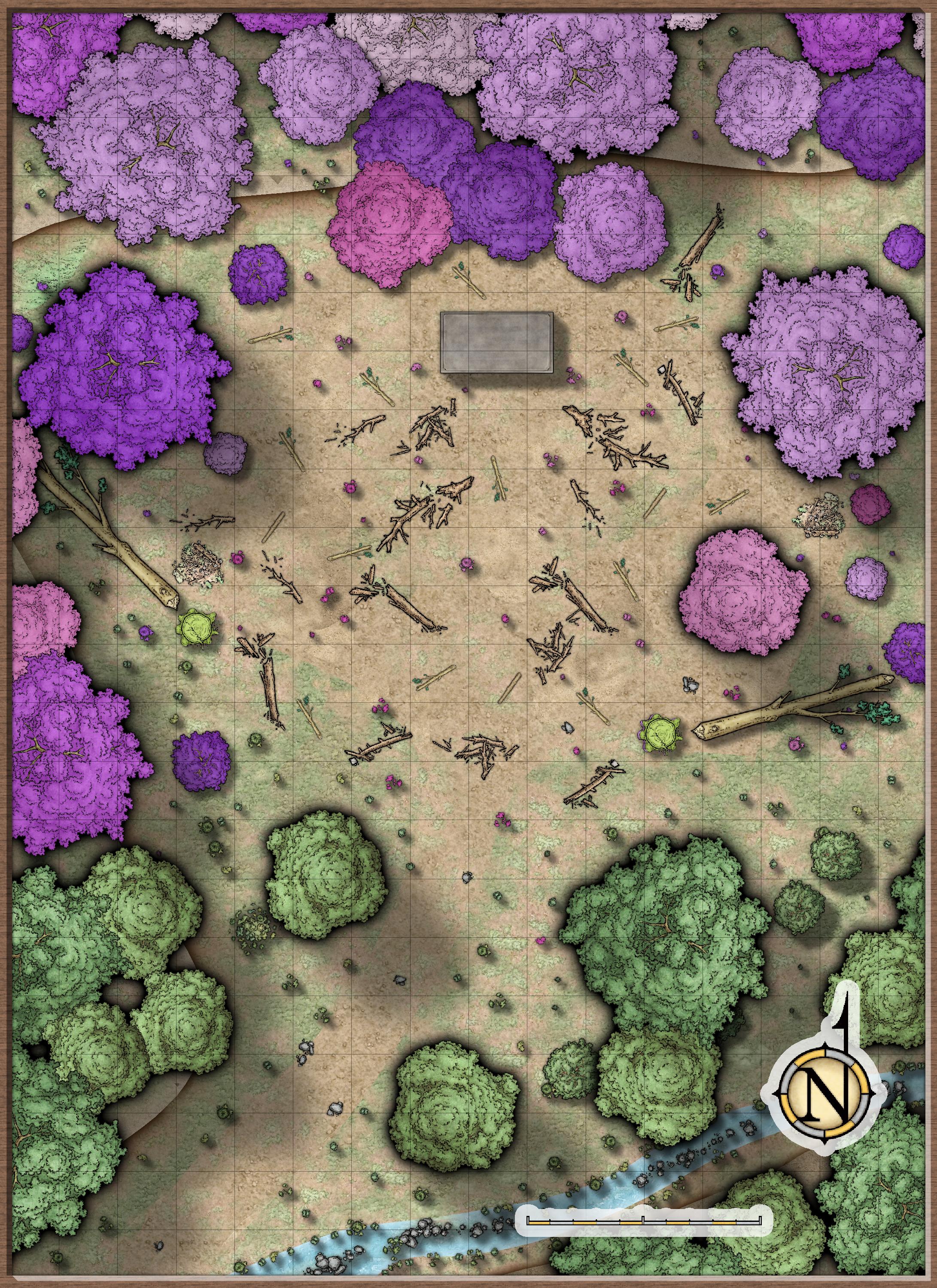
The gully where the altar is located is fairly easy to find. However, the party likely won’t be expecting what they find when they arrive.

After crossing a small creek and arriving at location #1, the characters will be aware that things feel a bit off. The sounds of their movement and any conversation that may be taking place is oddly muffled here. Looking forward into the clearing, describe the trees and any other vegetation as having a bizarre appearance. The colors are unnatural and vibrant shades of pinks and lavender. Finally, characters who are sensitive to such things will be aware that there is primal magic at work here.

While game statistics should not be altered, the audio and visual abnormalities will increase as the party nears the altar. Views seem to elongate, colors become more unnatural, and sounds more muffled.  

Ahead, the party will see Agatha situated behind the altar, gesticulating wildly. She appear as an emaciated woman, with mossy green skin. Her long, tangled hair is an unruly mass of leaves and twigs, and her claw-like fingers are tipped with sharp, jagged nails. She is dressed in tattered robes. As she sees the party she will bark out a command in a guttural language. At this point you should instruct your party to roll for initiative.

Two tree stumps (areas #2 & #3) will flare with an eerie yellow light. From each of these a toadstool sporeling will emerge and move to engage the party. The stumps are portals to the fey realm and will each produce another sporeling at the top of every round. These little combatants only have 1 hp each. They are easily dealt with but will add up quickly if the party is not careful. If the stumps themselves are targeted and dealt 5 hp of damage, the portal will be destroyed and prevent further combatants from joining the fray.

The Gnarr will step out from behind a small tree (location #4) and start moving to get between the party and the altar. The creature has been instructed to protect the hag and it will act accordingly. Its initial strategy will be to use its entangle ability to root the party, creating a situation where they are overrun by sporelings.

Agatha Verdantmire is cowardly. If it appears that her minions have the upper hand in the struggle, she will use her at will vicious mockery ability to hinder the party. However, if the tide shifts she will flee immediately, using invisible passage to make her escape.

The Aftermath

If the party succeeds in defeating (or running off) the hag and her minions, the strange audio and visual effects will fade immediately. Furthermore, placing the grain dollies Sister Elena gave them onto the altar of the Green Man will fill characters with a feeling of peace.

Over the course of the next 4 hours, the trees in the area will slowly revert back to their natural colors from the bizarre shades of shades of pinks and lavender. While there will not be any immediate proof of this, the crops in the fields surrounding Novos will heal over time. The following year’s yield will be off by a bit. However, it will be nowhere near as catastrophic as if would have been if the hag’s plan had come to fruition.

Keep in mind that hags are vengeful creatures. Assuming that Agatha Verdantmire made her escape, she will not likely forget about the party of adventurers who meddled with her plans. She will start plotting immediately, trying to devise some wicked way to make them suffer.

Conclusion

That is all for now. Thank you for taking the time to stop by. I hope you find the seeds of something here that you can use for a future game. If you do, please take a minute to let me know in the comments below.

Finally, as of this writing (11/9/23) I have a couple invite codes for Bluesky Social. If you would like one, please let me know.

For more maps & plot hooks, go here.

For some random tables, go here.

Want to help me to compile a list of TTRPG conventions? Click here.

Finally, for a bit about me and some general stuff, this is the spot.

Altar of the Green Man (Part I)

As the harvest season draws to a close, the simple people of Novos traditionally fashion crude dolls made of grain to represent the spirits of the harvest. They welcome these spirits to spend the winter in their homes. In the spring, the dolls are returned to the soil and ploughed into the first furrow of the new season. It is through this simple act that the people of Novos honor the Green Man, a revered figure who represents nature and fertility in the region. They believe that this ensures that they will have a bountiful harvest and will be able to survive the harsh Borean winters.

This year, however, something has gone awry in Novos. Farmers harvesting their crop have mentioned that the soil does not seem right. Others report signs of an odd blight affecting the crops. What is more puzzling is the fact that the grain dollies have gone missing. Homestead after homestead report that the effigies have disappeared and all agree that this must be an ill omen.

The village of Novos. Created with Campaign Cartographer.

What the Party Knows

The party has arrived in the mid-sized farming community of Novos and acquired rooms at the Harvest Hearth Inn (location #1). After stowing their gear in their rooms, the adventurers settle in for a hearty meal in the common room.

During the course of the evening, the party will notice the somber atmosphere at the inn. The locals’ faces are etched with worry and apprehension. A successful passive perception check will pick up on the fact that they speak in low voices about the problems plaguing the harvest. They mention how the soil feels different this year, as if it’s lost its vitality. Others express concerns about strange blights affecting their crops and causing them to wither prematurely.

Grain dolly. Artwork © 2023 Emily Bryant, used with permission. All rights reserved.

The disappearance of the traditional grain dollies, used to ensure a bountiful harvest, is particularly unsettling to the superstitious villagers. It is likely that the party will not be aware of this tradition, though the villagers will gladly share the tale if it appears that the outsiders are interested.

As villagers notice the newcomers and, sense that they might be adventurers, they will approach the party. With a mixture of hope and desperation in their eyes, they explain the situation and implore the party to help uncover the mystery behind these disturbing events. The villagers promise fair compensation and the gratitude of the community in return for the party’s assistance.

Investigation

In order to get to the bottom of the issue, it is likely that the party will need to carry out some investigation of the local area. The patrons of the Harvest Hearth will suggest the following locations.

Mikhail Kozlov’s Pumpkin Farm (location #2): Being the farm closest to the village itself, the party will be advised to start their investigation here.

A stout and weathered farmer with a grizzled beard, Kozlov greets the party as they approach his farm. The party will notice a sense of despair in his eyes and voice. He mentions the troubled state of his pumpkin patch, explaining that despite all his efforts, the pumpkins have been stunted and shriveled this year, far from the healthy, robust crops he usually reaps.

Upon investigating the pumpkin patch, the party notices several peculiarities. Most of the pumpkins are undersized, withered, and look like they’ve been drained of life. They’re deformed, as if something has sapped their vitality. A successful perception check will reveal that some of the pumpkins seem to bear odd carvings that resemble symbols or runes. These symbols are not part of any known local traditions that the farmer is aware of.

Borea. Created in Campaign Cartographer using the Herwin Wielink overland style.

Church of Ladina (location #3): Since she plays an unofficial leadership role within the village, the party may be advised to pay a visit to Sister Elena Novik, the cleric of the church of Ladina. A dignified woman with silver hair tied in a bun, the priestess expresses her deep concern over the blight that’s affecting the harvest and reveals a few more details.

She informs the party that she has been conducting ceremonies and blessings to seek Ladina’s guidance and protection for the crops, but her efforts have had limited success. The goddess has been silent, which troubles her deeply. She has visited a number of the farms and reports feeling an unnatural presence there.

Sister Elena will stress that the villagers are greatly distressed at the disappearance of the grain dollies and strange malady affecting the crops. She shares the tale of an Anton Baranov who has gone quite mad, reporting seeing odd creatures in the outlying forest. The cleric will explain that Baranov may often be found at the public market (area #5)

If questioned about the odd carvings found on the pumpkins at the Kozlov farm, she will not recognize them. However, she will suggest that the party seek out the aid of an elder in the village named Yevgeny Borislav. Yevgeny is known to be the keeper of traditions and folklore and he might have knowledge about these ancient symbols and their significance. He resides in a ruined tower to the northeast (area #4).

Ruined Tower (area #4): Sister Elena or some of the other villagers might suggest that the party stop at the ruined tower to the northeast of town. This is the residence of Yevgeny Borislav, a dignified figure within the village of Novos. He is an elderly man with a flowing white beard. His eyes still hold a spark of wisdom and he is usually dressed in simple, weathered robes. Yevgeny is a repository of traditions and folklore and has a deep understanding of the village’s history.

The elder recognizes the significance of the failed crops and the disappearing grain dollies. He will tell the party about the Green Man, a revered figure who represents the spirit of nature and fertility in the region. Followers of the old ways used to travel deep into the forest. There they would leave offerings at an ancient alter to the Green Man, ensuring a bountiful harvest. However, this year, it appears that something has disrupted the harmony with the Green Man’s spirit.

Should the party mention the strange carvings seen in Kozlov’s pumpkin patch, Yevgeny will be quite concerned. While he is unable to read the marking, he does recognize them as being Fey in origin and suspects that something unnatural is afoot. He suggests traveling into the forest to seek out the old altar dedicated to the Green Man and leaving a humble offering there to restore the balance between the village and the spirit of nature.

Altar of the Green Man. Artwork © 2023 Emily Bryant, used with permission. All rights reserved.

Public Market (area #5): If sent here by Sister Elena or merely passing through, the party will be hailed by Anton Baranov. Anton is a lanky, middle-aged man with unruly, salt-and-pepper hair. He sports a disheveled look, and reeks of ale. The man gesticulates wildly as the party approaches.

“I’ll tell you. I’ll tell you all about ‘em.” He says.

If the party gives the poor soul a moment to speak, he will inform them that he has heard that they are investigating the blight and he knows what is behind it. According to Baranov, strange little creatures have been coming out of the woods at night. He claims that he has seen them dancing little jigs out in the fields. If pressed for a description of the creatures, he will confess to it having been dark when he saw them but that he’s certain that they were goblins, or gremlins, or something of that ilk.

Other townsfolk will gently explain that Anton is known for enjoying his drink. However, the direction that he claims the creatures came from does happen to line up with the direction in which Yevgeny would have pointed the party in, in order to reach the Altar of the Green Man.

End of Part I

That’s all for now. Part II is already complete and you may find it here. Thank you for stopping by.

For more maps & plot hooks, go here.

For some random tables, go here.

Want to help me to compile a list of TTRPG conventions? Click here.

Finally, for a bit about me and some general stuff, this is the spot.

The Harvest Festival

For the 3rd week of October, I have another encounter that is perfectly suited to fill a Halloween game night. With a few minor tweaks, there is really nothing that would stop you from using this at other times of the year.

This is typical of something that I might throw together for an in-between session, on the heels of the party completing an adventure and deciding what to do next. This does not require a great deal of prep and works great for times when your session may need to be shorter than usual. It is also handy to have something like this ready for times when some of your players will be absent.

Made with Campaign Cartographer SS4 Dungeons of Schley.

The Festival

The premise here is simple. The party stumbles onto a harvest festival being held on the outskirts of a settlement. This is a joyous time and the whole community has turned out to celebrate a bountiful harvest. The key to this type of encounter is to really sell to your players that there is a lot going on.

The are a number of activities for your party to explore but I suggest that you weave in bits from your own campaign. This is a great place for the party to bump in to an NPC that they haven’t seen in quite a while. Someone might notice them from their previous exploits. Perhaps some lackeys from the BBEG turn up to spoil the fun. There are all sorts of possibilities.

Your party should hear the sounds of the festival as they approach. Even if you do not normally incorporate music into your sessions, I think you should consider it for this encounter. Simply playing an appropriate track in the background will go a long way toward setting the stage. There are countless options but in the past I have used this Joyful Festival track from The Ambiance Channel on YouTube. They have a lot of great stuff and are worth a listen.

There will be a number of food and drink vendors at the event. Be sure to at least jot down a few different culinary delights that might tempt your party members. If you want to go the extra mile and actually prepare something for your players, I have included some suggestions in this post.

The Hedge Maze

The main attraction of the festival is the hedge maze. Depending on the size of your party, either break them up or start each member at one of the 4 different starting areas. Once you are ready, they will race to see which group or individual can be the first to make it to the center.

Have each group roll for initiative and from there I would run it like an old school dungeon crawl. Starting with the first group, describe what they see, up until the need to make their first decision. For instance, “The path goes east for fifteen feet and then turns south. You now have to decide whether to proceed to the west or east.” While they are deciding, move on to the next group and continue on like this until someone makes their way to the center.

The winning team will be presented with:

  • The Medallion of Autumn’s Grace: This intricately designed bronze medallion is adorned with autumn leaves and acorns. When worn, it grants its wearer the ability to cause colorful autumn leaves to whirl around them once per day as a bonus action.

Puppet Show

There is a raucous puppet show set up in the center area of the hedge maze. There are a couple fun things that I like to do with this. The puppet show can be used as an opportunity to lay down some foreshadowing for future events in your story. Perhaps it helps to illustrate just how downtrodden the people are by the BBEG of your campaign. Alternatively, you might use the puppet show to tell the story of some local legend or some bit of lore that you want your players to have.

The other thing I occasionally do is have the puppet show actually be telling the story of some of the party’s exploits. This becomes extra entertaining if the puppets accidentally mess up the story in such a way that it embarrasses some of the party members.

Apple Bobbing

Also located in the center of the hedge maze is an apple bobbing station. Full disclosure, I have seen oodles of takes on this over the years. I do not want to copy anyone but the easiest thing that comes to mind would be to give each player 5 attempts at a DC 12 dexterity check. Every success indicates that the character successfully grabbed an apple with their teeth.

The character with the most apples at the end of the contest will win:

  • 3 Packets of Pumpkin Spice: All nonmagical food and drink sprinkled with one of these spice packets will be rendered free of poison and disease.

The Hatter & Haberdasher

I know that this seems incredibly mundane but trust me on this one. Yes, your players could potentially buy a hat or new clothing pretty much every time they are in a town or city. No, these are not magical hats or clothing.

However, unless you run with a group consisting solely of jaded power gamers, give this a shot. Describe some fanciful hats and garments. Create a colorful NPC, who is hawking his wares and I will bet that you hook at least one of your players who suddenly becomes interested in some new finery.

The Portrait Artist

This one is more of a slow burn but it really pays off in the end. I have done this twice now and it was a hit on both occasions.

A skilled artist calls out to the party and offers to create a portrait, either of them individually or as a group. The artist explains that they only need the party to pose long enough to make some charcoal sketches. Once that is complete, they will work on the piece over the following weeks and produce it for the party once completed.

I have used this as a great opportunity to commission an actual picture of the party from an online artist (of course I do not tell them this at the time). When I present it to them a few sessions later, it’s usually right around the holidays and everyone gets a big kick out of it.

Made with Campaign Cartographer SS4 Dungeons of Schley.

The Tattoo Artist

While some systems feature magical tattoos that enable various abilities, this is purely mundane. However, much like with the clothing options above, I find that this is a hit. Presented with the idea of getting tattoos for their characters, players often take the bait. I enjoy seeing what they com up with, regardless of whether they opt for something to make them look fierce or something in remembrance of a fallen comrade.

Fortune Teller

No Halloween themed harvest festival encounter would be complete without a fortune teller. You can go as deep with this on as you like. If you want to use props, a quick Google search should yield plenty of ideas for using a deck of playing cards, tarot cards, or even something more customized. Alternatively, you could just have the fortune teller use a crystal ball or simply “feel” the spirits.

I like to have fortunes ready for each player ahead of time. Fortunes do not need to be accurate; it’s all in good fun.  However, I have found it best to weave in little bits of the story while leaving things vague enough to allow the players to draw their own conclusions.

Conclusion

Those are just some ideas that you could include in a Harvest Festival encounter. Have you ever done anything like this? What else would you add to the mix? Leave me a note in the comments.

That is all for this week. Two more weeks until I head up to the Irvington Halloween Festival in Indianapolis, IN! Thank you for taking the time to stop by and have a great week!

For more maps & plot hooks, go here.

For some random tables, go here.

Want to help me to compile a list of TTRPG conventions? Click here.

Finally, for a bit about me and some general stuff, this is the spot.