Idea Chest: The X-Files

The X-Files was a groundbreaking American TV series that premiered in 1993 and continued until 2002 (later seasons were released in 2016 and 2018.) Created by Chris Carter, the show explores the world of unsolved paranormal cases and government conspiracies. The story follows two FBI agents, Fox Mulder and Dana Scully, played by David Duchovny and Gillian Anderson. Mulder believes in the paranormal, while Scully is a skeptic and a scientist. Their contrasting beliefs form the backbone of the series, as they work together on “X-Files”, mysterious cases ranging from the truth behind alien existence to government cover-ups.

This is my most modern (and probably most mainstream) Idea Chest franchise to date. However, with the main series ending its run in 2002, I suspect a number of readers may have never experienced it. I was in my early 20s when the series started and connected with it right away. While this was very much a modern show, I always felt that there was a lot of good stuff to be mined here. The following are just some of the examples of ideas that I believe could be lifted and dropped into the fantasy TTRPG of your choosing.

Fox Mulder and Dana Scully: The iconic duo that introduced us to a world of conspiracies and the paranormal.

Serving the Dubious Crown: Mulder and Scully work for the US government. However, it’s not long into the series before they start to question the motives of their superiors or perhaps the government itself. Emulating this and creating a campaign where the party serves a kingdom or empire with a murky agenda could be interesting. PCs might be dispatched to investigate arcane anomalies, politically charged missions, or even interdimensional threats.

Over time, the party will likely become aware of the shady side of the government. However, they may need to wait to confront those in power until they have gained enough evidence and influence in the realm to make a difference.

Balancing Myth Arc with Side Quests: The X-Files offered viewers “mythology episodes” mixed in with “monster of the week episodes”. The former touched on the overarching story of alien conspiracy, while the latter tended to be standalone episodes that might explore a cryptid or some other paranormal phenomenon.

Consider having a central myth arc in your campaign that slowly unravels, punctuated by self-contained quests. This structure allows players to enjoy immediate adventures while building towards a larger, more complex narrative.

William B. Davis portrays C.G.B. Spender, a.k.a. The Cigarette Smoking Man, orchestrating things from the shadows.

The Untouchable Puppeteer: The “Cigarette Smoking Man” was the epitome of a shadowy puppet master, weaving plots and plans into the narrative without ever dirtying his hands. A villain like this might be seen in the courts of power, whispering in the ears of kings or leading councils, yet they are never where the blame can be laid. This villain’s machinations are intricate, and their presence is a constant reminder to the players that there are bigger games at play. As your party encounters this figure, let them grapple with the infuriating reality that direct confrontation is impossible, at least for now. Instead, they must unravel the web of deceit, cut the strings of the puppet master, and expose the true nature of the adversary, all while dealing with personal connections that make the quest not just a matter of justice, but of personal closure and revenge.

Mr. X. The enigmatic informant, shrouded in secrecy.

The Dynamic Duo: While most of these ideas would work in a standard game, sometimes a full table just isn’t in the cards. Taking inspiration from Mulder and Scully’s relationship, a campaign with just two players can explore deep character development. One character could be driven by faith or belief in the mystical, while the other relies on logic and evidence. Their differing views would create plenty of role-playing opportunities, especially when their beliefs are challenged by the adventures they undertake.

The Mysterious Benefactor: Both “Deep Throat” and “Mr. X” helped Mulder and Scully with their investigations. However, neither were totally reliable and neither could be fully trusted. Consider introducing NPCs who provide information with their own agendas. These characters can offer crucial insights but leave the party questioning the validity and motives behind the help they receive.

Assistant Director Skinner. The duo’s reluctant ally within the FBI.

The Reluctant Ally: Modeling after Assistant Director Skinner, create an authority figure who navigates the treacherous waters of the government with the party. They can act as a buffer between the players and higher powers, providing support while remaining distant and bound by their duties.

The Eccentric Helpers: The Lone Gunmen are perfect templates for quirky allies who offer assistance with a side of humor. Create a group of street urchins, oddball mages, or eccentric artificers who can aid the party with intelligence, unconventional wisdom, and gadgetry, all while providing comic relief.

The Lone Gunmen. A trio of quirky conspiracy theorists who often provide aid to the protagonists.

Secret Societies and Hidden Agendas: Inspired by the show’s shadowy organizations, introduce secret societies that manipulate events for their own ends. The players could find themselves caught in a web of intrigue, where discerning friend from foe is as challenging as the quests themselves. The NPC who provided invaluable aid to the party two sessions ago may merely be using the PCs as pawns.

Conclusion

Mulder’s iconic motto.

That’ll do it for this week. Are you familiar with the X-Files? Can you think of any good source material that I have missed?  Leave a comment if you can and let me know. Thanks for stopping by and don’t forget—The Truth is Out There.

For maps & plot hooks, go here.

For my Idea Chest posts, go here.

For some random tables, go here.

Want to help me to compile a list of TTRPG conventions? Click here.

Finally, for a bit about me and some general stuff, this is the spot.

Idea Chest: Lonesome Dove

I may be going out on a limb with this week’s addition to the Idea Chest but I will ask that you bear with me on this one. When I hatched the idea for this regular feature, it was out of the desire to inspire other gamemasters with franchises that had inspired me. I can honestly say that this property has influenced me both as a gamemaster and a player for over 30 years.

Lonesome Dove is a 1985 western novel by Larry McMurtry, as well as a 1989 TV miniseries starring Tommy Lee Jones and Robert Duvall. The story tells the tale of two former Texas Rangers as they lead a cattle drive from Texas to Montana.

I was 15 years old when I found the novel laying around my house. My mother had finished reading it the week prior. Much like I suspect many of you are feeling at the moment, I had almost zero interest in westerns whatsoever. However, I was three weeks into my summer break from high school and I had nothing else to read. Thinking back, I did have Boot Hill from TSR Hobbies sitting on my game shelf. I suspect I was thinking that I might stumble onto a good idea for an adventure, if I just gave it half a chance.

I realize that a western is probably even less appealing to folks today than it was in 1985. That said, I can’t stop myself from suggesting it. Even for a fantasy campaign, I think it would be worth checking out either the novel or the miniseries. Both were excellent and I feel that at the very least you’d get some solid entertainment out of the experience. Without rattling on further, here’s what I find the most useful out of exploring the franchise.

The Epic Journey

The trope of the party getting hired to guard a caravan is probably as old as “the party meets in the tavern”. However, what if the journey was the point of the whole campaign? The central cattle drive in Lonesome Dove is an excellent framework for a campaign. Much like a religious pilgrimage, a crusade, or a grand expedition, a journey of that magnitude could provide everything you need to keep your players entertained.

As a GM, this type of campaign style would give you the ability to have a somewhat linear campaign, without really railroading your party. I mean, if the whole point of the campaign is to travel from point A to point B, it does really narrow the field in terms of what you need to prep for. For instance, the party may need to choose between Caradhras or Moria but at least they wouldn’t been choosing from anything under the sun.

Environmental Challenges

Still focusing on the journey, some of the most gripping parts of the story come from environmental challenges like dust storms or dangerous river crossings. It’s a good reminder that not all challenges need to be combats or monsters. Environmental obstacles can be just as compelling, testing the party’s skills and resourcefulness.

A Well-Crafted Party

While my previous Idea Chest posts have focused solely on GM inspiration, Lonesome Dove is great for players as well. The story is a virtual master class in interesting characters. The Hat Creek Cattle Company is essentially a party of adventurers, each member with their own backstory and role. Joshua Deets, Pea Eye Parker, Bolivar, Newt—they’re all vividly realized characters that could inspire PCs or NPCs in your campaign. If you encourage players to create characters with rich pasts and motivations, you’d be hard pressed to find a more dynamic group.

Twilight Heroes

The story’s protagonists, Woodrow Call and Augustus McCrae, are former Texas Rangers in the twilight of their lives. This aspect alone is a gold mine for your games. Instead of starting as green adventurers, imagine characters who have already lived a life full of stories, coming together for one last grand quest. Even if you’re starting a new campaign with level 1 characters, there’s no reason that you couldn’t opt for the narrative the some of the characters are grizzled old veterans who are a bit rusty but gradually getting their skills back.

Blue Duck: A Versatile Villain

Blue Duck is a memorable villain who exemplifies how to craft a villain’s ominous presence. He could be a notorious bandit, a cunning warlord, or even a mystical threat, depending on your campaign’s needs. McMurtry skillfully weaves whispers about Blue Duck into the narrative, long before the protagonists come face to face with him. The fear and anticipation build through the stories told by others, and this sets a done of dread that could be useful in your game.

In addition, Blue Duck’s terror stems not from supernatural abilities but from his malevolence and the psychological impact of his actions. This is a great lesion that a compelling antagonist needs no extraordinary powers to be formidable. Instead, the villain’s reputation and the fear they instill can serve as powerful tools, engaging your players on a psychological level.

The Tragic Tale of Jake Spoon

No spoilers but Jake Spoon’s storyline is ripe for adaptation as a PC or NPC. He’s a charming character that can serve as a cautionary tale or a complex backstory, offering moral dilemmas and character development opportunities. Bottom line, memorable characters make for a great campaign as much as a great story.

Conclusion

That’ll do it for this week. Have you ever crossed paths with Lonesome Dove? Leave a comment if you have and let me know. While it’s a western, I believe there’s a lot to be mined from it, even for a fantasy campaign. I know it would be a stretch for a lot of you but I recommend giving it a read or watching the miniseries if you’ve never seen it. Thanks for stopping by. Good gaming!

For maps & plot hooks, go here.

For my Idea Chest posts, go here.

For some random tables, go here.

Want to help me to compile a list of TTRPG conventions? Click here.

Finally, for a bit about me and some general stuff, this is the spot.

Have You Ever Used a Real-World Map for Your Campaign?

If you have visited my blog previously, it’s probably fairly obvious that I fall into the camp of those who enjoy tinkering around with maps. I spend far more time creating maps and adventures than I do actually playing. To me, it’s another part of the hobby that I find very rewarding. However, I realize that some people don’t enjoy it and others simply don’t have that kind of time to spend on prep.

For those of you who may be short on time or inspiration, one little trick we would use back in the day was to use a real-world map as a template for some or all of your campaign map. It’s a resource that’s versatile and can be adapted with minimal effort for a variety of settings.

My friend Mike used this park map for years to represent the western portion of his campaign setting.

For instance, I grew up in upstate New York and my family would frequently vacation in the Adirondack mountains. Back in the early 1980s when I first got heavily into role-playing games, there were always paper road maps lying around. These mundane maps became the campaign setting for my high school AD&D group. Oh, I made the scale larger and changed most of the names. However, it provided me would a workable map on a very limited budget. A few years later, my friend Mike used a map of Mount Desert Island in Maine for the western side of his Fantasy Hero campaign. 

These days there are quite a few resources out there, allowing people to easily craft their own maps. However, real-world maps can still be useful. The geological features in our world have been crafted by eons of history. If you are wanting to create your own map but time is precious, maps from our world can be a great place to start. Simply choose an appropriate area, trim a bit here and there, and you’ll be on your way with geography that makes sense. Using a little artistic license, it’s relatively easy to take a real-world map and sprinkle in some fantasy elements where you see fit. A mysterious forest here, an ancient ruin there, and before you know it, you have a living, breathing world that your players can explore.

Years later I recreated Mike’s campaign world in Campaign Cartographer. As you see, the western third of the map is simply Mount Desert Island.

It occurs to me that since returning to the hobby I haven’t been exposed to much other than my own games. I’m curious to hear what is common for other game masters. Do you lean toward using published campaign settings? Do you run your games in your own world and create your own maps? Alternately, do you tend to leave the overland stuff a bit more abstract and only focus on adventures and encounters?

That’s all for now. Thank you for stopping by and I hope you have a great week. Good gaming!

For more maps & plot hooks, go here.

For my Idea Chest posts, go here.

For some random tables, go here.

Want to help me to compile a list of TTRPG conventions? Click here. Finally, for a bit about me and some general stuff, this is the spot.

The Port Town of Hughgrot

The port town of Hughgrot lies along the southern coast of Archia, on the shore of the Zarhut’lm sea. A forsaken naval outpost, its abandonment became a siren call for pirates, smugglers, and a motley crew of those who preferred life in the shadows.

Made in Campaign Cartographer. I primarily used the Cities of Schley symbol set but added some other touches as necessary.
The notorious Grondo-Ri once held Hughgrot with his warband. Artwork © 2015 Dean Spencer, used with permission. All rights reserved. dean-spencer@live.co.uk

This coastal haven, colloquially known as “The Underbelly,” bustles with clandestine dealings. An unspoken code, rather than formal laws, governs its narrow, chaotic streets. Leaders of shadowy factions pull strings from behind the scenes, understanding that too much noise could attract the unwanted gaze of Archian authorities.

Nestled along the eastern shore, Hughgrot sprawls around the mouth of the river Alum. Weather-beaten docks stretch into the bay, bearing witness to the constant flow of contraband. A handful of warehouses are located on eastern edge of town, storing the storing various ill-gotten goods. Ramshackle structures and makeshift stalls cling to the shoreline, where dubious transactions play out on a daily basis.

Hughgrot is melting pot of architecture from different eras. Sturdy remnants from the Archian days stand beside hastily assembled buildings of questionable design. Here and there, traces of orcish construction linger-a testament to the time when the orc shaman Grondo-Ri and his warband claimed residence here.

Statue of Mareen in Hughgrot. Artwork © 2015 Dean Spencer, used with permission. All rights reserved.

An old church of Mareen crowns the cliffs to the north. Though lacking in followers, it stands unmolested. Superstitious as they are, seafarers offer a wary nod to the goddess of the seas.

Hughgrot’s streets echo with the tongues of many different races and cultures, each telling the tale of trade, and survival. Secrets are currency, and every shadow hides a story. Those who dare to visit are best suited to mind their own business and watch their backs.

Conclusion

This week’s map is another creation that sprang forth from my friend Mike’s Fantasy Hero campaign, back in the 1980s. I have used it regularly in my games ever since. I think a place like this fits into almost any campaign, so I figured it was time to make a proper map of it.

Do you have a seedy town in your campaign? Do your players have a place to go when they need to acquire that rare spell component or elusive bit of information?

I appreciate you taking the time to visit. I hope you’ve enjoyed the holiday season and are getting some much-needed free time to spend with your hobby. Good gaming!

For the Village of Cross Tree, go here.

For maps & plot hooks, go here.

For my Idea Chest posts, go here.

For some random tables, go here.

Finally, for a bit about me and some general stuff, this is the spot.

Idea Chest: The Land of the Lost

For the lack of a better name, welcome to “Idea Chest”. This is a feature I’ve considered for some time but held off on because I couldn’t settle on a proper name. As you can see, I’m still not there with the name but rather than procrastinate endlessly, I’m going to trudge on.

Old-timers will already be familiar with “Appendix N”, a section at the back of the AD&D Dungeon Masters Guide (1e) (1979) listing authors and works which influenced the creation of Advanced Dungeons & Dragons. As a kid I spent countless hours reading books from that list after tracking them down at my local library.

Well, with this feature I would like to showcase some other properties that have influenced my tabletop adventures over the years. Some of these are still fairly mainstream today and some have been somewhat lost to time. With each of these I will attempt to illustrate how bits and pieces may be borrowed to build rich stories and content for your games. Each installment will dive into a specific property, offering insight into its TTRPG adaptation possibilities. Hopefully, you’ll find something that sparks an idea for your games along the way.

As always, I’d love to hear your thoughts on these and please chime in if you have any suggestions of your own.

The Land of the Lost

I am going to kick things off with a property that is dear to my heart. The Land of the Lost was a children’s adventure television series produced by Sid and Marty Krofft. It ran for 3 seasons, starting in 1974-not to be confused with the unfortunate 2009 Will Ferrell movie of the same name. Being born in 1970, I suppose I was in the target demographic for this show and it certainly made an impression on me.

The series portrays the adventures of the Marshall family (Rick and his two children Will and Holly). After an earthquake strikes during a white-water rafting trip, the trio find themselves trapped in a prehistoric world (and likely an alternate universe). The titular Land of the Lost is inhabited by dinosaurs, other curious humanoid creatures, and occasional travelers from other places/times. Each episode revolves around the family trying to survive and find their way home.

A word of caution—this was a television show crafted in the 1970s, for children. If you explore this property expecting something binge-worthy for adults, you will likely be disappointed. While hokey and clearly showing its age, the charm lies in the nostalgia it carries. That said, I believe there are some elements present that are great inspiration for a fantasy ttrpg campaign. Here are just a few:

Stranded in a Strange Land: The concept of having your party find themselves stranded in a foreign place could take any number of forms. While it’s unlikely that a band of adventurers would be white-water rafting during an earthquake, they might easily walk through a magic portal, tinker with and ancient artifact, or even escape a sinking ship, only to wash up on shore of some uncharted land.  

Something like this could provide an exciting new arc for your players or even encompass the entirety of a campaign. Exploration and survival would take on a new meaning when faced with the unknown dangers and wonders of this new territory. The party would need to adapt quickly, forging alliances with local inhabitants or outsmarting hostile creatures. Scarcity of resources and the constant quest for essentials like food and shelter would add a layer of urgency, emphasizing the struggle for survival.

The Dinosaurs: Stats for dinosaurs have been common in gaming bestiaries since the 1970s. However, few published adventures take advantage of them. It certainly seems plausible that the prehistoric behemoths could still be found lumbering around parts of your fantasy world.

Sleestak leader visiting the Skull of Wisdom.

The Sleestak: The Sleestak are a reptilian humanoids in the Land of the Lost. They have scaly skin, large eyes, and a distinct hissing language. I recently borrowed these fellows and their underground lair for my Revisiting the Isle of Dread campaign. Dwelling in subterranean tunnels under a Lost City, the Sleestak made for a mysterious and ominous presence.

Sleestak wandering the jungle at night.

Goblins and kobolds are largely played out with most groups. However, Sleestak could easily fill the same role, even in an existing campaign. Their mysterious nature allows for narrative flexibility and you’re not bound to the source material. The party might encounter them as guardians of an ancient prophecy, or they could be the last remnants of a once-mighty civilization with dark secrets. File off whatever you like and use what works for your game.

The Pakuni: The Pakuni resembled early human primates who were nearly fully covered in fur. Indigenous to the Land of the Lost, the Pakuni are initially aggressive and mistrusting of the humans. However, over time, one of their group (Cha-Ka) warms up to the family and becomes a regular.  

The Pakuni visit the Marshalls.

The play here I would think would be to introduce another culture for the PCs to interact and exchange knowledge with. Fantasy cities are often very diverse, with NPCs of varying ancestries. However, how often does your party come into contact with a group that has been lost to time? Adding a group like the Pakuni would offer a unique opportunity for cultural exchange and learning within your campaign. As the party gradually earns their trust, they might uncover valuable information about the region, hidden dangers, or even ancient secrets. This interaction adds depth to your world and creates opportunities for quests, alliances, or conflicts based on how the players navigate these newfound relationships

“Grumpy” the T-Rex visits a pylon.

Unknown Technology: The pylons were one of the most captivating parts of the show for me as a child. These metallic obelisks were larger inside than out (like a TARDIS from Dr. Who). They contained stone tables bearing colored crystals that served various purposes. The exact mechanics governing the use of these crystals was never fully explained in the show, contributing to their mysterious nature. The Marshalls often experimented with different crystal combinations, leading to unexpected adventures and encounters.

Introducing unknown technology to your campaign can be a good way to keep your players on their toes and add an element of discovery. These could be magical in in nature, divine, or truly alien (as was the case with S3 Expedition to the Barrier Peaks.) Ancient, structures similar to the pylons could be scattered across your world, waiting to be explored. These structures might house forgotten knowledge or powerful artifacts. The party could stumble upon an underground complex filled with arcane machinery, or perhaps a floating island with a dormant device. The mystery surrounding this technology offers you the flexibility of having its true nature be anything from a simple diversion to a central pillar of your campaign world.

Conclusion

It’s possible that I simply have fond memories of this property from my youth. However, I suspect I’m not the first to find some inspiration within The Land of the Lost. Hopefully you can find some use as well.

Have you ever borrowed from The Land of the Lost? Do you have any properties that are dear to your heart and often find their way into your games? Please take a minute and let me know. This is the stuff I love about gaming.

That’s all for this week. The holiday rush has taken a bite out of my writing time but I’m now free from work until the new year. Thank you for taking the time to stop by and I hope you have a great week.

For posts Cross Tree, my starting village go here.

For maps & plot hooks, go here.

For my Idea Chest posts, go here.

For some random tables, go here.

Finally, for a bit about me and some general stuff, this is the spot.

The Lost City of Wakou M’baque

Two weeks ago, I posted a map of some ruins deep within the jungles of Gowandia. Among the crumbling stones, a spiral staircase was found, tempting adventurers to descend into the unknown.

The spiral staircase descends for hundreds of feet, in total darkness. Characters with any type of mining skill will marvel at how this could have been created. The stairs end at a 20-foot-wide tunnel running south-southwest. The air grows increasingly humid, and the distant sound of rushing water becomes a steady echo in the darkness.

The lost city of Wakou M’baque. Created with Campaign Cartographer.

The passage ends after roughly 50 feet with more stairs going down, though straight and steep this time. A faint yellowish glow beckons from the depths. Reaching the final stretch of the descent, the glow intensifies, casting an eerie light that dances on the edges of the cavern. The stairs widen, revealing a breathtaking sight—a massive cavern (visible from location #1)

Stretching over 700 feet in each direction this immense chamber is a natural wonder. A glowing chartreuse lichen adorns the vaulted ceiling. Weaving around giant stalactites, it casts an eerie yellow light over the ground, some 100 feet below.

In the heart of this colossal cavern, a forgotten city lies frozen in time. Stepping onto the widened stairs, the sight unfolds—buildings crafted from clay with flat roofs, stand like silent sentinels against the glow of the chartreuse lichen. Single and two-story dwellings line the streets, remnants of a civilization tucked away from the world above. The city’s layout reveals an intricate design, reflecting the architectural prowess of those who called this underground expanse home.

While not visible from this vantage point, two similar stairways lead up from the city. One may be found at location #2 and the other at location #3.

A roaring river bisects the city from northeast to southwest. Two bridges span the water, connecting the two halves of the metropolis. The glow of the lichen, combined with the reflections from the water creates the sensation that the center of the city is undulating. While not clearly evident, if someone were to exit the cavern following the path of the river (location $4), they would eventually come out to Maguni Falls.

At the far end of the cavern, a monumental ziggurat dominates the skyline (location #5), reaching halfway to the cavern ceiling. Its purpose, like the city itself, is veiled in the echoes of time. Beyond the ziggurat, a colossal statue of Ka-Zaa, the ancient Gowandian god of magic, surveys the subterranean realm (location #6).

The entire city, though silent and seemingly abandoned, carries an air of preserved majesty. Odd markings on some structures hint at a purpose but their meaning may be lost to time. Patches of multi-colored crystals jut out of the earth in many places. Looking down the empty streets, one is forced to wonder what this place looked like in its prime.

The air within the cavern is thick with humidity, and strange flora adds an otherworldly charm. Giant mushrooms (some as tall as a man) and patches of orangish-brown fungus litter the area. Despite a lack of any actual sunlight, towering purple ferns can be found throughout the city.

Taking in the sights from the staircase, the adventurers are poised for discovery. surrounded by the echoes of a city lost to time. The lost city of Wakou M’baque lies before them and the secrets it guards are ready to unfold.

Conclusion

Wakou M’baque has lived in my head for over 40 years, in one form or another. To me it’s always been a bit of a mash-up of Robert E. Howard tales, with a bit of the classic B4 The Lost City thrown in for good measure.

How would you use a location like this in a game? Is the city truly abandoned? Are their still people living here? Has some bizarre alien presence taken hold of the place? Let me know in the comments, as I’m always curious to see what folks will come up with.

That will do it for this week. Thank you for taking the time to stop by and I wish you the best with the week to come. Good gaming!

For maps & plot hooks, go here.

For some random tables, go here.

Want to help me to compile a list of TTRPG conventions? Click here.

Finally, for a bit about me and some general stuff, this is the spot.

Maguni Falls

Nestled deep within the heart of Gowandia’s jungle, Maguni Falls stands as a forgotten sacred site, shrouded in mist and mystery. Sacred to the early Gowandians, this enchanting locale has remained untouched for ages. Adventurers lucky enough to find this location will be the first witnesses in untold years.

Maguni Falls. Created with Campaign Cartographer’s Forest Trail style.

Amidst the lush jungle, unique flora thrives (more about this in Weeds of Wonder). The Stikricki Bush, whose razor-sharp thorns serve as natural caltrops, and the Magasorium, whose leaves offer protection against the jungle’s relentless insects may both be found here. The air is rich with the scent of the Billitri plant, a fragrant guardian against keen-nosed predators, while the Manshooki tree provides resilient vines coveted by the Gowandian tribes.

A rickety old bridge (location #1) tempts the party to cross the raging river to a narrow strip of land along the base of the northernmost cliff. Those who are brave enough to traverse the span will find a hidden path behind the waterfall (location #2).

Emerging on the western side of the veil of water, the path leads to a stone arch at the edge of the southern cliff (location #3). Ancient Gowandian runes are carved into the side of the arch. If any of the party are able to decipher these runes, they will learn of a secret entrance to the lost city of Wakou M’baque in the cave directly below (location #4).

Conclusion

I struggled a bit with this map style in trying to properly illustrate the different cliffs. Hopefully things ae clear enough. Having now explored two different entrances to Wakou M’baque, we’ll head underground next week to see some of the city itself.

Thanks for stopping by. Have a great week!

For more maps & plot hooks, go here.

For some random tables, go here.

Want to help me to compile a list of TTRPG conventions? Click here.

Finally, for a bit about me and some general stuff, this is the spot.

The Altar of the Green Man (Part II)

In part one of The Altar of the Green Man, the party visited the village of Novos. The residents of this small agricultural community hired the adventurers to get to the bottom of some strange happenings.

The Altar of the Green Man. Artwork © 2023 Emily Bryant, used with permission. All rights reserved

Farmers harvesting their crops noticed that something was wrong with the soil. Others reported signs of an odd blight. Evan more puzzling was the fact that grain dollies (crude dolls made of grain to represent the spirits of the harvest) have been disappearing from people’s homes.

Following some investigations around the village, the party learned about the Green Man, a revered figure who represents the spirit of nature and fertility in the region. Followers of the old ways once left offerings at an ancient altar to the Green Man, to ensure a bountiful harvest.

  • A village elder suggested the party travel into the forest to seek out the old altar and leave a humble offering.
  • A less reputable villager also mentioned having seen strange little creatures coming out of the woods at night.

The journey out to the location of the altar should only take a couple hours. However, the villagers will gladly supply the party with any mundane gear needed for the trip. In addition, Sister Elena will provide the party with a number of remaining grain dollies to take with them as an offering at the altar.

Created with Campaign Cartographer.

What the Party Doesn’t Know

The Gnarr. Artwork © 2023 Emily Bryant, used with permission. All rights reserved.

A green hag by the name of Agatha Verdantmire is behind the blighted crops. Taking great delight in corrupting the natural order of things, the twisted fey creature is feeding upon the misery and suffering of the village. Her plan is to spread a blight across the region until the people of Novos are forced from their homes. To assist her in her cruel machinations, she has enlisted the aid of some creatures from the fey realm. These foes are unique to my game, so I will provide you with a brief description and you can create stats as you see fit.

  • The Gnarr: Standing nearly 10’ tall, this creature resembles a misshapen tree. It plods along at movement rate of 15’ (3 squares). The Gnarr swings its branches for defense and also has the ability to cast entangle twice per day. Damage from fire sources will cause double damage to this creature.
Toadstool Sporeling. Artwork © 2023 Emily Bryant, used with permission. All rights reserved

  • Toadstool Sporelings: These diminutive horrors are what Agatha has been using to spread her blight to the nearby farms. At 30” in height, these creatures are what Anton saw dancing around in the farm. They move at 30’ and could be considered as minions (will drop with a single hit). While not physically intimidating, the Sporelings drip a contact poison that affects anything they touch. In addition, they have circular rows of sharp teeth under their caps. On a hit, the sporeling attaches to the target. While attached, the sporeling doesn’t attack. Instead, at the start of each of the sporeling’s turns, the target loses hit points due to blood loss.

Agatha stumbled onto the altar of the Green Man months ago and has been working to corrupt it ever since. The Green Man’s influence over the region has long ensured bountiful harvests. By tainting his altar, the wicked hag aims to weaken his power and clear the way for her magical blight to spread unchecked across the land.

In a desperate attempt to seek help, the spirit of the Green Man caused the grain dollies to disappear from homes across the village. This unexplained phenomenon was a plea for aid, a sign that something was terribly wrong.

The Encounter

Toadstool Sporeling. Artwork © 2023 Emily Bryant, used with permission. All rights reserved

The gully where the altar is located is fairly easy to find. However, the party likely won’t be expecting what they find when they arrive.

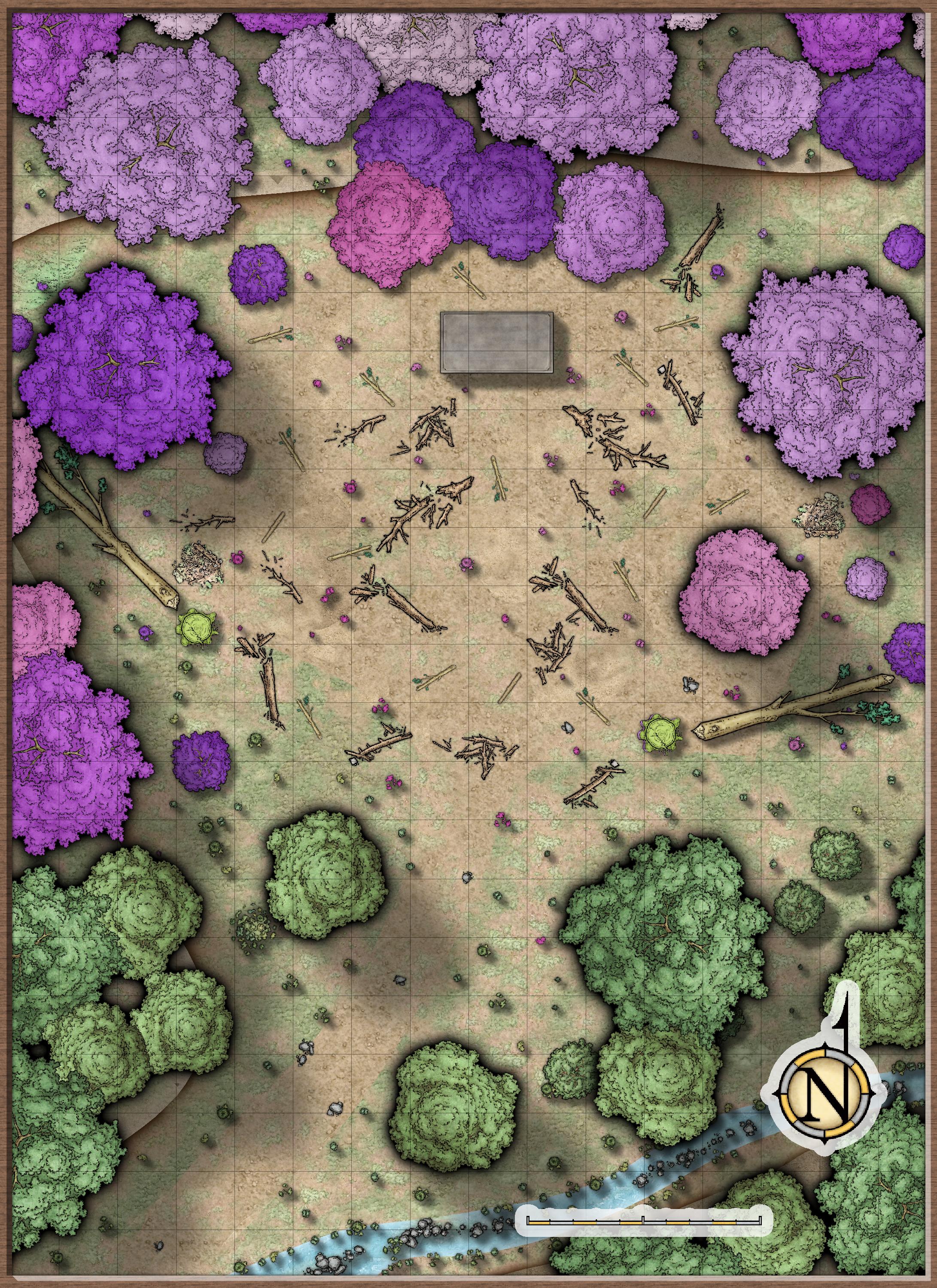
After crossing a small creek and arriving at location #1, the characters will be aware that things feel a bit off. The sounds of their movement and any conversation that may be taking place is oddly muffled here. Looking forward into the clearing, describe the trees and any other vegetation as having a bizarre appearance. The colors are unnatural and vibrant shades of pinks and lavender. Finally, characters who are sensitive to such things will be aware that there is primal magic at work here.

While game statistics should not be altered, the audio and visual abnormalities will increase as the party nears the altar. Views seem to elongate, colors become more unnatural, and sounds more muffled.  

Ahead, the party will see Agatha situated behind the altar, gesticulating wildly. She appear as an emaciated woman, with mossy green skin. Her long, tangled hair is an unruly mass of leaves and twigs, and her claw-like fingers are tipped with sharp, jagged nails. She is dressed in tattered robes. As she sees the party she will bark out a command in a guttural language. At this point you should instruct your party to roll for initiative.

Two tree stumps (areas #2 & #3) will flare with an eerie yellow light. From each of these a toadstool sporeling will emerge and move to engage the party. The stumps are portals to the fey realm and will each produce another sporeling at the top of every round. These little combatants only have 1 hp each. They are easily dealt with but will add up quickly if the party is not careful. If the stumps themselves are targeted and dealt 5 hp of damage, the portal will be destroyed and prevent further combatants from joining the fray.

The Gnarr will step out from behind a small tree (location #4) and start moving to get between the party and the altar. The creature has been instructed to protect the hag and it will act accordingly. Its initial strategy will be to use its entangle ability to root the party, creating a situation where they are overrun by sporelings.

Agatha Verdantmire is cowardly. If it appears that her minions have the upper hand in the struggle, she will use her at will vicious mockery ability to hinder the party. However, if the tide shifts she will flee immediately, using invisible passage to make her escape.

The Aftermath

If the party succeeds in defeating (or running off) the hag and her minions, the strange audio and visual effects will fade immediately. Furthermore, placing the grain dollies Sister Elena gave them onto the altar of the Green Man will fill characters with a feeling of peace.

Over the course of the next 4 hours, the trees in the area will slowly revert back to their natural colors from the bizarre shades of shades of pinks and lavender. While there will not be any immediate proof of this, the crops in the fields surrounding Novos will heal over time. The following year’s yield will be off by a bit. However, it will be nowhere near as catastrophic as if would have been if the hag’s plan had come to fruition.

Keep in mind that hags are vengeful creatures. Assuming that Agatha Verdantmire made her escape, she will not likely forget about the party of adventurers who meddled with her plans. She will start plotting immediately, trying to devise some wicked way to make them suffer.

Conclusion

That is all for now. Thank you for taking the time to stop by. I hope you find the seeds of something here that you can use for a future game. If you do, please take a minute to let me know in the comments below.

Finally, as of this writing (11/9/23) I have a couple invite codes for Bluesky Social. If you would like one, please let me know.

For more maps & plot hooks, go here.

For some random tables, go here.

Want to help me to compile a list of TTRPG conventions? Click here.

Finally, for a bit about me and some general stuff, this is the spot.

Altar of the Green Man (Part I)

As the harvest season draws to a close, the simple people of Novos traditionally fashion crude dolls made of grain to represent the spirits of the harvest. They welcome these spirits to spend the winter in their homes. In the spring, the dolls are returned to the soil and ploughed into the first furrow of the new season. It is through this simple act that the people of Novos honor the Green Man, a revered figure who represents nature and fertility in the region. They believe that this ensures that they will have a bountiful harvest and will be able to survive the harsh Borean winters.

This year, however, something has gone awry in Novos. Farmers harvesting their crop have mentioned that the soil does not seem right. Others report signs of an odd blight affecting the crops. What is more puzzling is the fact that the grain dollies have gone missing. Homestead after homestead report that the effigies have disappeared and all agree that this must be an ill omen.

The village of Novos. Created with Campaign Cartographer.

What the Party Knows

The party has arrived in the mid-sized farming community of Novos and acquired rooms at the Harvest Hearth Inn (location #1). After stowing their gear in their rooms, the adventurers settle in for a hearty meal in the common room.

During the course of the evening, the party will notice the somber atmosphere at the inn. The locals’ faces are etched with worry and apprehension. A successful passive perception check will pick up on the fact that they speak in low voices about the problems plaguing the harvest. They mention how the soil feels different this year, as if it’s lost its vitality. Others express concerns about strange blights affecting their crops and causing them to wither prematurely.

Grain dolly. Artwork © 2023 Emily Bryant, used with permission. All rights reserved.

The disappearance of the traditional grain dollies, used to ensure a bountiful harvest, is particularly unsettling to the superstitious villagers. It is likely that the party will not be aware of this tradition, though the villagers will gladly share the tale if it appears that the outsiders are interested.

As villagers notice the newcomers and, sense that they might be adventurers, they will approach the party. With a mixture of hope and desperation in their eyes, they explain the situation and implore the party to help uncover the mystery behind these disturbing events. The villagers promise fair compensation and the gratitude of the community in return for the party’s assistance.

Investigation

In order to get to the bottom of the issue, it is likely that the party will need to carry out some investigation of the local area. The patrons of the Harvest Hearth will suggest the following locations.

Mikhail Kozlov’s Pumpkin Farm (location #2): Being the farm closest to the village itself, the party will be advised to start their investigation here.

A stout and weathered farmer with a grizzled beard, Kozlov greets the party as they approach his farm. The party will notice a sense of despair in his eyes and voice. He mentions the troubled state of his pumpkin patch, explaining that despite all his efforts, the pumpkins have been stunted and shriveled this year, far from the healthy, robust crops he usually reaps.

Upon investigating the pumpkin patch, the party notices several peculiarities. Most of the pumpkins are undersized, withered, and look like they’ve been drained of life. They’re deformed, as if something has sapped their vitality. A successful perception check will reveal that some of the pumpkins seem to bear odd carvings that resemble symbols or runes. These symbols are not part of any known local traditions that the farmer is aware of.

Borea. Created in Campaign Cartographer using the Herwin Wielink overland style.

Church of Ladina (location #3): Since she plays an unofficial leadership role within the village, the party may be advised to pay a visit to Sister Elena Novik, the cleric of the church of Ladina. A dignified woman with silver hair tied in a bun, the priestess expresses her deep concern over the blight that’s affecting the harvest and reveals a few more details.

She informs the party that she has been conducting ceremonies and blessings to seek Ladina’s guidance and protection for the crops, but her efforts have had limited success. The goddess has been silent, which troubles her deeply. She has visited a number of the farms and reports feeling an unnatural presence there.

Sister Elena will stress that the villagers are greatly distressed at the disappearance of the grain dollies and strange malady affecting the crops. She shares the tale of an Anton Baranov who has gone quite mad, reporting seeing odd creatures in the outlying forest. The cleric will explain that Baranov may often be found at the public market (area #5)

If questioned about the odd carvings found on the pumpkins at the Kozlov farm, she will not recognize them. However, she will suggest that the party seek out the aid of an elder in the village named Yevgeny Borislav. Yevgeny is known to be the keeper of traditions and folklore and he might have knowledge about these ancient symbols and their significance. He resides in a ruined tower to the northeast (area #4).

Ruined Tower (area #4): Sister Elena or some of the other villagers might suggest that the party stop at the ruined tower to the northeast of town. This is the residence of Yevgeny Borislav, a dignified figure within the village of Novos. He is an elderly man with a flowing white beard. His eyes still hold a spark of wisdom and he is usually dressed in simple, weathered robes. Yevgeny is a repository of traditions and folklore and has a deep understanding of the village’s history.

The elder recognizes the significance of the failed crops and the disappearing grain dollies. He will tell the party about the Green Man, a revered figure who represents the spirit of nature and fertility in the region. Followers of the old ways used to travel deep into the forest. There they would leave offerings at an ancient alter to the Green Man, ensuring a bountiful harvest. However, this year, it appears that something has disrupted the harmony with the Green Man’s spirit.

Should the party mention the strange carvings seen in Kozlov’s pumpkin patch, Yevgeny will be quite concerned. While he is unable to read the marking, he does recognize them as being Fey in origin and suspects that something unnatural is afoot. He suggests traveling into the forest to seek out the old altar dedicated to the Green Man and leaving a humble offering there to restore the balance between the village and the spirit of nature.

Altar of the Green Man. Artwork © 2023 Emily Bryant, used with permission. All rights reserved.

Public Market (area #5): If sent here by Sister Elena or merely passing through, the party will be hailed by Anton Baranov. Anton is a lanky, middle-aged man with unruly, salt-and-pepper hair. He sports a disheveled look, and reeks of ale. The man gesticulates wildly as the party approaches.

“I’ll tell you. I’ll tell you all about ‘em.” He says.

If the party gives the poor soul a moment to speak, he will inform them that he has heard that they are investigating the blight and he knows what is behind it. According to Baranov, strange little creatures have been coming out of the woods at night. He claims that he has seen them dancing little jigs out in the fields. If pressed for a description of the creatures, he will confess to it having been dark when he saw them but that he’s certain that they were goblins, or gremlins, or something of that ilk.

Other townsfolk will gently explain that Anton is known for enjoying his drink. However, the direction that he claims the creatures came from does happen to line up with the direction in which Yevgeny would have pointed the party in, in order to reach the Altar of the Green Man.

End of Part I

That’s all for now. Part II is already complete and you may find it here. Thank you for stopping by.

For more maps & plot hooks, go here.

For some random tables, go here.

Want to help me to compile a list of TTRPG conventions? Click here.

Finally, for a bit about me and some general stuff, this is the spot.

The Harvest Festival

For the 3rd week of October, I have another encounter that is perfectly suited to fill a Halloween game night. With a few minor tweaks, there is really nothing that would stop you from using this at other times of the year.

This is typical of something that I might throw together for an in-between session, on the heels of the party completing an adventure and deciding what to do next. This does not require a great deal of prep and works great for times when your session may need to be shorter than usual. It is also handy to have something like this ready for times when some of your players will be absent.

Made with Campaign Cartographer SS4 Dungeons of Schley.

The Festival

The premise here is simple. The party stumbles onto a harvest festival being held on the outskirts of a settlement. This is a joyous time and the whole community has turned out to celebrate a bountiful harvest. The key to this type of encounter is to really sell to your players that there is a lot going on.

The are a number of activities for your party to explore but I suggest that you weave in bits from your own campaign. This is a great place for the party to bump in to an NPC that they haven’t seen in quite a while. Someone might notice them from their previous exploits. Perhaps some lackeys from the BBEG turn up to spoil the fun. There are all sorts of possibilities.

Your party should hear the sounds of the festival as they approach. Even if you do not normally incorporate music into your sessions, I think you should consider it for this encounter. Simply playing an appropriate track in the background will go a long way toward setting the stage. There are countless options but in the past I have used this Joyful Festival track from The Ambiance Channel on YouTube. They have a lot of great stuff and are worth a listen.

There will be a number of food and drink vendors at the event. Be sure to at least jot down a few different culinary delights that might tempt your party members. If you want to go the extra mile and actually prepare something for your players, I have included some suggestions in this post.

The Hedge Maze

The main attraction of the festival is the hedge maze. Depending on the size of your party, either break them up or start each member at one of the 4 different starting areas. Once you are ready, they will race to see which group or individual can be the first to make it to the center.

Have each group roll for initiative and from there I would run it like an old school dungeon crawl. Starting with the first group, describe what they see, up until the need to make their first decision. For instance, “The path goes east for fifteen feet and then turns south. You now have to decide whether to proceed to the west or east.” While they are deciding, move on to the next group and continue on like this until someone makes their way to the center.

The winning team will be presented with:

  • The Medallion of Autumn’s Grace: This intricately designed bronze medallion is adorned with autumn leaves and acorns. When worn, it grants its wearer the ability to cause colorful autumn leaves to whirl around them once per day as a bonus action.

Puppet Show

There is a raucous puppet show set up in the center area of the hedge maze. There are a couple fun things that I like to do with this. The puppet show can be used as an opportunity to lay down some foreshadowing for future events in your story. Perhaps it helps to illustrate just how downtrodden the people are by the BBEG of your campaign. Alternatively, you might use the puppet show to tell the story of some local legend or some bit of lore that you want your players to have.

The other thing I occasionally do is have the puppet show actually be telling the story of some of the party’s exploits. This becomes extra entertaining if the puppets accidentally mess up the story in such a way that it embarrasses some of the party members.

Apple Bobbing

Also located in the center of the hedge maze is an apple bobbing station. Full disclosure, I have seen oodles of takes on this over the years. I do not want to copy anyone but the easiest thing that comes to mind would be to give each player 5 attempts at a DC 12 dexterity check. Every success indicates that the character successfully grabbed an apple with their teeth.

The character with the most apples at the end of the contest will win:

  • 3 Packets of Pumpkin Spice: All nonmagical food and drink sprinkled with one of these spice packets will be rendered free of poison and disease.

The Hatter & Haberdasher

I know that this seems incredibly mundane but trust me on this one. Yes, your players could potentially buy a hat or new clothing pretty much every time they are in a town or city. No, these are not magical hats or clothing.

However, unless you run with a group consisting solely of jaded power gamers, give this a shot. Describe some fanciful hats and garments. Create a colorful NPC, who is hawking his wares and I will bet that you hook at least one of your players who suddenly becomes interested in some new finery.

The Portrait Artist

This one is more of a slow burn but it really pays off in the end. I have done this twice now and it was a hit on both occasions.

A skilled artist calls out to the party and offers to create a portrait, either of them individually or as a group. The artist explains that they only need the party to pose long enough to make some charcoal sketches. Once that is complete, they will work on the piece over the following weeks and produce it for the party once completed.

I have used this as a great opportunity to commission an actual picture of the party from an online artist (of course I do not tell them this at the time). When I present it to them a few sessions later, it’s usually right around the holidays and everyone gets a big kick out of it.

Made with Campaign Cartographer SS4 Dungeons of Schley.

The Tattoo Artist

While some systems feature magical tattoos that enable various abilities, this is purely mundane. However, much like with the clothing options above, I find that this is a hit. Presented with the idea of getting tattoos for their characters, players often take the bait. I enjoy seeing what they com up with, regardless of whether they opt for something to make them look fierce or something in remembrance of a fallen comrade.

Fortune Teller

No Halloween themed harvest festival encounter would be complete without a fortune teller. You can go as deep with this on as you like. If you want to use props, a quick Google search should yield plenty of ideas for using a deck of playing cards, tarot cards, or even something more customized. Alternatively, you could just have the fortune teller use a crystal ball or simply “feel” the spirits.

I like to have fortunes ready for each player ahead of time. Fortunes do not need to be accurate; it’s all in good fun.  However, I have found it best to weave in little bits of the story while leaving things vague enough to allow the players to draw their own conclusions.

Conclusion

Those are just some ideas that you could include in a Harvest Festival encounter. Have you ever done anything like this? What else would you add to the mix? Leave me a note in the comments.

That is all for this week. Two more weeks until I head up to the Irvington Halloween Festival in Indianapolis, IN! Thank you for taking the time to stop by and have a great week!

For more maps & plot hooks, go here.

For some random tables, go here.

Want to help me to compile a list of TTRPG conventions? Click here.

Finally, for a bit about me and some general stuff, this is the spot.