When I started this blog, I knew that I wanted to interact with people and that I wanted to create the type of content that I enjoy reading myself. Over the course of the past year, I’ve written a couple posts about how I go about running my games and each of these has performed quite well.
As with those, I’m not entirely sure that what I’m about to share will land with any of you. However, it’s something that I enjoy, so here we are. I believe I’ve been clear about this in the past but I’m not here to preach to you. I’m simply sharing things that I enjoy, in hopes that you will find something that is useful.
As a GM, sometimes you just know what you want to run. You just purchased a published adventure path or maybe you have a homemade campaign that you have been dying to share. However, on some occasions I find that the process of starting a new game is more about hooking the players.
I find myself in that boat fairly often. I am older guy (53 at the time of writing this) and solely play in-person games. My groups tend to consist of people who are already friends, or at least friends of friends. While these individuals are people I know, they are rarely gamers, or diehard gamers at any rate.
Some of my players join my game because we have played before, some briefly dabbled with TTRPGS back in college, and others have always been curious but have never been exposed to the hobby. Ok, probably a few of them also get dragged along by a spouse or significant other.
While I don’t want to sound desperate, I often feel a great deal of pressure to give the folks a good time. Nobody wants their players to feel like game night is a drag. However, there is also the fact that if I don’t have a group of players, I’m not going to be able to play myself.
When I am ready to start a new game I get excited. I don’t know about you but I find that I start daydreaming about it while I’m at work, when I’m going to bed at night, and all through the day. At this point I will start “fishing” for players. I might start with an email to former players or this could take the form of floating out that fact I’m interested in getting a game together while at a dinner with friends. I’m actually going through this now, as I find that running from October – March or April (with a couple weeks of over the holidays) seems to yield reliable players.
Having discussed the impending game ahead of time, I like to reach out to my players via email and get a feel for them as I am putting a campaign together. This accomplishes two things; it helps me to get a sense of the type of game these people would enjoy but it also allows me the fun of seeing what kind of feedback I receive. I’ve found over the years that I really enjoy this step.
Usually, I will start by polling players on different fantasy franchises and how they feel about them. For instance, it might look something like this:
Following this I will often go back and hit them with another poll about types of plots. This just gives me a general sense of where the interests of my players lie. The second poll might look something like this:
I use the information that I receive from each of these to decide both what type of campaign I think would best suit them but also what kind of adventures I want to start with. I’m not claiming that it’s a magic formula but I have always found it useful. Again, the key fact here is that I ENJOY this. I find it very interesting to see the choices people make. When Bob from accounting is playing and you suspect he’s only playing because his wife dragged him into it, it’s pretty fun to see his responses come in during the middle of the work day and to also see that he added two pages of explanation. This is the stuff that GMs live for.
I may be odd but I don’t give a damn whether my players know the rules, buy a bunch of game books, or anything like that. That will all come with time. In my opinion, a role-playing game requires no more knowledge or skill than simply being able to convey how you would react, if you were an imaginary person, faced with an imaginary situation.
What I want is players who have fun and keep coming back. When I hear that on of my players who never played a TTRPG before drew up plans for assaulting the enemy stronghold during her staff meeting, I know I’ve won.
Wrap Up
That’s all for now. What about you? Do you usually play with people that you know or is it usually total strangers? Do you have any little rituals or traditions that you do before you start a new game? Please let me know in the comments and thank you for stopping by.
If you’d like to see my other posts about how I run my games, here are the links:
Hello. Real life work continues to be a challenge. However, I am stubbornly doing my best to keep my posting schedule regular. This week I am once again going back to the well of classic monsters for inspiration.
My introduction to this hobby was due in no small part to the 1977 animated version of The Hobbit by Rankin/Bass. While many would point to goblins/orcs as being the classic villain of fantasy tabletop role-playing game, I would make a case for giant spiders.
I don’t happen to be an arachnophobe myself but there’s no denying the fact that real world spiders are creepy on their own. The thought of giant versions is particularly terrifying.
Galeton Lumber Camp. Made with Campaign Cartographer SS4 Symbols of Schley.
What the Party Knows
The party has been hired to deliver a bag of mail and sundries to a lumber camp, about a day’s ride outside of the small town of Galeton.
Arriving at the lumber camp the party will be surprised to find that it appears to have been abandoned. While the party expected to see a bustling scene of people chopping wood and going about their daily chores, there is not a soul in sight. Beyond that, apparently even the beasts of burden are missing. Where did everyone go?
What the Party Doesn’t Know
The workers of the logging camp delved a bit too deep into the ancient forest. While going about their work they uncovered a nest of ancient giant spiders.
The queen of this cluster of spiders is possessed an unnatural intelligence. One by one, they picked off the lumberjacks, learning along the way. The spiders would pull one hapless soul deep into the forest. Realizing that his cries would soon draw others, they adopted the practice of always leaving one of their victims alive.
This process continued until nearly all of the lumbermen and their animals were devoured. By the time the party arrives on the scene, only the foreman clings to life. The spiders are holding him at location #5. However, it has been the better part of the day and no one has arrived to help. The spiders are hungry and ready to feed but then they see the party arrive in the camp.
The lumber camp is clearly deserted but it doesn’t make sense. While there are no great treasures present, there are enough personal belongings to make it clear that the lumbermen would have never simply left without taking their gear with them.
A careful search will turn up the quartermaster’s tent, which holds the payroll for the whole camp. Surely brigands or even orcs would have ransacked this and taken everything of value.
2. The Work Site
While there are no traces of horses or mules, it’s clear that they had once been at the camp because the tack and saddlery are evident. Downed trees have been readied for transport but lay abandoned where they were left.
3. Pine Creek
A worn path leading up to Pine Creek indicates that members of the camp regularly used this area to bathe and do laundry. Characters approaching this area will hear moans and screams of agony coming from the northeast. If the party crosses the creek when they hear the screams, consider it to be difficult terrain. The stream is fairly shallow here, though the rocks are slippery. The hill on the opposite bank is manageable but fairly steep.
4. The Hill
Arriving at location #4, the party will be able to see the foreman on the ground at location #5. It is at this point that the spiders will attack. Two will attack from the rear on either side. Two are perpendicular to the party in the trees. Once some of the party members are ensnared in webs, the queen will charge from across the clearing.
5. The Foreman
Should the party be victorious they will find the foreman webbed to the ground here. He’ll be in bad shape but will pull through if he receives healing right away.
Wrap Up
If I were to run this one again, I think I’d focus on some custom mechanics for the spiders. How about you? Any thoughts come to mind?
Thanks for taking the time to stop by. The little interactions I have with all of you really do help to get me through the week at work. Have a great week!
I have always had a soft spot for green slime. After receiving the Holmes Basic Edition of Dungeons & Dragons for my birthday in 1979, I would spend hours reading through the monster descriptions. I was already familiar with many of these, from different myths or old movies. However, the green slime always stood out and sparked my imagination.
The green slime has gone through a bit of an evolution over the various versions D&D. While this green substance features heavily in this week’s post, I will leave it to you to tune things in such a way that would best fit your game. As always, I have tried to tried to keep this as system agnostic as possible.
Alchemy Lab w/ Grid & Labels. Created with Campaign Cartographer SS4
What the Party Knows
To kick things off, arrange for your party to get hired to recover an exotic object. In my game, I went with something called the Burundi Apparatus, a device created by a Gowandian scholar. What you use for your game is entirely up to you.
The individual hiring the party recently loaned the apparatus to a gnome alchemist named Fineous Fizzlecrank. The gnome was supposed to have returned the item weeks ago. However, as Fizzlecrank is known to be a bit eccentric and get caught up in his work, the party has been sent out to fetch the overdue device directly. The gnome lives on the outskirts of a small village, about 2 days’ travel from the party’s current location.
Should the party happen to ask around, they may learn the following bits of information about Fizzlecrank:
The gnome is filthy rich, having made his money selling potions and elixirs to the wealthy.
He lives in a large estate on the outskirts of the village.
He has a staff of human servants who wait on him hand and foot.
People call him eccentric but he is really quite mad.
Some say that he can turn lead into gold.
He is absolutely obsessed with green slime.
He has not been seen for weeks.
What the Party Doesn’t Know
Fineous Fizzlecrank, the eccentric gnome alchemist, was always known for his unconventional methods and insatiable curiosity. His reputation for pushing boundaries made him both revered and ridiculed among his peers.
Fizzlecrank’s fascination with green slime began innocently enough. He had read ancient texts that hinted at the slime’s potential applications in alchemical concoctions. His early experiments involved extracting and distilling the slime’s essence to create powerful acids for his potions. But as time went on, Fizzlecrank’s obsession grew, and he delved deeper into the mysteries of the substance.
He spent countless nights pouring over his notes, scribbling equations, and muttering to himself. His once-pristine laboratory was soon a mess of vials, flasks, and slime samples. The more he experimented, the wilder his ideas became. He believed that the slime held the key to unlocking extraordinary abilities—immunity to disease, increased longevity, and even the power to transmute materials.
When his staff became fearful for his health, the alchemist dismissed them all, assuring them that he was fine. However, Fizzlecrank’s experiments became increasingly reckless. He began exposing himself to small doses of the slime, believing it would grant him the insights he sought. His skin developed strange patterns and a sickly green hue, while his mind started to unravel. Yet, he pressed on, his obsession blinding him to the dangers he was courting.
One fateful day, driven to a fevered state of delirium, Fizzlecrank ingested a substantial amount of the slime. His transformation was swift and horrifying. His body convulsed, his bones shifted, and his limbs contorted into a gelatinous form. As his consciousness melded with the slime, he gained a rudimentary form of sentience, albeit one warped by his madness.
The Manor House
Fizzlecrank’s alchemy lab is located in the basement under his opulent manor house. Should you desire, you could certainly map out the full structure and create other encounters. For the purposes of this post, I will limit myself to the alchemy lab itself.
Whether you decide to spend time detailing the manor house or not, you will want to leave some clues to make sure the party suspects something is amiss. My party waited politely at the door. Once they were fairly certain no one would answer, the rogue took care of the lock and the let themselves in.
It was clear from the state of disarray that something was not right. However, seeing a number of valuable objects lying around left the party feeling fairly certain that the manor had not been robbed. Ultimately, the party discovered a diary Fizzlecrank had left in the study. This document clearly documented the alchemist’s descent into madness and made numerous mentions of green slime.
Concerned for the well-being of the gnome and not yet having found the Burundi Apparatus, the party made their way downstairs.
The Alchemist Lab
Entering this massive room, the party will immediately know that they have found the alchemist lab. 11 pillars support the ceiling and the room is lit with a sickly green phosphorescent light that emanates from the top of each.
The room is in a great deal of disarray and the air is filled with a strange, pungent odor. There are 4 cluttered tables on each side of the room, with crates, barrels, bookshelves, and all manner of odd storage beyond.
1-4 Loose Slimes
Areas marked 1-4 show loose minor green slimes that have been roaming the lab since Fizzlecrank’s transformation. When the party first opens the door, slime #1 will begin moving toward area #5, at a pace of 5’ per round. On the second round after the party opens the door, slime #2 will similarly start moving, and so on.
These minor slimes will pay no attention to the party unless attacked or blocked. If so, they will hold their ground and fight back. You will need to adjust accordingly for your game but in my Rules Compendium game I gave these minor slimes a pseudopod melee attack with a reach of 5’, dealing 1-2 hit points of damage. They were unharmed by all attacks, except cold or fire (again adjust as necessary) but only had 1 hp each.
Upon dispatching one of these minor slimes, the pile of ooze starts to quiver in an unstable fashion. At the top of the following round, the minor slime corpse will burst like a bubble, dealing 1 hit point of damage to all adjacent targets. If the bursting slime happens to be adjacent to any of the 8 tables in the room, roll a d4 and the result will be the number of beakers containing other minor slimes that are shattered, releasing more minor slimes into the room.
These extra slimes will only be released once per table and any new slimes will start heading toward area #5 unless hindered by the party.
5 Greater Slime / Fineous Fizzlecrank
A wooden basin 12’ in diameter is inset within the floor here. Inside lies the slumbering form of what remains of Fineous Fizzlecrank. Now a giant amorphous green slime with a vaguely humanoid face, the creature is resting when the party initially enters the room.
If any of the minor slimes reach it or if the party disturbs the basin in any way, it will wake and attack. In addition, any subsequent minor slimes that reach it will have a healing effect on the abomination.
6 Burundi Apparatus
The Burundi Apparatus may be found inside a small crate here.
Wrap-Up
This week was a touch more silly than my usual fare but my group had a lot of fun with this fight. You’ll have a bit of tinkering to do, in deciding on what stats you want to use for the minor and greater slimes. That said, I suspect that most folks reading gaming blogs know the drill and wouldn’t have much trouble putting something together. I’m just trying to toss stuff out there to inspire people.
Do you have any favorite old-standby monsters that you’d enjoy seeing in an encounter? Drop me a line and let me know. Thanks for taking the time to stop by and have a great week!
This week’s entry picks up where I left off with The Mine at Mt. Morris. As a refresher, at the end of that tale, the party had recovered the diary of a long-dead necromancer named Elthane Vanator (known as the Darkstalker). In interrogating Foreman Fugue from that adventure, they also learned that a shadowy consortium had been feverishly seeking out the diary.
Being generally averse to shadowy consortiums as a whole, my players decided to not only guard the diary themselves but also go about collecting any other artifacts the necromancer left behind. The object in question for this week happens to be one of the Darkstalker’s spellbooks.
As always, change the MacGuffin as necessary for your game. This is merely presented as something to help spark ideas you your game.
Island map w/grid. Created with Campaign Cartographer SS4 Dungeons of Schley.
The Circle of Cairns
The party has traveled for days, to the northernmost reaches of Archia, to a place where the notorious necromancer Elthane Darkstalker is said to have left one of his spellbooks. Over 100 years ago, this border region was hotly contested with the neighboring country of Caledos. The locals believe this forest to be haunted to this day.
Bushwhacking nearly 8 hours from the nearest settlement, the party has arrived at a small lake. A rickety old wooden bridge leads to a small island. While the bridge will be able to safely support the party across, you should play up the fact that it is old and not in great shape.
Crossing the bridge, the party will discover a ring of nine stone cairns circling a roughly hewn altar. Each of the cairns stands roughly 10’ tall, though the one to the southwest appears to have been toppled long ago. The altar itself stands 5’ high and is roughly 5’ in diameter. Atop the altar sits the spell book of Elthane Darkstalker. While it has clearly been exposed to the elements for all these years, it shows no signs of wear.
As soon as the first party members sets foot within the circle defined by the cairns, a pulse of purple light will flash from the spell book, as a wave of energy shoots out. This will immediately be followed by a low humming sound that will begin to emanate from the cairns. Depending on the game system you are using, you may wish to allow your players to make a saving throw, to avoid experiencing a mild wave of nausea. There will be no mechanical effects to a failed save. This is merely to drive home the fact that they are interacting with something that is very evil. Obviously, any character with any latent abilities to detect evil will be aware that this is a vile location.
Island zoom.
Unbeknownst to the party, the pulse of energy serves another purpose. Fanning out past the small lake, it reaches the woods beyond. In this haunted forest, lie the skeletal remains of ancient combatants. As the pulse washes over them, these old warriors animate and are drawn to protect the spell book.
There are a total of 48 skeletons affected by the pulse. Wearing antique armor from both Archia & Caledos, they are each armed with either a short sword or a spear. These ancient skeletons are brittle and will be considered to only have 1 HP each, in addition they only move at a rate of 15’ per round. Obviously, you may decide to adjust this as you see fit, to ratchet things up for your game.
Unless the party happened to leave a sentry to watch the bridge, the humming sound from the cairns will be enough to mask the sound of the skeletons moving about in the forest. Arriving at the bridge, the skeletons will be forced to proceed 2 by 2. At this point the sounds of the creaking bridge will be enough to allow the party a chance to perceive the approach of the undead band.
How this encounter plays out will largely depend on when the party becomes aware of the skeletons. If a number of skeletons make it to the island undetected, while more follow behind them, this could become a tricky encounter. If the party is able to engage the undead while they are bottlenecked on the bridge, the party has a good chance of holding their own, at least long enough for them to figure out another plan.
When I ran this for my group, it was never my intention for the party to fight all 48 skeletons. However, you must take into consideration that your players won’t know everything that you know. Seeing a seemingly endless stream of undead marching toward them may be very intimidating. I always enjoy seeing how things like this will play out.
Aside from engaging with all of the skeletons, there are a number of other ways to wrap up this encounter. Toppling over another of the cairns will instantly cause any remaining skeletons to fall over in a pile of bones.
The bridge itself is old and fragile. A concentrated effort from the party will succeed in destroying the bridge. In the event of a bridge collapse. Any remaining skeletons will not enter the water. Instead, they will stand motionless at the shore. After 12 hours they will fall and become unanimated.
Finally, the party may opt to flee across the water themselves. The water is on average only 6’ deep and 10’ in the deeper blue sections. With the skeletons only focused on getting to the altar, this would be an easy, if ignoble, way to exit. Skeletons on the shore will completely ignore feeling adventurers.
Wrap Up
Assuming the party makes it out with the pollbook, they are now in the possession of two of the notorious necromancer’s most important belongings. What are they goals of this shadowy consortium that are seeking them out. What do you do with such items?
That’s all for this week. Real life work has been a bear lately, so I’ll take any good vibes you can send me. I hope you all have a great week and appreciate you stopping by.
I am excited to share this week’s post. Since starting this endeavor, it has been my goal to share things that would help spark ideas with GMs and ultimately make the process of running their games easier.
This week’s plot hook is one that I stole from my dear friend Mike Capron’s Fantasy Hero campaign, all the way back in 1988. I have used this thread, or some version of it, in pretty much every campaign I have run as an adult. As always, this is system agnostic and could easily be dropped into the TTRPG of your choosing.
Act I
At some point early in my adventuring party’s career, I will have them meet a stranger. This generally occurs as a means to break up a period of overland travel. For instance, the group may literally be headed from their starting town to their first adventure when they cross paths with a lone traveler.
Sometimes this fellow is broken down by the side of the road and requests aid, sometimes he asks to camp with the party for the night, and sometimes he’s simply passing by. It does not matter how the traveler meets the party or how long he spends with them.
He will introduce himself as “Cedric Farnum”. The stranger should seem completely non-threatening and polite. He should appear a bit foppish but have a couple of telltale hints that there is something more to him. Perhaps he has striking eyes, his sword is of fine quality, or his boots are not quite as worn as one would expect for long-distance travel. If asked about any of these things, be sure to have a logical answer prepared for him.
Whatever the means of introduction, and whatever transpires while he is with the party, Cedric will not linger long. Even if he spends a night camping with the group, he will be up early, thank everyone for their hospitality, and head on his merry way.
Act II
The second part of this plot hook will involve waiting for a bit to let things breathe. 2-3 game sessions are generally sufficient. For instance, if your party had been on their way to an adventure when they met Cedric, perhaps wait until the party returns to civilization with their spoils.
Making their way through the bustling city, the party will spy a wanted poster. The poster reads:
WANTED
Dead or Alive
Morgan Ravenswing
The Imperial Highwayman
There is a hefty reward being offered for this individual. However, that is not what catches their eyes. There on the poster is the spitting image of the stranger they knew as “Cedric Farnum”. If you happen to have a player who is religious at taking notes, this reveal is a great way to reward them. In that case, I might just describe the person and let the player take the credit for the recognition.
If the party inquires with any locals about this Morgan Ravenswing fellow, they will receive all sorts of information. The most common tale will be that he and his band of cutthroats are notorious for ambushing travelers on their way to and from the city. Some of the townsfolk see him as a villain while others seem to view him as something of a local folk hero. Build what you want from there and don’t be afraid to ham it up.
Should the party mention to any local authorities that they believe they have met this fellow before, they will be very interested in the details. They will pester the adventurers with all sorts of questions regarding where this took place, as well as how large of a band Ravenswing had with him. Hearing that he was by himself and did nothing to accost the party will leave the officials somewhat uncertain regarding the validity of the claims.
Once again it’s best to sort of let this whole thread go cold. I’ve never had a party want to immediately pack up and search for this highwayman, though I suppose it could happen. Most often the party will move on to their next adventure and largely forget that this ever happened.
Over the course of the next adventure or two, it can be fun to drop in little reminders. Perhaps they see more wanted posters or perhaps they stumble upon a band of nobles in their skivvies, who claim to have been robbed by Ravenswing. However you go about it, I find that it’s a fun exercise. It reminds players that other events are happening in your world, outside of whatever they have been up to.
ACT III
Finally, we have arrived at the payoff. There are really only 2 keys to pulling this off. You want to make sure that since the initial meeting, you have brought up Morgan Ravenswing enough that everyone will immediately know who you are talking about. You will also need to have let things go cold enough that the party isn’t expecting to meet a highwayman around every corner. If you manage to nail both of these, you’ll have a memorable encounter on your hands.
As the party is returning from or heading to their next adventure, they cross a small bridge heading to a crossroads. Up ahead, a wagon blocks the road, surrounded by odd planks and debris. A figure stands atop the wagon, waiving frantically to the party.
“Hello. Hello, my friends.” the figure calls, once the party is within earshot.
By the time that they can hear the greeting, you may describe the figure as a tall, slender fellow, dressed in flamboyant, colorful attire. His clothing is a mixture of fine silks, velvets, and lace, adorned with intricate embroidery and shimmering jewels that catch the light with every move he makes.
His hat, adorned with an ostentatious plume of feathers, sits at a jaunty angle atop his head, giving him an air of casual elegance. He is, as surely your party will have guessed, Morgan Ravenswing, the Imperial Highwayman.
Perceptive characters will immediately be aware that they are surrounded. While the exact numbers are hidden within the woods, there are clearly quite a few other people out there. From those that can be seen, it’s clear that they are armed with bows. While they are not directly aiming at the party, they have arrows knocked.
By this stage in their careers, most parties will likely be itching for a fight. Ravenswing will attempt to reassure them that he merely wants to talk. At the same time, sufficiently describing the number of archers in the woods is likely to give even the most trigger-happy party members a moment of pause.
Where you take it from here is up to you but allow me to point out a few different options:
The Highway Robbery
My least favorite option. If the party is too big for their britches or it works best for your story, this could devolve into a fight. Ravenswing & his band will fight the characters if need be. A victorious party will be allowed to head back to town and collect a bounty. Should Morgan Ravenswing and his band win, they’ll not kill the party unless absolutely necessary. Instead, party members will be stripped down to only what is required to maintain their modesty. The highwayman will express his disappointment in the party and leave them, bound, and gagged, for someone else to find.
The Philanthropist
If the party can keep their cool long enough to hear Ravenswing out, things will get interesting. The party will be led deep into the forest, to the band’s secret hideaway.
The highwayman will apologize for the surprise but claim that it was necessary due to not knowing how the party would react. Once everyone is calm, he will explain that he has been following the party’s actions for some time and is reaching out to them for help.
In this scenario, Morgan Ravenswing is essentially a Robin Hood type character. He’s a philanthropist who has wrongly been labeled a criminal. Yes, he may occasionally bend or break some laws. However, he always does it with the best of intentions.
Having some knowledge of the “big bad evil guy” of the campaign, the highwayman and his gang have waylaid the party specifically to provide them with vital information and to lend their support in the future.
This is a very cinematic twist, that often leaves players squirming with excitement. Build on it from there.
The Dread Pirate Roberts
In a shameless riff on The Princess Bride, the highwayman reveals that he is not the only “Morgan Ravenswing” but rather that a number of different people have taken up the mantle over the years. As with the last option, he’s a bit of a philanthropist but for some reason must step down from the role.
Having watched the party for a while now, he believes that one of the party members would be the perfect candidate to take on the persona and continue carrying out good deeds across the empire.
Final Thoughts
I hope that you find something here that inspires you in some way for your game. If so, please drop me a note down below and let me know what you would do. I appreciate you taking the time to stop by.
If you would like to see more of my maps with plot hooks, you may find them here.
That’s all for now. Have a great week and don’t forget to daydream a bit if the week gets you down. We all share an amazing hobby, and those fantastic places can be a great escape! Good gaming.
This week I’m sharing this simple battlemap from a short game session for my group. It could serve in a number of possible scenarios but I will briefly explain how I used it for my game.
Battlemap with grid & labels.
The Story
In the bustling city of Summerville, a wealthy merchant sought the aid of a capable party to retrieve a jeweled dagger he had recently agreed to purchase. The dagger belonged to a retired adventurer; a renowned rogue known as Alphonse “the Cat” Richter. With a bag of gold in hand for the purchase, the party embarked on a day’s journey to Richter’s modest cottage, eager to secure the prized treasure.
Unbeknownst to the party, a pack of four wererats had recently killed Richter. Led by a particularly cunning fellow named Gravik, they sought to recover the dagger for themselves. Having dispatched the rogue, they set about trying to locate the treasure with no luck.
With two of the band keeping watch, the wererats were aware of the party’s approach. Gravik remained in the cottage (location #1) in his human form, pretending to be Richter. The others each waited for signs of trouble (at locations #2, #3, & #4 respectively) and observed from a distance.
Expecting to meet a dashing and experienced rogue, the party was taken aback when “Richter” appeared unremarkable and disinterested. Claiming to no longer desire the merchant’s payment for the dagger, Gravik nervously sent the party away without even inviting them in.
Making their way back to the bridge, doubts began to arise within the party. Two of the adventures mentioned that “Richter” seemed a bit off. Another had noticed odd tracks leading around behind the cabin.
In the meantime, Gravik decided that if he couldn’t find the dagger, he might as well end up with the bag of gold from the merchant. Before the party could act on their suspicions, Gravik transformed into his hybrid form and ran out to attack. Seeing their leader spring into action, the rest of his band joined the fray. A ferocious battle ensued, and the party fought for their lives against the lycanthropes.
Battlemap without grid.
The party emerged victorious from the encounter, though one of the characters suffered a concerning bite. Richter’s lifeless body was discovered beside a freshly dug burrow in the garden (location #5). A search of the flower beds to the south of the cabin (location #6) yielded the jeweled dagger, wrapped-up burlap bag.
With the mystery unraveled, the party headed back to Summerville to claim their fee from the merchant.
That is the tale that this simple map was for used for in my game. As is always the case, a number of other questions were raised. What would have happened if the party had decided to keep the dagger for themselves? Aside from being jeweled, what was so special about the dagger in the first place? Were Gravik and his band acting on their own or is there a larger pack lurking around the Summerville area? If so, will the party have a target on their back?
Closing
That’s all for this week. Still tinkering to try to find the right mix of sharing maps with just enough of a plot hook to spark ideas. Thanks for stopping by. If you would like to see some more of my maps with plot hooks you may find them here. Good gaming!
Sooner or later, every adventuring party ends up returning to civilization. Continuing along with my series of random encounters, I am going to dive into the bustling streets of the city.
One of the biggest challenges to running towns or cities lies in being able to sell your players on the illusion that they are in a vibrant location with lots of activity and interesting people to meet. If one of the characters heads off to go shopping or another goes to visit the church, it can be helpful to have a little something ready for everyone else. This helps to keep everyone entertained but also fleshes out the city a bit.
These are all non-combat encounters (at least they start out that way) and most could be as mundane as can be. That said, I have tried to leave the door open for you to build on them as you see fit. You could easily use many of these as ways to introduce important new NPCs or plot threads within your campaign. These are merely intended to give you little hooks to work with.
That is enough out of me. When you find yourself in need of a little urban encounter, scroll through for something you like or roll a d100 and let the city unveil its secrets before you.
My starting town of Cross Tree. Made with Campaign Cartographer’s Isometric Cities of Schley symbol set.
1-2. Mysterious Art Piece: A skilled artist showcases their wares, included a painting that is the spitting image of one of the party members. The character has never met the artist, so how did the piece come to be made? Was it mere coincidence or is there something more at work?
3-4. Unusual Street Vendor: An eccentric merchant peddles curious trinkets and unique items from a mobile cart. While likely mundane baubles, these wares may hold hidden magical properties, secrets, or serve as conversation starters. Might they be a source of information for some items the party recently acquired?
5-6. Graffiti Artist: A graffiti artist captures the party’s attention as she puts the finishing touches on a vibrant mural. Perhaps the artwork conveys a hidden message that is recognized by one of the party members. Alternatively, what will the party do if the city watch attempts to apprehend the artist?
7-8. Lost Pet: A distressed citizen seeks help in finding their beloved pet that has gone missing. The individual would surely be in the party’s debt if they help to return the lost creature. Perhaps the hunt will reveal a hidden side of the city.
9-10. Accused!: A stranger points out the party to the city watch and accuses them of a minor crime. Yes, the band could likely fight their way out but would it be worth being branded as criminals? Why were they accused in the first place and could the party end up benefitting from the situation?
11-12. Urchins: A band of street urchins approaches the party, begging for handouts. The waifs will be thankful for any help that they receive and could become valuable assets to the party in the future.
13-14. Street Performer: A talented bard captivates the crowd with a mesmerizing display of music or storytelling. As the party passes by, he encourages them to join with him in song or dance. Allow characters who oblige temporary bonuses to performance-based skills.
15-16. Wanted!: After making the acquaintance of a helpful stranger earlier in the day, the party sees a wanted poster bearing the likeness of the individual. How will the party respond? Do they seek out the fellow and ask for his side of the story or immediately run to the authorities?
17-18. Street Brawl: A heated dispute between rival factions erupts into a chaotic street brawl. The party can choose to intervene, support a side, or find a diplomatic solution to ease tensions and prevent further violence.
19-20. Secretive Exchange: A party member witnesses two suspicious figures engage in a clandestine meeting, exchanging cryptic messages. Observing or interfering in their dealings might lead the party down a path of intrigue and espionage.
21-22. Fortune Teller’s Prophecy: A fortune teller with a decorated tent beckons the party to unveil their future through palm reading or reading tea leaves. The predictions can provide valuable hints or create new plot threads.
23-24. Mysterious Puzzles: Characters with an appropriate background identify a series of cryptic riddles etched on city walls. These seem to challenge passersby to solve the puzzle. Unraveling the enigma may grant access to hidden locations, secret societies, or reveal a long-forgotten treasure.
25-26. Street Food Extravaganza: A vibrant street market lures the party with an array of tantalizing aromas and mouthwatering delicacies. Trying the exotic dishes may grant temporary benefits or lead to an unpleasant digestive issue. Perhaps the vendor hails from some exotic locale that the party wishes to know more about.
27-28. Crier’s Announcement: A town crier delivers an urgent message, revealing the arrival of a renowned figure. Paying attention to the announcement could open new opportunities for the party.
29-30. Busker Battle: Two competing street performers engage in a friendly rivalry, showcasing their talents in a captivating music or dance battle. The party members get dragged in to deciding on the winner. Taking sides or joining the performers might result in a memorable performance or unexpected rewards.
31-32. Fanatic: A follower of a fringe cult preaches what seems to be nonsense in the town square. However, as the party passes some of what the fanatic says starts to sound very familiar to the party. Do they shrug it off or attempt to question the individual further?
33-34. Lost Heirloom: A distraught citizen recounts the story of a stolen family heirloom and implores the party’s help in recovering it. The search could unravel a larger conspiracy or connect the party with influential individuals.
35-36. Drunken Celebration: The party witnesses another group of adventurers who are celebrating a successful campaign while quite inebriated. In their impaired state, is the group boisterous and looking for a fight? Perhaps they let slip a mention of some great treasure that they failed to recover?
37-38. Mysterious Street Merchant: A half-starved merchant sells bizarre and seemingly useless items. These seemingly worthless objects might hold hidden properties or serve as catalysts for unique quests and encounters. Is there some benefit if a party member takes pity on him?
39-40. Public Debate: Intellectuals or scholars engage in a spirited debate on a prominent topic that interests the party. Participating in the discussion may grant valuable knowledge or insight into ongoing events in the city. Alternately, it may show the party’s hand and allow nefarious individuals to know their stance.
41-42. Secret Meeting: A group of cloaked figures gathers in a secluded alleyway, exchanging hushed whispers and secretive glances. Eavesdropping or confronting them could reveal a conspiracy or lead the party into an unexpected alliance.
43-44. Wizard’s Apprentice: An aspiring young wizard performs tricks on the street. He is not terribly skilled but is clearly giving the performance his all. Assisting the apprentice may help to gain the favor of his patron, who may hold valuable information.
45-46. Fortune’s Wheel: A mysterious woman offers the party spin on her wheel of fortune for a nominal cost. The outcome of their spin may grant them a boon, bestow a temporary curse, or open a pathway to unexpected encounters.
47-48. Eloquent Orator: A charismatic orator captivates a crowd with a powerful speech, stirring emotions and raising awareness about a pressing issue. Choosing to support their cause or challenge their beliefs can shape the city’s future.
49-50. Ghostly Haunting: The party encounters a ghostly apparition or lingering spirit seeking closure or assistance. Helping the ghost find peace may unravel a dark secret, lead to hidden treasures, or unveil forgotten history within the city.
51-52. Cryptic Street Art: An enigmatic piece of street art appears overnight, featuring symbols or cryptic messages that seem to defy interpretation. Deciphering its meaning may lead the party to a hidden location, a secret society, or a mysterious individual.
53-54. Hidden Resistance Movement: The party stumbles upon a covert resistance movement working against an oppressive regime or corrupt organization. Earning their trust and joining their cause could lead to a city-wide revolution.
55-56. Dragon Chess Master: A skilled dragon chess player sets up a public board, challenging passersby to a game. Defeating the master could earn the party member a seat at an underground tournament, with a special prize.
57-58. Illusionist’s Performance: An illusionist stages a breathtaking performance in a public square, showcasing mind-bending tricks and optical illusions. Knowledgeable party members can see through his illusions but he is passing them off to the gullible as being legitimate. Citizens are spending their hard-earned money, will the party intervene?
59-60. Local Celebrity Encounter: The party encounters a well-known figure from the city’s social scene, such as a famous actor or renowned author. Engaging with them could lead to unexpected opportunities or potential complications. What if he is not all he is cracked up to be?
61-62. Wishing Well: While passing by an ordinary looking well, one of the party members hears a voice saying, “Drop a coin and make a wish.” Was this some trick played by local youths or is there some enchantment to the well?
63-64. Bizarre Street Vendor Competition: Two eccentric street vendors engage in a whimsical competition, each trying to outdo the other with peculiar and exotic goods. The party can choose to assist one of the vendors or find creative uses for their extraordinary merchandise.
65-66. Mysterious Midnight Procession: The party stumbles upon a solemn and mysterious midnight procession, led by robed figures carrying cryptic symbols or sacred relics. Following the procession may lead to an ancient ritual or a secret gathering of cultists.
67-68. The Haunted Alley: An infamous alleyway is rumored to be haunted by a vengeful spirit or ghostly apparition. Exploring the haunted alley could unveil a tragic past, provide clues to a murder mystery, or even grant an unexpected boon.
69-70. Secret Underground Gambling Den: The party accidentally discovers a hidden entrance leading to an underground gambling den. High-stakes games of chance unfold all around them but there are a lot of shady characters. Participating in the games could lead to fortune or ruin.
71-72. Conspiracy Theorist: A passionate conspiracy theorist pulls aside one of the characters and shares their theories about secret societies or government cover-ups. Engaging with them might reveal kernels of truth or inspire the party to investigate further. Alternatively, he may be a total nut.
73-74. Urban Oasis: Amidst the concrete jungle, a gardener has created a stunning oasis of vibrant flowers, herbs, and foliage. Assisting the gardener in maintaining the sanctuary could unlock benefits or provide a valuable source for ingredients.
75-76. The Enigmatic Beggar: A seemingly destitute beggar possesses an uncanny knowledge of the city’s secrets. In exchange for simple acts of kindness, he will gladly share his knowledge with the party. Building a relationship with the beggar may unlock vital information or unexpected assistance.
77-78. Execution: A large crowd has gathered in the town square to witness a series of public executions. As the prisoners are marched through the crowd, the party realizes that one of the condemned is someone they know!
79-80. Pickpocket: While walking through a crowded square, a youth bumps into one of the party members in an obvious attempt at pickpocketing. Catching them red-handed, how will the party react? Do they turn the would-be thief over to the authorities? Could the young fellow become a valuable asset?
81-82. Foreigner: One of the party member notices a foreigner who is clearly new to the city. The poor soul can’t speak the language and appears confused. Will the party lend a hand? Perhaps this individual is from somewhere of interest to the party.
83-84. Underground Market: A stranger mistakes a simple gesture from the party to be a secret password. As a result, the party gains access to a hidden underground market where illegal goods and contraband are traded. Navigating the market may reveal rare items or lead to encounters with dangerous criminals.
85-86. Rats!: Some of the party members witness rats scrabbling over the wares of a local food vendor. Do they keep this knowledge to themselves, risk upsetting the vendor, or possibly help with the issue?
87-88. Noblewoman: A noblewoman and her retinue barge their way through the busy street. It is clear to the party that she views the townsfolk as being beneath her because her retainers roughly shove them out of the way. Does the party let this stand or do they stand up for the regular folks?
89-90. Wedding Objection: A wedding procession makes it way through the busiest part of the city. All is well until a spurned suitor and his family arrive to object. Things could become violent. Will the party intervene? What if they personally know one of the individuals?
91-92. Sculptor’s Commission: A renowned sculptor approaches one of the party members and asks them to model for their latest masterpiece. Participating in the project might lead to unexpected connections or lead to unexpected fame.
93-94. Afflicted Outcast: In a quiet corner of the city, the party comes across a secluded figure shrouded in tattered rags, clearly afflicted by disease. He piteously calls for aid. Will the party keep a safe distance or offer to help the poor soul?
95-96. Follower: One of the group notices that the party is being followed. The follower isn’t particularly stealthy but is persistent. Is it someone with an evil agenda or perhaps the hireling f a foe? Alternatively, it could be a fan of the party or someone looking for help.
97-98. Citywide Celebration: The entire city is swept up in a grand celebration for a local holiday. Apparently it is customary for outsiders to put on a little performance for the citizens. This could take the form r a song, dance, or story. Will the party participate when they are put on the spot or disappoint the crowd?
99-100. Wagon Wheel: A local farmer, visiting the city with his produce is having trouble. One of his wagon wheels has come off in a busy intersection. The party could easily ignore this but if they help, a farmer could be a handy friend to have.
Conclusion:
That will wrap up my 50 urban encounters. Most of these are simply intended to give you something to toss out to the group while some of the party members are engaged in another activity. Little shorts like this have always been useful for me, to help make my cities feel alive. If you happen to be using my suggestion of providing a Who’s Who for your campaign, be sure to jot down the names of any new NPCs you end up creating.
Do you have any standby tips or tricks for when you are running your characters through populated areas? If so, drop a comment below. I would love to hear what you do. That is all for now.
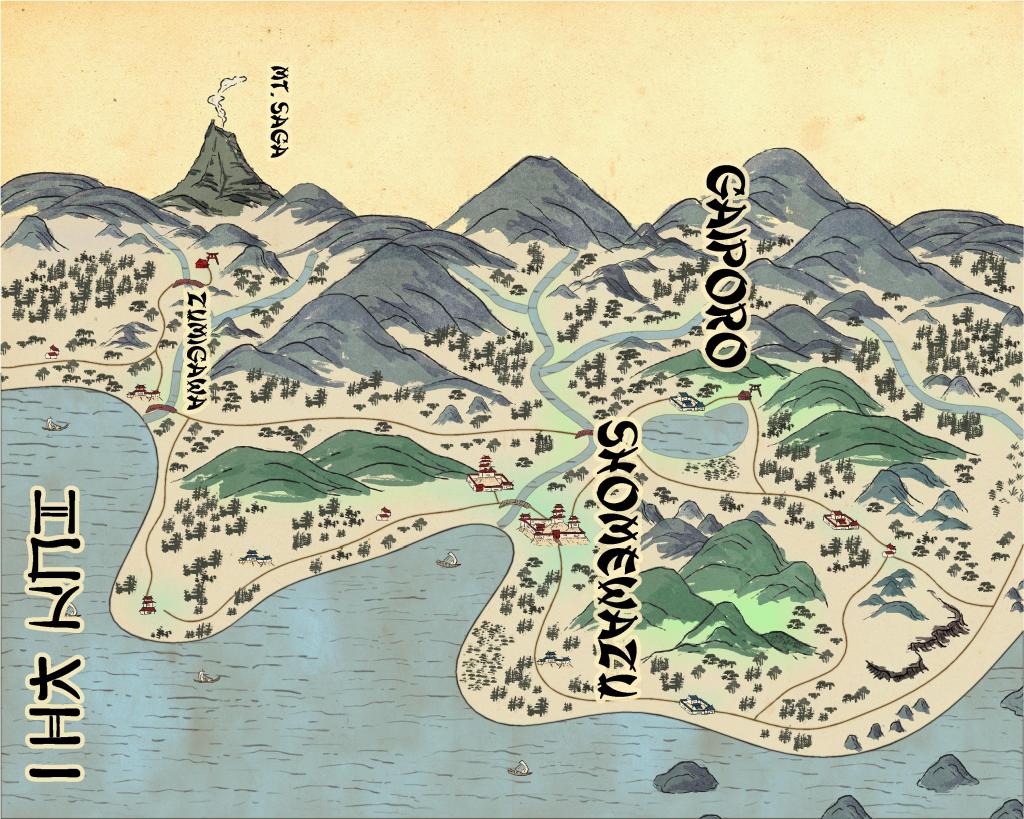
Hun Khi. Created using Campaign Cartographer’s Empire of the Sun style.
In the ancient land of Hun Khi, somewhere to the southeast of Mt. Saga, lies the small lakeside village of Gaiporo. Serene and picturesque, this village thrives on the bounties of the nearby lake and the lush surrounding forests. However, a chilling presence lingers beyond the village’s borders, concealed within the depths of the misty forest.
Hidden away in the foothills, stands the Haunted Shrine of Gaiporo. For nearly seven decades, this sacred place has remained untouched, haunted by the spirits of the Toyagaru family. These ill-fated siblings met their untimely demise when a rival warlord’s agents infiltrated their home, slaying them in their sleep.
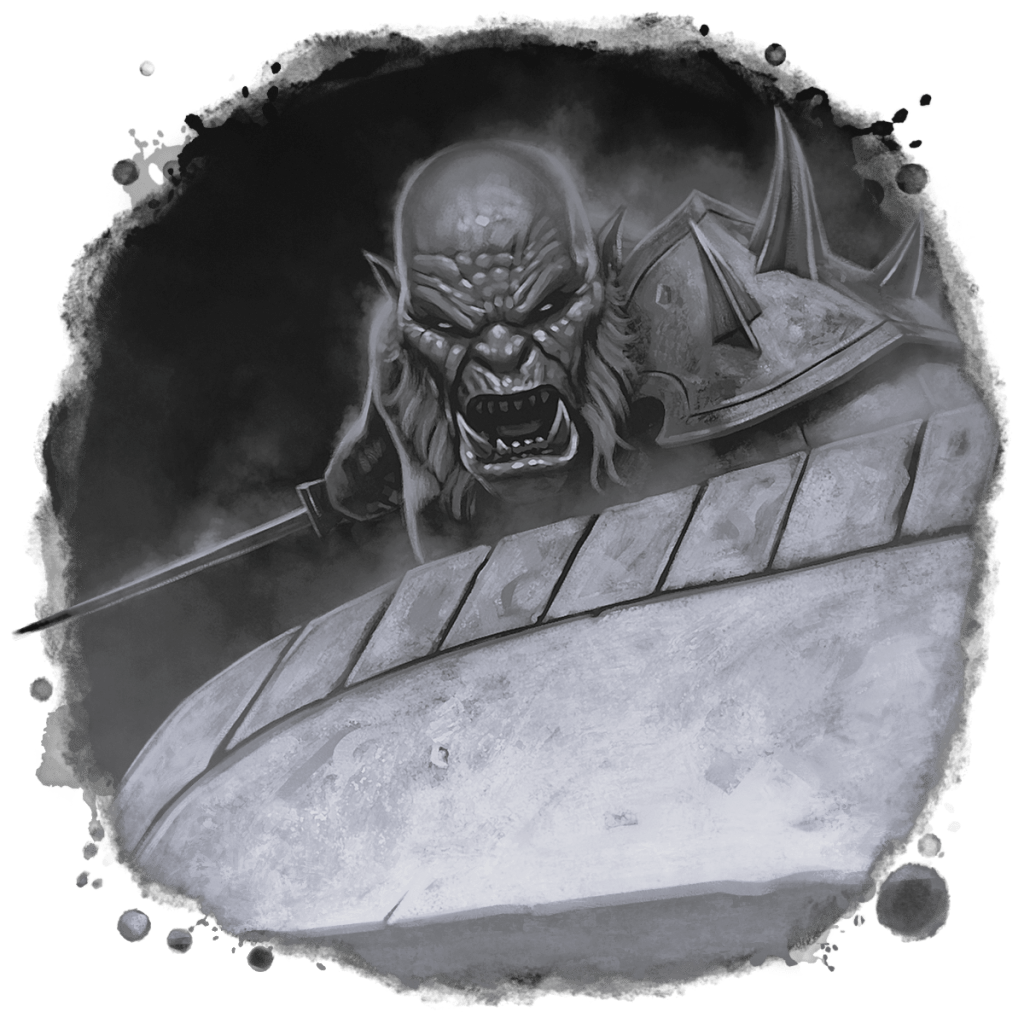
Tethered to this world by an unquenchable thirst for revenge, the ghostly apparitions of the brothers now haunt the shrine. These vengeful entities manifest themselves when any approach. In death their faces have taken on a bestial look and their eyes glow a crimson red.
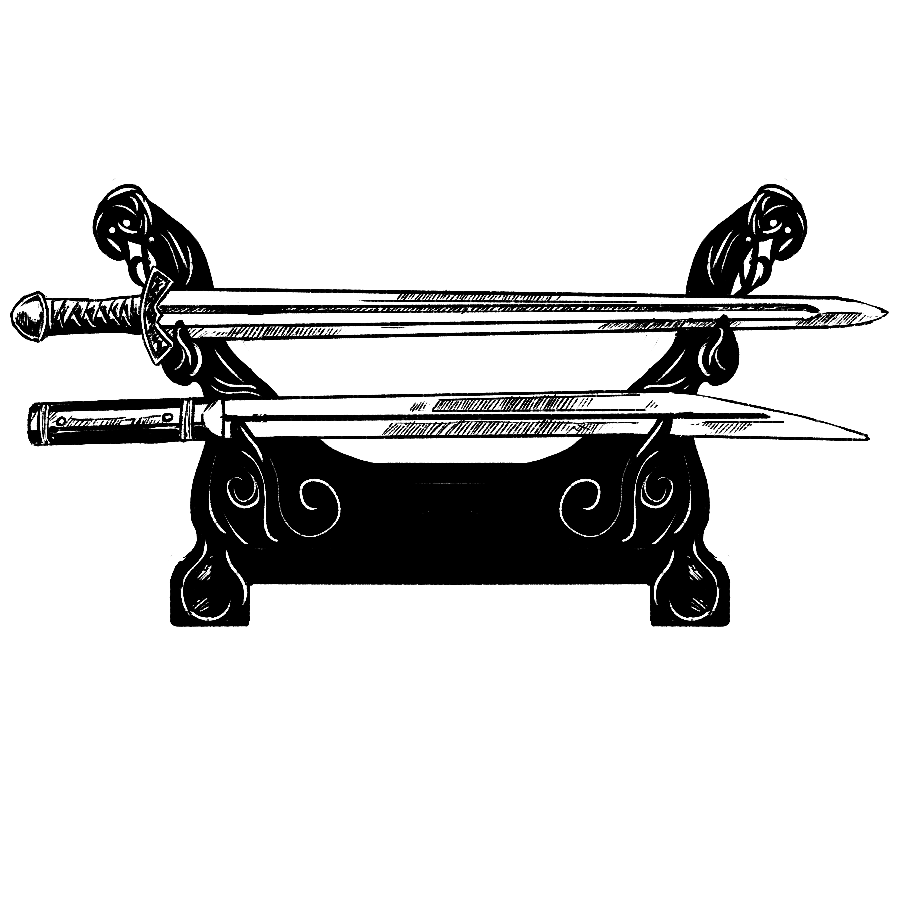
Whispers of their spectral presence have long circulated among the villagers, filling their hearts with trepidation. Legends speak of the fabled Twin Blades of Toyagaru, two exquisite swords of immense power and mystical enchantment. It is said that any who can defeat the vengeful spirits or bring peace to their souls by exacting revenge upon the rival warlord’s family may claim these legendary weapons as their own.
Brave adventurers seeking glory and riches may find themselves drawn to the Haunted Shrine of Gaiporo, enticed by the lure of the twin blades. But beware, for the path to redemption is fraught with danger and the spirits of the Toyagaru brothers are not easily vanquished. To claim the fabled swords, heroes must navigate the misty forest, face spectral adversaries, and uncover the truth that lies hidden within the shadowed depths of the shrine.
Thanks for stopping by. I am trying to find the sweet spot with these, where I provide an interesting idea to build an adventure around without going too deep. If you have a preference either way, please drop me a note in the comments.
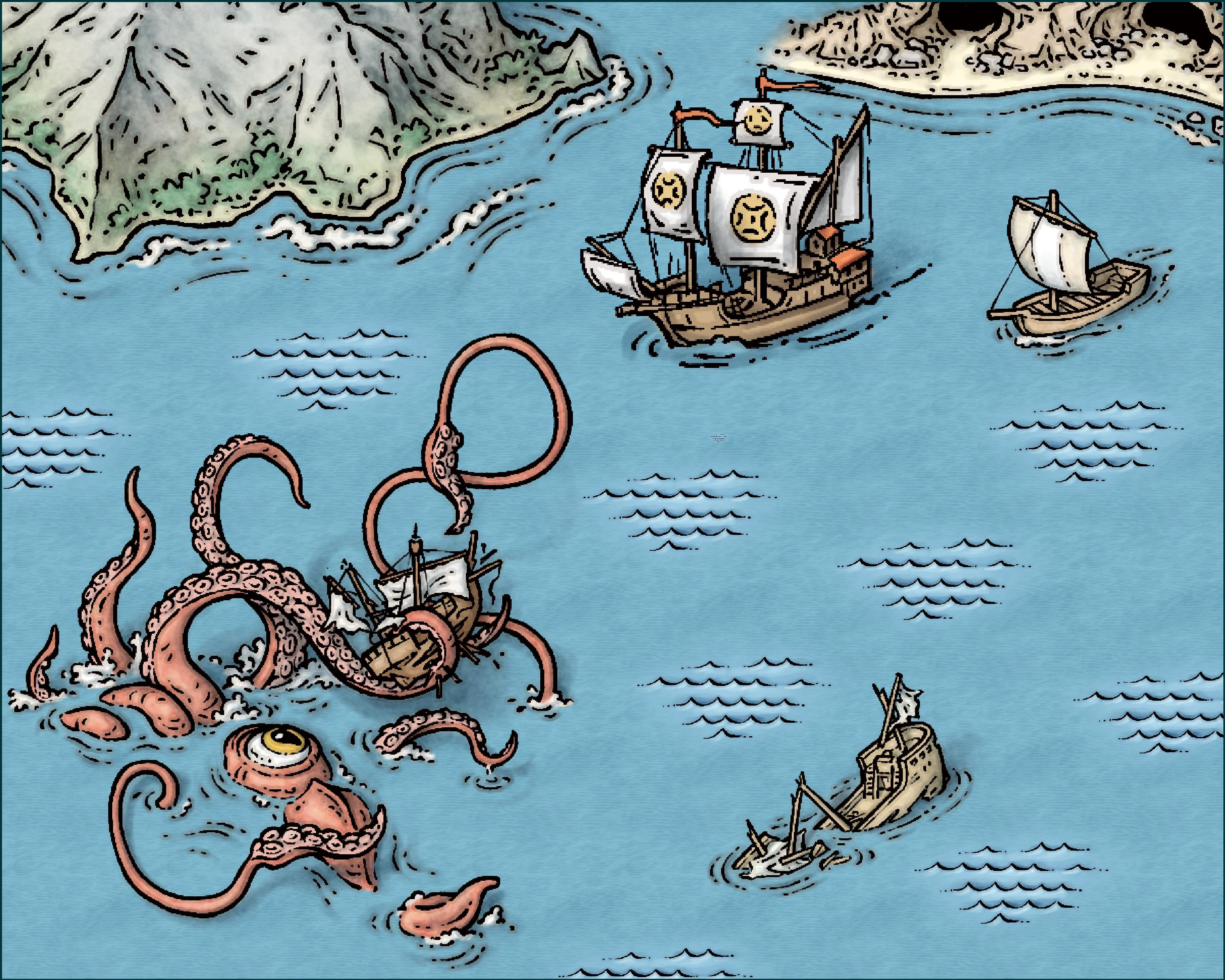
Ahoy mateys! Continuing along with my series of random lists I am going to add some maritime encounters. As with my post about 50 Wilderness Encounters, all of these could range from unexplained occurrences to hooks for you to base entire adventures off of.
When your party is traveling from one locale to another, waterborne travel is common. Rather than hand-waiving the journey, sometimes you want something interesting to happen. During these voyages you may find yourself wanting a non-combat encounter. I find that occasionally tossing in something like this will help to keep everyone engaged during long periods of travel. Whatever the case, roll a d100 and consult below, to find out whether there be stormy seas ahead.
Doodle made with Campaign Cartographer Mike Schley Overland Style.
1-2. Bioluminescent Delight: The water glows with ethereal light as the ship sails through a mesmerizing stretch of bioluminescent plankton, casting an otherworldly ambiance.
3-4. Celestial Navigator: The night sky reveals a constellation that guides the ship, providing a temporary bonus to navigation or granting insight into a hidden location.
5-6. Mysterious Fog Bank: The ship sails into a dense fog bank, concealing strange sounds and eerie shapes. It dissipates after a while, leaving the crew wondering what they witnessed.
7-8. Song of the Sirens: A hauntingly beautiful melody fills the air, captivating those aboard the ship. The source of the music remains elusive but stirs intense emotions.
9-10. Message in a Bottle: A weathered, sealed bottle bobs alongside the ship, containing a message from a distant traveler seeking aid or sharing a cryptic riddle.
11-12. Dolphin Escort: A playful pod of dolphins joins the ship, gracefully leaping and swimming alongside, as if guiding the crew towards a significant discovery or impending danger.
13-14. Flotsam and Jetsam: The ship encounters a floating debris field, harboring remnants of a shipwreck, valuable items, or a survivor desperately in need of rescue.
15-16. Mermaid’s Lament: A mournful melody reaches the ship’s ears as a curious mermaid emerges from the water, sharing a tragic tale or offering a cryptic warning.
17-18. Roving Trading Vessel: An unusual ship, brimming with exotic wares and colorful characters, sails by. The crew has the opportunity to engage in trade or gather information.
19-20. Oceanic Mirage: The crew spots a mirage on the horizon, appearing as a shimmering island or a distant vessel. It fades away as they approach, leaving them questioning their senses.
21-22. Storm’s Symphony: The thunderous storm that brews overhead transforms into a mesmerizing symphony of lightning and thunder, evoking awe and granting temporary inspiration to those who witness it.
23-24. Whirlpool’s Secret: The ship sails near a powerful whirlpool, revealing a hidden underwater cave or ancient treasure chamber accessible only during certain tidal conditions.
25-26. Starlit Reflections: On a calm night, the stars above reflect perfectly on the undisturbed sea, creating a breathtaking celestial mirror that mesmerizes those who witness it.
27-28. Lost Mariner’s Journal: The crew discovers a waterlogged journal floating in the sea, chronicling the adventures of a long-lost sailor, and revealing valuable navigational insights or hidden knowledge.
29-30. Coral Reef Serenade: A choir of aquatic creatures harmonizes in a symphony of song and dance, performed around a vibrant coral reef. Witnessing this enchanting display grants a temporary bonus to charisma-based checks.
31-32. Ghostly Flotilla: A spectral armada appears on the horizon, manned by the shades of long-deceased sailors. They pass by the ship without interference, leaving the crew with a sense of awe and wonder.
33-34. Enchanted Breeze: A gentle breeze fills the sails, carrying with it melodious whispers that share tales of forgotten lands or distant legends, inspiring the crew’s creativity.
35-36. Lighthouse Beacon: A remote lighthouse emerges from the darkness, providing a guiding light for ships at sea. It serves as a welcoming haven or harbors a secret within its walls.
37-38. Kraken’s Lullaby: The ship sails through an area inhabited by a slumbering kraken, surrounded by a serene calmness that evokes a sense of tranquility and safety.
39-40. Triton’s Greeting: A regal triton emerges from the depths, offering guidance or challenging the crew to a riddle or contest, promising rewards for success.
41-42. Spectacular Migration: The ship witnesses a breathtaking migration of aquatic creatures, such as massive whales or graceful sea turtles, granting a temporary connection to nature for those who behold it.
43-44. Sunken Ship’s Bounty: The crew spots a partially submerged shipwreck, still holding valuable cargo or secrets waiting to be discovered with the aid of skilled divers.
45-46. Mystic Tides: The ship sails through a region where the tides take on a mystical quality, revealing submerged paths or hidden entrances to underwater realms.
47-48. Elusive Seafarer: A mysterious sailor, speaking in riddles and prophecies, boards the ship briefly, imparting cryptic knowledge before disappearing as mysteriously as they arrived.
49-50. Living Reef: A massive, sentient coral reef comes to life, interacting with the ship and its crew, sharing ancient wisdom, or granting a temporary blessing for respecting the sea’s harmony.
51-52. Mysterious Shipwreck: The ship stumbles upon a sunken vessel that defies explanation. It appears to be from a time long past or a civilization unknown, tempting the crew with the allure of lost treasures and untold stories.
53-54. Haunted Waters: The ship sails into an area haunted by vengeful spirits, causing unsettling phenomena such as flickering lights, disembodied voices, or objects moving on their own. The spirits may have a message to convey or require assistance to find peace.
55-56. Legendary Seafarer’s Rest: The crew discovers a hidden island where a legendary seafarer, believed to have perished long ago, resides in peaceful seclusion. They can offer valuable advice, teach new skills, or share tales of the sea.
57-58. Eerie Sea Silence: The ship enters a region where all sounds are absorbed, creating an unsettling silence that heightens the crew’s senses. It may hold hidden dangers or offer a respite from the usual clamor of the sea.
59-60. Leviathan’s Wake: A massive leviathan breaches near the ship, its sheer size and power awe-inspiring. The encounter may evoke fear, but it could also serve as a moment of reverence for the wonders of the natural world.
61-62. Treacherous Currents: The ship finds itself caught in powerful currents, requiring skilled navigation or clever tactics to escape their grasp. Success brings a sense of accomplishment and the admiration of the crew.
63-64. Mirage Island: A mirage of a lush, tropical island appears on the horizon, complete with palm trees, pristine beaches, and the promise of relaxation. However, it proves elusive, vanishing as the ship draws near.
65-66. Seafarer’s Graveyard: The ship comes across a desolate area littered with the wreckage of countless vessels. It serves as a chilling reminder of the sea’s unforgiving nature and may hold clues to the perils that lie ahead.
67-68. Lunar Tide: The moon’s gravitational pull creates an unusually high tide, revealing hidden caves, underwater passages, or submerged treasures that are normally inaccessible. The crew must act swiftly to explore before the tide recedes.
69-70. Whispers from the Deep: Faint, unintelligible whispers rise from the depths, hinting at ancient secrets or forgotten knowledge. Deciphering these mysterious voices may lead the crew to a hidden discovery.
71-72. Enchanted Seashells: The crew finds seashells imbued with magical properties, granting temporary enhancements or spellcasting abilities. These shells can be used in rituals, traded for favors, or kept as valuable souvenirs.
73-74. Lost Navigation Charts: A tattered and waterlogged set of navigation charts drifts alongside the ship. Although damaged, they provide hints to hidden routes, uncharted islands, or treacherous reefs.
75-76. Monstrous Migration: A migration of colossal sea creatures, such as giant sea serpents or immense octopuses, causes a temporary disruption in the ship’s course. The crew must navigate carefully to avoid colliding with these awe-inspiring beasts.
77-78. Singing Sandbar: The ship encounters a sandbar that emits melodic tones when struck or walked upon. This enchanting phenomenon grants temporary bonuses to performance-based skills or attracts the attention of curious creatures.
79-80. Sunken Temple: The ship comes across the ruins of an ancient temple submerged beneath the waves. Exploring this underwater marvel reveals forgotten relics, hidden chambers, or puzzles that guard ancient knowledge.
81-82. Poltergeist Seas: The crew finds themselves in a region where mischievous spirits play pranks, causing objects to move, disappear, or reappear in unexpected places. Overcoming these antics may lead to the spirits’ gratitude or further challenges.
83-84. Ghostly Navigator: A ghostly figure materializes on the ship, possessing vast knowledge of uncharted waters and navigation techniques. They offer to guide the crew to a specific location or reveal a hidden treasure before fading away.
85-86. Stormcaller’s Orchestra: The ship sails through a storm infused with a symphony of sounds—thunder, rain, and wind harmonize to create a captivating, almost musical experience. The crew may find inspiration or insights within this natural spectacle.
87-88. Enchanted Bioluminescence: The waters become alive with a radiant display of bioluminescent organisms, illuminating the ship’s path, and creating a mesmerizing scene. These enchanted lights may have magical properties or attract otherworldly creatures.
89-90. Navigational Riddle: The crew encounters a magical puzzle or riddle inscribed on an ancient stone marker. Solving the riddle reveals a hidden navigational route, a forgotten island, or a trove of valuable information.
91-92. Pirate’s Buried Treasure: Following a cryptic treasure map, the crew discovers a hidden cache of pirate loot buried on a remote island or at the ocean floor. Unearthing the treasure may attract the attention of other treasure seekers or supernatural guardians.
93-94. Siren’s Song: The ship becomes entranced by a hauntingly beautiful siren’s song, threatening to lure the crew to their doom. Overcoming the enchantment requires strong willpower or counteracting the song with a different melody.
95-96. Aerial Show: Majestic flying creatures, such as giant roc or shimmering dragons, engage in an aerial display above the ship. Observing these magnificent creatures may bestow temporary flight or inspire tales of mythical creatures.
97-98. Becalmed: The ship sails into an area where the wind mysteriously vanishes, leaving the vessel stranded in a state of calm. The crew must find creative solutions, such as rowing or utilizing magical means, to navigate and escape this stagnant situation. Time may become a pressing concern as supplies dwindle.
99-100. Calm Before the Storm: The sea turns eerily calm, an unnatural stillness that precedes a violent storm. The crew must prepare for the impending tempest or search for shelter to ride out the waves and winds.
Conclusion:
That is all for now. I hope these additions bring a bit of wonder to your party’s seafaring exploits. Thanks for stopping by. If you have any suggestions for other encounters, please leave a note in the comments.
When it comes to running tabletop role-playing games (TTRPGs), there is no one-size-fits-all approach. Some players enjoy diving deep into character creation and exploring complex rules and mechanics, while others prefer a faster, more streamlined experience. That is ok. There is no “right” way to enjoy the hobby, and it is all about finding what works best for you and your group. This post will not be for everyone. I am merely sharing something that works well for the groups that I run games for.
I personally enjoy digging into my games. I see character creation as part of the game and not some chore that must be suffered though. As a GM, working on my campaign world gives me a great deal of joy and is probably just as much fun to me as actively playing.
Creating My Player’s Guide
While not necessary, I will usually create a campaign map once my player’s guide is complete.
As I did when I wrote my post about creating a Who’s Who for your campaign, I wanted to share something that I enjoy doing for my campaign settings. When I am in between games and decide that it is about time to start a new campaign, the first thing I will do is start jotting down some notes to create a player’s guide.
It all starts with my original inspiration. Perhaps a new book series or movie caught my attention or possibly I stumbled onto some old property from my youth that I wanted to build on (this was the case with the Land of the Lost influence in my Revisiting the Isle of Dread post.) By this point I will likely know what genre I am picturing and probably also know which game system I want to use.
Next, I will get down to more formally capturing my thoughts. This step usually takes place in a Word doc or spiral notebook. I will tell my players a bit about what to expect from the campaign. For instance, will this be an epic tale of saving the world or a lighthearted romp in a fanciful setting?
Mind you, this is far from complete. I am not proposing mapping out a full campaign here. There is no way I could know what kind of twists and turns will develop. I merely know what kind of game and what kind of setting I want to be playing in.
A polished up player’s guide that has evolved over a few campaigns.
From there I start to think about the types of cultures that exist in the world. For example, if I want to include a region that is vaguely similar to ancient Greece or the Shire from The Hobbit, I note that. I will create a name for each region and jot down a few facts about it. Again, this is far from complete. I do not force anything but rather list the areas that come to me organically.
I do not go crazy with this but rather provide enough information to remind myself (and my players) “Hey, this place is similar to ancient Greece.” In the case of any unique locations that were purely created by me, I simply strive to give players enough of a feel for the location to allow their imagination to fill in the blanks.
Finally, if I am running with some new players I might also include some information about the various classes or professions that will be available in the campaign. This is largely dependent on the game system we are using and which selections I feel would be a good fit for the campaign.
With all of this information in hand, I will then polish it up a bit. I format things and drop in some pictures to help convey what I am going for. There is no need to go crazy here, though I find that making the player’s guide look sharp goes a long way toward early player buy in. Once everything is in order, I will distribute the document to my players. I ask them to skim through and give me feedback as to where they think they would like their character to come from, as well as what class/profession they would like to play.
The Players
I enjoy the process once my players get hold of the document. Again, if you are the type who prefers to roll up characters in 5 minutes and hit the dungeon, this probably is not going to appeal to you. However, for our games, this really starts to breathe life into the budding campaign.
Over the course of the next week or so, players will reach out to me with questions. Some may immediately relate to certain areas within the campaign world and decide that is where they want their characters to come from. Occasionally a player might not see a locale that calls to them. When this occurs, it is not a problem but rather an opportunity for us to discuss and possibly add something new to the document.
Natural questions develop about certain regions such as “What is the capital city of _____?” or “What deities are worshipped in _______?” I generally do not know the answers to these questions until they are asked but am able to create them once I know that they are of particular interest to my players. As I do, I jot them down and add them into the document. In this way I am not filling in an entire campaign setting from scratch but merely focusing on the parts that are important to my players.
An old player’s guide from my friend Mike’s game, dating back to ~1988.
You may have noticed that I did not mention a section on races/ancestries for the game. That is largely because I tend to run games that are lower fantasy and human centric. When I do have nonhumans in my games they would generally be mentioned in the location description. Something like “Westberry Farthing” might be listed as the pastoral home to the Halflings or “Tindu Loren” could be home to the Forest Elves. On the off-chance that a player wants to play something like an anthropomorphic rabbit, they can always discuss with me and we will see whether or not it would make sense in the world.
Closing
That is really all there is to it. As with previous posts, this may all be common sense to you or you may see it as completely unnecessary. If that is the case, that is fine. This is simply a little tool that has been valuable in my home games and has given me a great deal of pleasure outside of our actual game sessions.
Beyond the value for the campaign at hand, I will often resurrect old player’s guides for other campaigns down the road. When reused like this I can often update them with new information, based on all of the adventures that have already taken place. This process saves me a great deal of time and also adds to the richness of the campaign world.
That is all for now. Do you do anything similar to this with your own games or do you have any tips or suggestions to add? Thanks for reading.
If you would like to see some other general posts, you may find them here.
If you would like to see some maps with plot hooks, you may find them here.





 Talaraska