Vintage Ads From Dragon Magazine # 74

Art by James Holloway as I recall.

Last year, when I was just getting settled with this blogging stuff, I wrote a post containing some ads from an old issue of Dragon magazine. For whatever reason, that post has been steadily one of the most popular I have written. At any rate, this week has been super busy at work so I have decided to share some more. This time around we’re going to try issue #74 from June 1983.

For those of you who happen to be younger than myself, the thing to remember here is that this was before the Internet. Unless you happened to be lucky enough to live in close proximity to a gaming store, the pages of Dragon magazine were probably your only source of information regarding other game systems that might exist out there. These ads inspired wonder and opened the door to new possibilities.
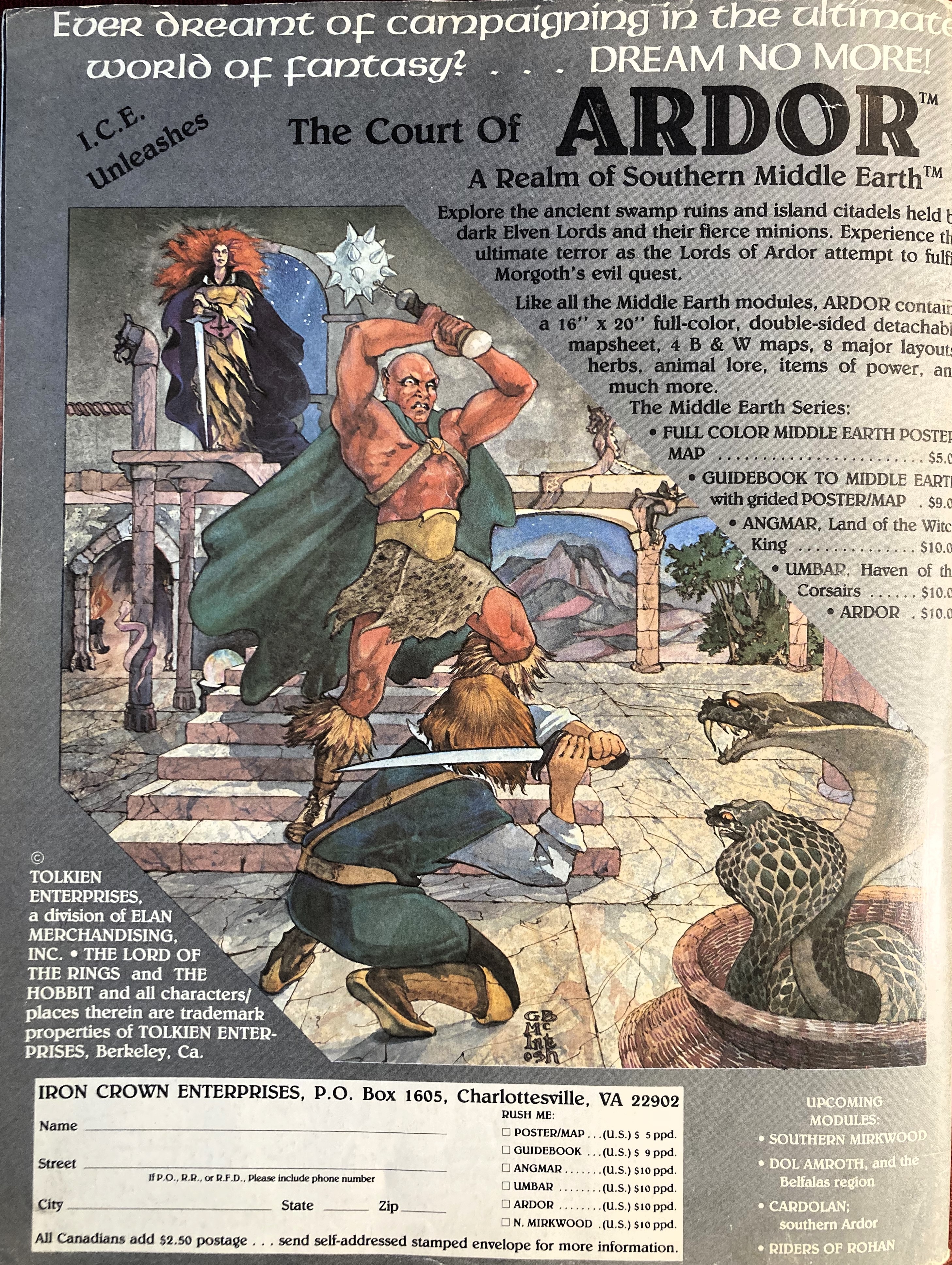
The Court of Ardor  

A supplement for Middle-earth Role Playing (MERP), a role-playing game set in J.R.R. Tolkien’s Middle-earth. This source book introduced players to a new region of Middle-earth, Ardor, and provided additional adventures, characters, and details for the MERP gaming experience.

I did not own this supplement but I did own the Mirkwood supplement and the MERP boxed set. The game itself was sort of a streamlined version of Rolemaster (which I believe is still available today). Back then it was criticized for the fact that the system didn’t really feel like it captured the feeling of Tolkien’s works. This was not an issue for our neighborhood group of junior high school students.

Produced by Iron Crown Enterprises (I.C.E.), MERP seemed to have a solid budget, as they often graced Dragon with full page ads.
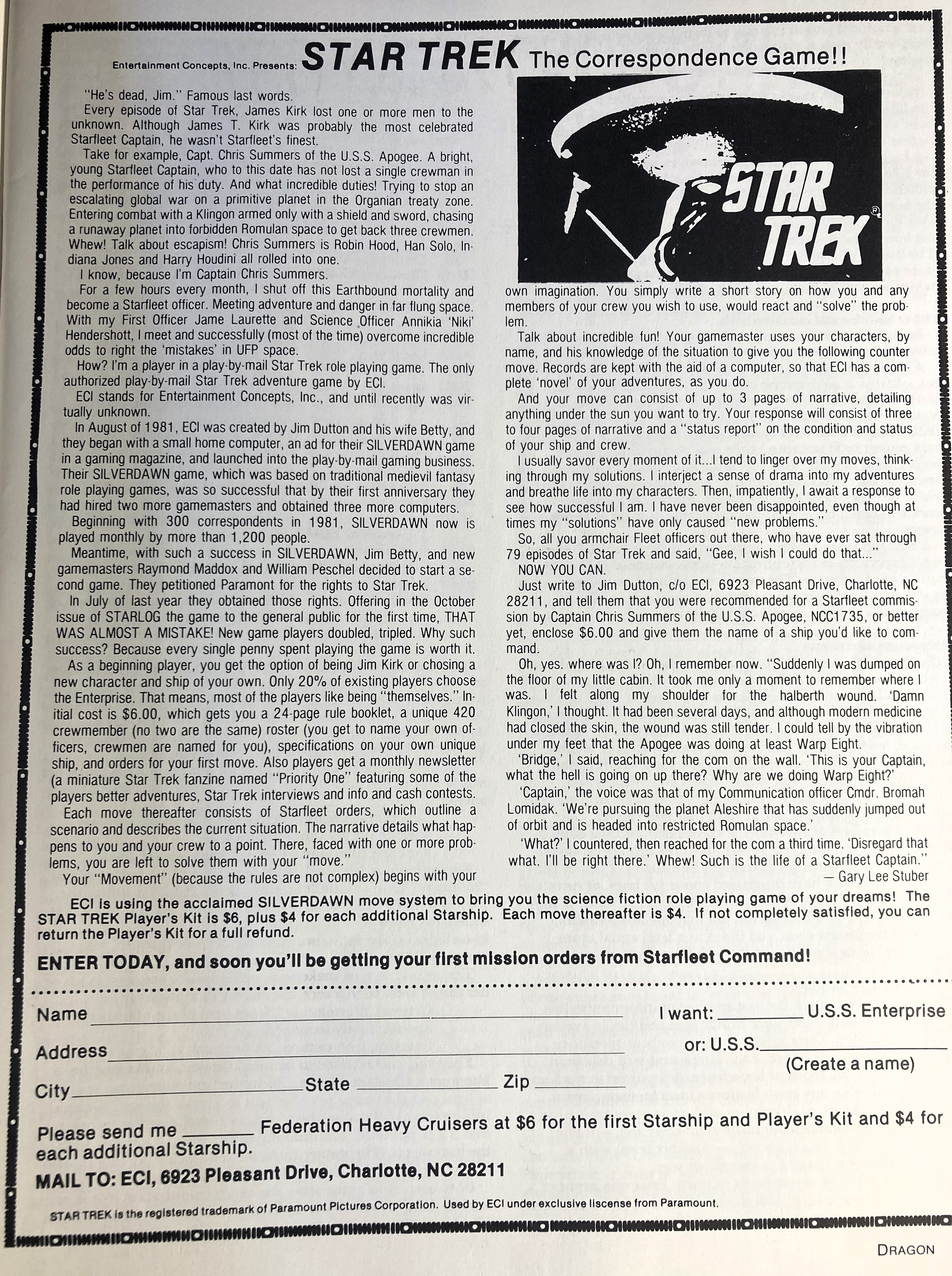
Star Trek the Correspondence Game

Here’s one that may be a bit of a time capsule, as I’m not certain whether younger folks will remember play-by-mail (PBM) games.

Play-by-mail games were a form of gaming before the widespread use of the internet. In these games, players would interact with each other and the game master through written letters sent via postal mail. The game master would update the game world based on the players’ actions and decisions. There were quite a few of these out there, with Silverdawn and Hyborian War being the two that immediately com to mind.  

I digress. This ad was for Star Trek: The Correspondence Game. It was a play-by-mail game that allowed participants to immerse themselves in the Star Trek universe. Players would take on the roles of starship captains, crew members, and other key personnel. The game was played through written correspondence, where players would send orders, reports, and other interactions to the game master via postal mail. Get a load of those $4/move rates. That seems high, even by today’s standard.

Being a poor high-school student, I never played in one of these games. However, I did run my own PBM game for members of the TSR RPGA for a year or so. I met folks through the RPGA directory and ran a campaign for them through the mail. I didn’t charge anyone but rather simply asked for a S.A.S.E. (that’s a self-addressed stamped envelope for the young folks) to be included with each turn.

James Bond 007 Role-Playing In Her Majesty’s Secret Service

By Victory Games. This tabletop RPG transported players into the thrilling and glamorous world of the iconic British secret agent, James Bond. I had this one, along with the Octopussy module. However, the best supplement for the game in my opinion was the Q Manual

The Q Manual expanded the gameplay experience by providing players with the full array of gadgets, vehicles, and equipment straight from the movies. I recall it having great attention to detail and spent more hours flipping through the pages and daydreaming than I ever did actually playing the game.

Bushido

From Fantasy Games Unlimited, “Bushido” transported players to a land where samurai warriors, mystics, and ninja assassins roamed. Drawing inspiration from Japanese history, mythology, and folklore, the game allowed players to immerse themselves in bushido – the way of the warrior.

Note the “Coming Soon: Ninja: Shadows over Nippon”. In 1983, it wasn’t a certainty that even TTRPG gamers knew what a ninja was.

The was another that certainly caught my eye. However, my 13-year-old budget never allowed me to get there. My Fantasy Games Unlimited experience was limited to Villains & Vigilantes, which I still own to this day.

Hârn

Created by N. Robin Crossby Hârn was one of the first 3rd party campaign settings that I was aware of at the time. With a vivid tapestry of interconnected cultures, kingdoms, and landscapes, Hârn offered players an immersive and highly authentic experience.

The setting was known for its attention to historical accuracy and deep world-building. The system-neutral nature of Hârn allowed it to integrate with various role-playing game mechanics. While I never dabbled with it myself, I believe it eventually spun out into its own RPG HârnWorld.

It appears that some of the HârnWorld may still be picked up on DriveThruRPG.

Closing

That’s all for this week. I could use some good vibes if you have any to send. Hoping things at work settle down soon. In the meantime, thanks for stopping by. I appreciate that you took the time to visit. If you have any memories of any of these ads, please share them below. Have a great week!

Have some time to kill? For maps & plot hooks, go here.

For some random tables, go here.

Finally, for a bit about me and some general stuff, this is the spot.

Consider Creating a Player’s Guide for Your Campaign World

When it comes to running tabletop role-playing games (TTRPGs), there is no one-size-fits-all approach. Some players enjoy diving deep into character creation and exploring complex rules and mechanics, while others prefer a faster, more streamlined experience. That is ok. There is no “right” way to enjoy the hobby, and it is all about finding what works best for you and your group. This post will not be for everyone. I am merely sharing something that works well for the groups that I run games for.

I personally enjoy digging into my games. I see character creation as part of the game and not some chore that must be suffered though. As a GM, working on my campaign world gives me a great deal of joy and is probably just as much fun to me as actively playing.

Creating My Player’s Guide

While not necessary, I will usually create a campaign map once my player’s guide is complete.

As I did when I wrote my post about creating a Who’s Who for your campaign, I wanted to share something that I enjoy doing for my campaign settings. When I am in between games and decide that it is about time to start a new campaign, the first thing I will do is start jotting down some notes to create a player’s guide.

It all starts with my original inspiration. Perhaps a new book series or movie caught my attention or possibly I stumbled onto some old property from my youth that I wanted to build on (this was the case with the Land of the Lost influence in my Revisiting the Isle of Dread post.) By this point I will likely know what genre I am picturing and probably also know which game system I want to use.

Next, I will get down to more formally capturing my thoughts. This step usually takes place in a Word doc or spiral notebook. I will tell my players a bit about what to expect from the campaign. For instance, will this be an epic tale of saving the world or a lighthearted romp in a fanciful setting?

Mind you, this is far from complete. I am not proposing mapping out a full campaign here. There is no way I could know what kind of twists and turns will develop. I merely know what kind of game and what kind of setting I want to be playing in.

A polished up player’s guide that has evolved over a few campaigns.

From there I start to think about the types of cultures that exist in the world. For example, if I want to include a region that is vaguely similar to ancient Greece or the Shire from The Hobbit, I note that. I will create a name for each region and jot down a few facts about it. Again, this is far from complete. I do not force anything but rather list the areas that come to me organically.

I do not go crazy with this but rather provide enough information to remind myself (and my players) “Hey, this place is similar to ancient Greece.” In the case of any unique locations that were purely created by me, I simply strive to give players enough of a feel for the location to allow their imagination to fill in the blanks.

Finally, if I am running with some new players I might also include some information about the various classes or professions that will be available in the campaign. This is largely dependent on the game system we are using and which selections I feel would be a good fit for the campaign.

With all of this information in hand, I will then polish it up a bit. I format things and drop in some pictures to help convey what I am going for. There is no need to go crazy here, though I find that making the player’s guide look sharp goes a long way toward early player buy in. Once everything is in order, I will distribute the document to my players. I ask them to skim through and give me feedback as to where they think they would like their character to come from, as well as what class/profession they would like to play.

The Players

I enjoy the process once my players get hold of the document. Again, if you are the type who prefers to roll up characters in 5 minutes and hit the dungeon, this probably is not going to appeal to you. However, for our games, this really starts to breathe life into the budding campaign.

Over the course of the next week or so, players will reach out to me with questions. Some may immediately relate to certain areas within the campaign world and decide that is where they want their characters to come from. Occasionally a player might not see a locale that calls to them. When this occurs, it is not a problem but rather an opportunity for us to discuss and possibly add something new to the document.

Natural questions develop about certain regions such as “What is the capital city of _____?” or “What deities are worshipped in _______?” I generally do not know the answers to these questions until they are asked but am able to create them once I know that they are of particular interest to my players. As I do, I jot them down and add them into the document. In this way I am not filling in an entire campaign setting from scratch but merely focusing on the parts that are important to my players.

An old player’s guide from my friend Mike’s game, dating back to ~1988.

You may have noticed that I did not mention a section on races/ancestries for the game. That is largely because I tend to run games that are lower fantasy and human centric. When I do have nonhumans in my games they would generally be mentioned in the location description. Something like “Westberry Farthing” might be listed as the pastoral home to the Halflings or “Tindu Loren” could be home to the Forest Elves. On the off-chance that a player wants to play something like an anthropomorphic rabbit, they can always discuss with me and we will see whether or not it would make sense in the world.

Closing

That is really all there is to it. As with previous posts, this may all be common sense to you or you may see it as completely unnecessary. If that is the case, that is fine. This is simply a little tool that has been valuable in my home games and has given me a great deal of pleasure outside of our actual game sessions.

Beyond the value for the campaign at hand, I will often resurrect old player’s guides for other campaigns down the road. When reused like this I can often update them with new information, based on all of the adventures that have already taken place. This process saves me a great deal of time and also adds to the richness of the campaign world.

That is all for now. Do you do anything similar to this with your own games or do you have any tips or suggestions to add? Thanks for reading.

If you would like to see some other general posts, you may find them here.

If you would like to see some maps with plot hooks, you may find them here.

Have a great week!

Have You Played Any Solo TTRPGs?

Over the past year or so, have been seeing people mention solo role-playing game experiences. Up until very recently I have ignored the topic entirely. As someone who was born an only child and is a bit of an introvert by nature, TTRPGs have always been the one part of my life where I have specifically craved social interaction.

Ironsworn by Shawn Tomkin will likely be my starting point.

To be honest, I have not even experimented with virtual tabletop gaming. It just doesn’t seem appealing to me. I think VTTs are wonderful. I am sure they have brought many more people to the hobby and provided access to games for many who would not be able to partake. It is just that to me, gaming is all about having a bunch of people over, sitting down and rolling dice.

Even my decision to write this blog was largely out of the desire to interact with people and share. The process of reading someone’s comments or posting my own thoughts on someone else’s post is enjoyable to me. It is just very pleasant to interact with a community like this.

All of that aside, I have been unable to escape the topic of solo games. This post is my white flag of surrender. I am going to dip a toe in and see what it is all about.

My History With “Solo Games”

Encyclopedia Brown.

I have written previously about how I came to discover role-playing games. While I have never actually played a solo TTRPG, I guess you could say that my first experience with some type of solo game would have been with the Encyclopedia Brown books by Donald J. Sobol.

These children’s mysteries focused on a boy detective in a contemporary setting, solving local crimes. Hints would be provided throughout the book and then the reader would attempt to solve the mystery by the end of the book. These were a bit juvenile for me by the time I discovered them, but the concept was very interesting.

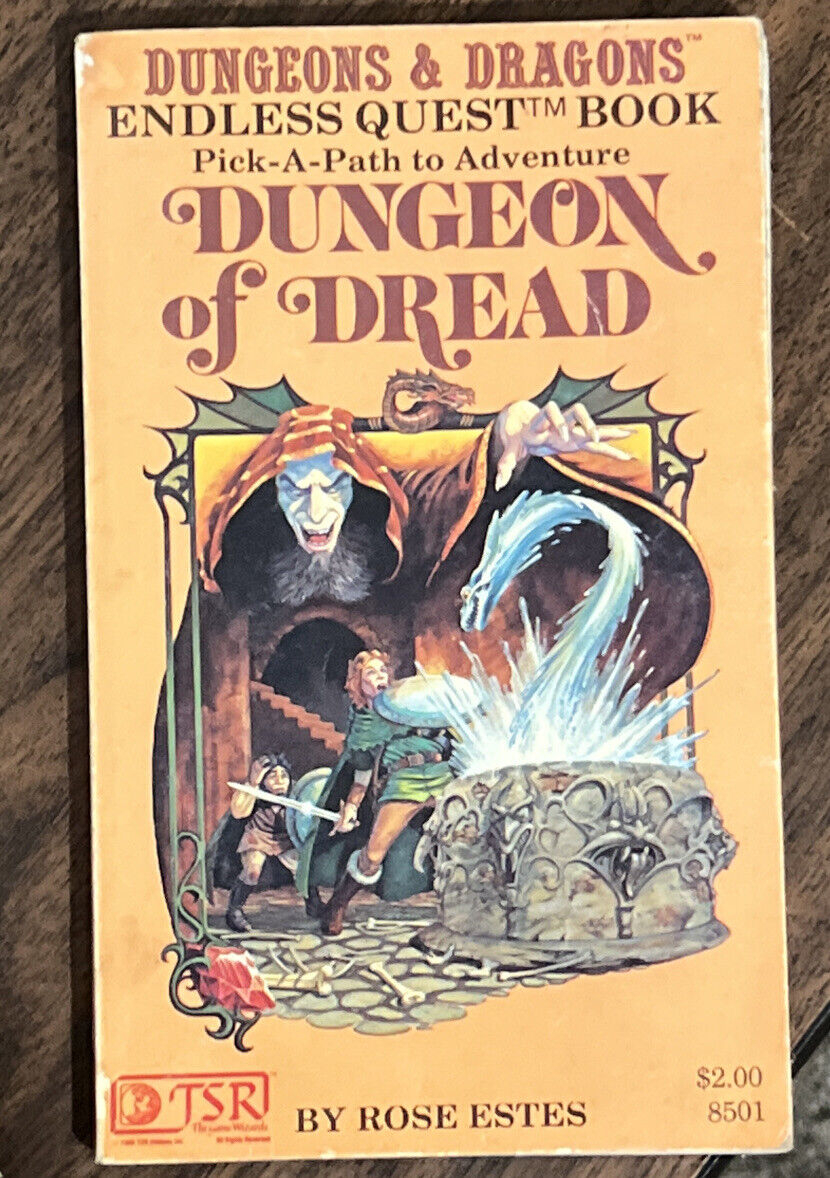
Dungeon of Dread.

My first genre specific solo game book came in 1982 with Dungeon of Dread by Rose Estes. Released by TSR Hobbies, this was part of their new “Endless Quest” line of paperbacks. To my recollection, the Endless Quest line was preceded by and similar to the Choose Your Own Adventure books by Bantam Books.

Written in the second person, these stories followed a pattern of providing the reader with options as to how to continue after a number of pages. Each option would direct the reader to flip to a specific page within the book, where the story would continue. This process would continue until you ultimately arrive a one of numerous endings to the story.

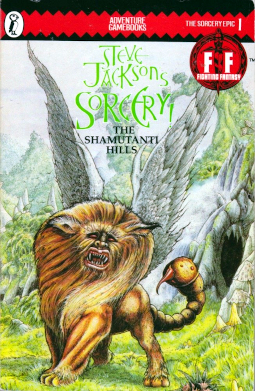
Sorcery!

The following year, while browsing a downtown bookstore, I landed a copy of The Warlock of Firetop Mountain by Steve Jackson and Ian Livingstone. This first book in the famed “Fighting Fantasy” series, this built on the “choose a path” idea by adding actual die rolls, which further simulated playing a TTRPG. From there I recall exploring the Steve Jackson’s Sorcery! series, which built on the Fighting Fantasy series by allowing players to take on the role of either warrior or a wizard.

By the time I was done with these, I was in my mid-teens and my interest in these types of books was waning. It was another 10 years or so before the grind of real life pulled me away from RPGs altogether but in terms of any type of solo gameplay, that was it for me.

Current State of Things

It has been about 10 years now since I have made my way back to the TTRPG hobby. Since that time, I have tinkered with a number of new systems, as well as more old ones than I would have expected. As I mentioned previously, I have been aware of actual solo games being “a thing” for a few years now. However, in the past couple months I have really started to take the idea seriously.

In my ignorance I had assumed that these solo games would not amount to much more than more of what I had experienced in the 80s. However, with the more I read, it becomes clear that it is possible to weave creative tales with these systems. I have decided to investigate a bit deeper and see what I can learn.

I am most likely to start with Ironsworn by Shawn Tomkin. It seems to be the title that crosses my path more frequently than any other. In addition, the few interactions I have had with people who have played the system have been very positive. However, the purpose of this post was to reach out to the folks I interact with the most on here and see what you might be able to suggest.

Have you played any solo TTRPGs? If so, which ones and what were your experiences? Do you have any suggestions to share with someone who is just starting to explore this part of the hobby? I am really starting from square one here, so I would appreciate any input that you might be able to provide.

That is all for now. I hope you have a great week. Good gaming!

Consider a Who’s Who for Your Campaign

Whether we are running published adventures or using a world of our own creation, I suspect most gamemasters want to feel that their players are invested in the game. There is nothing quite as nice as wrapping up a session and listening to players discussing how they can’t wait to get together next week. Ever have a player tell you that they were daydreaming about the game while stuck in a meeting or commuting to work? It’s the best.

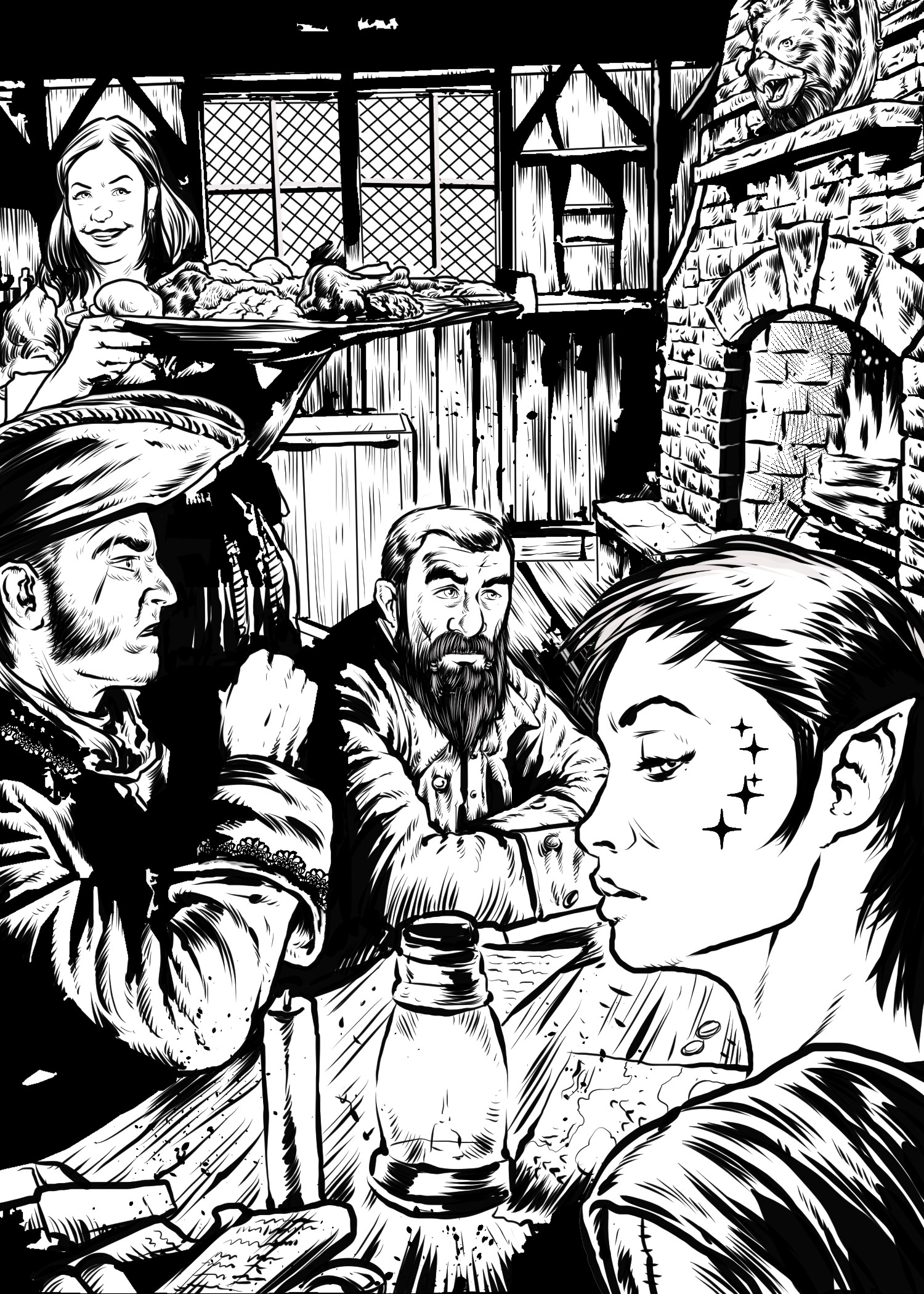
Does your party know these people? Publisher’s Choice Quality Stock Art @ Rick Hershey / Fat Goblin Games. http://www.fatgoblingames.com

Populating your game with interesting and believable characters is key to hooking your players. That’s not to say that every character in your world needs to have a dossier complete with birthdate, star chart, and defined goals. Sometimes Wilbur the fish monger, is simply Wilbur the fish monger. Having said that, the more fleshed out your NPCs appear to be, the easier it will be for your players to escape into your imaginary world.

Who’s Who?

I believe that creating a “Who’s Who” for your campaign is a great tool for building rich NPCs that your players will want to engage with. I was first introduced to this concept during my friend Mike Capron’s Fantasy Hero campaign in the late 1980s. I’ve been doing this for over 40 years and the practice has served me well. The process is simple enough and until recently I just assumed that everyone did it.

While I’m doing my prep for each session, I just keep a notebook or Word document open. Whenever I come to an NPC who the players are likely to meet, I jot down their name and maybe a line or two. If you want to go crazy, you can do this for places as well.

If you’re someone who struggles with names, there are countless name generators floating around online. Just plug in what you’re looking for and you’ll have something in a pinch.

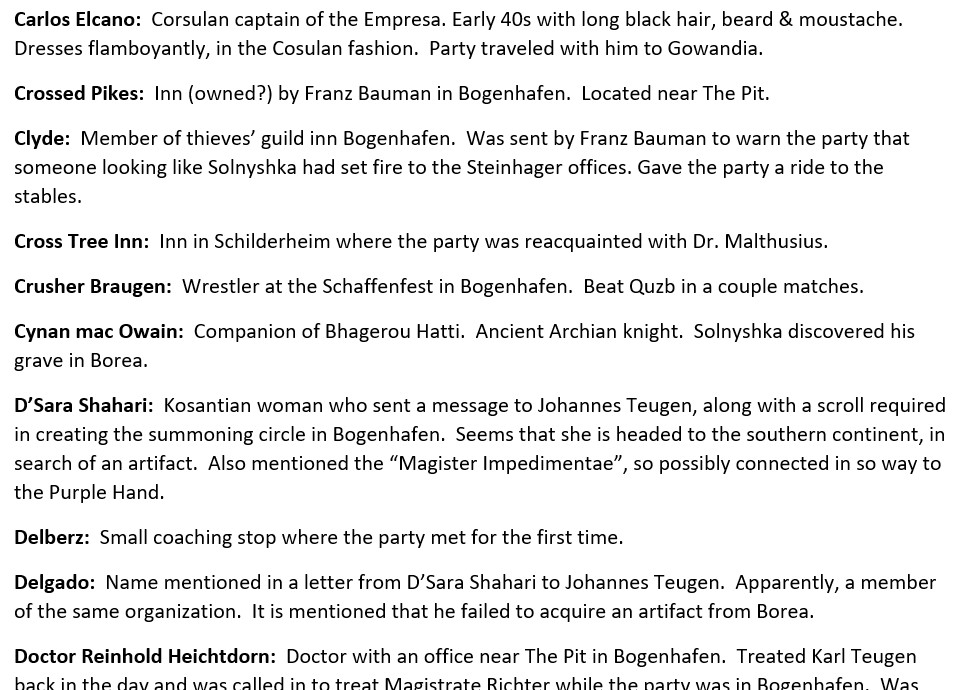
A sample Who’s Who from a recent campaign.

By adding no more than 10 minutes to my prep time, my players no longer meet the dockmaster, city guard, and innkeeper. Instead, armed with this information they encounter Buckeye Crabcracker the halfling wharf-keeper, Sgt. Atheld of the city watch, & Suleiman the Kosantian owner of the Blushing Siren Inn.

Coming up with names for NPCs is pretty basic but it’s only the first step in creating a Who’s Who for your campaign. The next part is up to the players. I visit this after every few sessions, at the end of an arc, or whenever it seems convenient.

Our game nights usually start with players arriving one by one. It can be a bit chaotic. Everyone is usually chit-chatting and I need to get them to switch gears and focus on the game. During this time I announce that we’re going to update the Who’s Who.

I go around the table and ask all of the players who their characters have met during the sessions since we last updated the list. At this point everyone chimes in with the names of NPCs that they remember, as well as what they remember about them. I document all of this as they do, including only what the players themselves remember. The whole process takes no more than 10 minutes but it serves to both center the players on the game, as well as offer an interactive recap of recent sessions.

Is this fellow simply the “ship captain” or is he Ebeneezer Bellows, captain of the Tiburon? Publisher’s Choice Quality Stock Art @ Rick Hershey / Fat Goblin Games. http://www.fatgoblingames.com

I will usually reward the player who contributes the most with some small boon. For OSR games this might be an XP bonus, 5e players might get Inspiration, Savage Worlds players get a benny, and so on. I find that this really helps to get everyone to participate.

After every session, I send the revised document out to all players. However, I only share the version with the names of people and places that the group remembered. If the group as a whole missed any NPCs, those do not get passed along.

Over the course of time, I find that having access to this reference document really engages my players. When your cities feel like they are populated with living and breathing people, it increases the chances that your players will interact with them.

It’s satisfying to see the group break out with the Who’s Who as they are heading back to town following an adventure. Often each player will be flipping through the pages, deciding who they want to go see first. Maybe they know the perfect buyer for a piece of loot or perhaps they’ll seek out an old contact for important information.

On the flipside, the document acts as a tool for me during session prep. I can briefly scan through and pick different NPCs to drop into different scenes. Do I need someone to pass along a juicy tip? That sounds like the perfect job for young Jacob, who the party saved on their first adventure. Do I need a victim for the big bad evil guy? Hearing that Fletcher Orlem was slain while out hunting will ratchet up the tension more than some nameless villager.  

An old text editor Who’s Who from my friend Mike’s game, going back to the early 1990s.

Since we update entries for NPCs after every time the players mention them, they really start to take on a life of their own. Over the years, some of my most mundane NPCs (like Wilbur the fish monger) have ended up playing important roles in my games.

Finally, the Who’s Who gives me a nice souvenir from each campaign. Whether we run for years or a handful of sessions, having this document gives me something fun to look back on. Sometimes names and sub-plots get recycled and that’s all part of the fun.

Recap

That’s it for this week. Thank you for stopping by. If you do something akin to this or even something more elaborate, please drop a note below and let me know. Have a great week!

For the Village of Cross Tree, go here.

For maps & plot hooks, go here.

For my Idea Chest posts, go here.

For some random tables, go here.

Finally, for a bit about me and some general stuff, this is the spot.

Weeds of Wonder

Gather round the fire, you children of the jungle. Let it be known by you that the wilds of our homeland can be harsh indeed. Even our mighty heroes and wise elders are, at times, at the mercy of the land. You must learn that, in times of need, the jungle itself can provide for its people. Beware, however, for just as an incautious man may find himself in the belly of the tiger, so too can malady befall one who is careless with the bounty of the wilds.

-Bhagiro Hatti, Gowandian Scholar

Intro

I mentioned in a previous post that one of my groups will be revisiting The Isle of Dread. I spent some time over the holidays prepping for our January sessions and stumbled across some old articles that I had written for the Polyhedron Newsine. I wrote Weeds of Wonder for issue #108 in 1995, as part of the RPGA’s Living Jungle campaign. Since I am going to be dealing with a jungle setting, I decided to reprint it here.

Weeds of Wonder

Below is a partial list of some of the more useful plants to be found within the jungles of Malatra. There are, of course, many others awaiting discovery; some of these will have benign properties, while others will be harmful or even toxic.

Most intelligent inhabitants of Malatra should be aware that plants like these exist. Heroes with herbalism, survival, or other appropriate skills should be allowed a proficiency check to identify or locate these plants.

Stikricki Bush

Part used: Whole Bush

Description: Found only in dry areas of the Rayanna Savannah, this gnarled, woody Bush appears dead even when flourishing. Actually, it is nothing more than a tangled ball of razor-sharp thorns. The Bush seems to serve no other purpose than to shelter small animals which often seek its cover on the otherwise open savannah.

Uses: After carefully harvesting the Bush and allowing it to dry in the sun (this normally takes two to five days, assuming that it is not the rainy season), the bush may be broken into many pieces. These pieces may then be efficiently used as caltrops. Any person with bare feet moving through an area containing stikricki bushes suffers one hit point of damage. In addition, he will have to make a successful save against paralyzation in order to keep moving through the caltrops. Two mature stikricki bushes will bear enough thorns to cover effectively a 10-foot square area.

Tiki

Part Used: Root

Tiki Plant. Art property of Wizards of the Coast. ©Wizards of the Coast LLC.

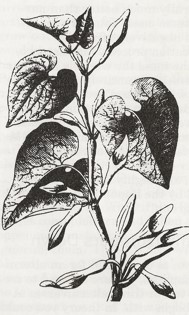
Description: This distinctive plant has stems that vary in length from two to four feet. Broad leaves surround the plant, and its flowers are large and white with Violet centers. The root is sandy brown and very bitter to the taste. The tiki is found only in humid regions which receive a fair amount of sunlight.

Uses: For as far back as they can remember, the inhabitants of Malatra have been using the root of the tiki plant. Anyone versed in the knowledge of this plant can boil the roots in water to create a thick, pungent brew which will slow poison as does the second level priest spell slow poison. These benefits, however, are granted only if the person drinking the brew also gets complete bed rest.

Gualla

Part Used: Juice from stem

Description: This is a fairly large plant, growing to nearly six feet in height. The leaves range in color from light green to yellow and are long and thin. The flowers are delicate and yellow, and the gualla produces clusters of golden berries. There is a common legend among various tribes that the Ancients brought gualla with them when they came to Malatra.

Uses: Within the stem of the gualla is a thick chartreuse liquid, the juice has a luminescent property which causes it to glow in the dark period objects or persons covered in gualla juice will glow with a faint green light which will be visible from up to 60 yards away in the dark period the juice will lose its luminescence approximately 12 hours after being exposed to the air, although it can be stored in an airtight container for months.

Magasorium

Part Used: Crushed leaves

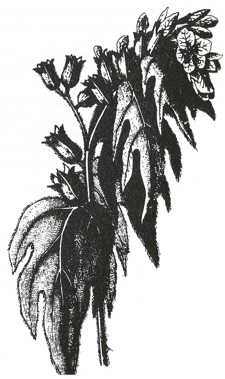
Magasorium. Art property of Wizards of the Coast. ©Wizards of the Coast LLC.

Description: Magasorium is a short, stocky plant with thick, flat leaves. It is entirely green, except for black ribbing along its leaves. Magasorium grows abundantly throughout the Malatran jungle. However, since it grows close to the ground, often it can be hard to find.

Uses: Magasorium is an excellent repellent against the many insects of the jungle. For personal use, the leaves are crushed, and the juice is rubbed on the skin. This application will remain effective for approximately 4 hours (less if the recipient is engaged in strenuous activity). Some tribes also burn the plants in order to keep insects away from their villages.

Billitri

Part Used: Crushed leaves

Billitri Plant. Art property of Wizards of the Coast. ©Wizards of the Coast LLC.

Description: Billitri is a fragrant, delicate looking plant with numerous slender leaves. It is commonly found on hills and on the sides of mountains. The stem is about 6 inches long and usually produces 3 flowers, which are lavender with golden centers in color.

Uses: The juice from the leaves of the billitri is so fragrant that its scent will remain for days with a person who has applied it to his skin. Many hunters of Malatra use crushed billitri leaves to mask their scent while stalking their prey. The fragrance is strong enough to mask their natural scent, rendering them difficult to detect by creatures that rely on their senses of smell. Some crafty heroes, when being chased by keen nosed predators have been known to lead the creatures through a patch of billitri. Even in its natural state, billitri’s fragrance is strong enough to deaden temporarily the sense of smell of a creature that gets too close to the plants. Although this is not a guaranteed method of throwing off prey, it has worked often enough to make it worth an attempt.

Biseechee Bush

Biseechee Bush. Art property of Wizards of the Coast. ©Wizards of the Coast LLC.

Part Used: Berries

Description: This is a short Bush with slender branches. It grows in dry soil, near the edges of the Rayanna Savannah. Its stems are covered with tiny, cactus-like thorns. The flowers are delicate and white with four petals. Those harvesting the berries of the biseechee bush must do so cautiously, for cobras often make their homes in the areas where these bushes are found.

Uses: The berries of the biseechee bush have incredible healing properties. Many of the Nubari believe these bushes to be gifts from the Ancients. Eating the berries will heal 1hp per berry, to a maximum of four hp over a 24-hour period. Unfortunately, these berries lose their special healing properties within a day, so heroes must seek them out whenever they need them.

Manriki Bush

Part Used: Berries

Description: This short bush looks very similar to the biseechee bush and the one is often mistaken for the other. A close inspection will show that manriki berries are a deeper shade of red and its flowers have only three petals. As with the biseechee, the manriki can be found on the outskirts of the savannah.

Uses: The berries of the manriki bush are extremely toxic to most humanoids. Though they taste sweet and pleasant at first, they quickly cause intense headaches, nausea, and dizziness. Anyone eating them will need to save against poison at +2. If the save fails, the victim will start to see spots shortly after ingestion. Within an hour, the victim will become blind. Any method of slowing or neutralizing poison will affect the onset of this blindness. The blindness will wear off on its own in 3-10 rounds. Blinded characters suffer a – 4 penalty to their attack rolls, and their opponents gain a + 4 to their attack rolls against them, for the duration of the blindness.

Manshooki Tree

Part Used: Vines

Description: The manshooki is a towering tree found in the deepest recesses of the jungle. It closely resembles a massive willow tree, with hundreds of vines dangling down to the jungle floor. The limbs of the manshooki tree are more than strong enough to support humans. Many of the Malatran tribes build storage platforms on these trees high enough off the jungle floor to protect their provisions from prowling jungle animals.

Uses: The vines of full grown manshooki trees are extremely strong and vary in length from 20 to 130 feet. As they are even stronger than hemp, more limber, and narrower in diameter, many inhabitants of Malatra prefer them to ropes woven from hemp. Ultimately, the vines are not as durable, becoming dried out within 3-4 days after being removed from the tree, after which time they could break at any time.

Final Notes

The RPGA’s Living Jungle campaign was written for Advanced Dungeons & Dragons 2nd Edition and was located within the Forgotten Realms campaign setting. Because of this, some of the proper names are specific to Toril. If you are using another campaign setting, such as Mystara or a homebrew, it should be easy enough to make the necessary changes.

While these were originally written for AD&D 2e, I think everything is tame enough that it should work with pretty much any old school or current system with minor tweaks. For instance, I do not believe slow poison existed in B/X or BECMI but I that would be easy to work around.

Thanks for stopping by and have a great week!

Weeds of Wonder is owned by Wizards of the Coast. I am reprinting this post in a strictly non-commercial, voluntary basis as unofficial Fan Content permitted under the Wizards Fan Content Policy. Not approved/endorsed by Wizards. Portions of the materials used are property of Wizards of the Coast. ©Wizards of the Coast LLC.

Revisiting the Isle of Dread

I have been running a group using the Rules Cyclopedia (with various tweaks) for about 6 months now. While it started as an experiment, it has become a fun endeavor. Up to this point, I’ve put them through their paces in “The Tower of Zenopus”, “Caves of Chaos”, and various homegrown one-shots.

Going into our holiday hiatus, the group consensus is that they would like to continue. I’ve spent the past week deciding where to take them next. Having enjoyed our previous romps through classic adventures I’ve decided to continue retracing the steps of my youth and chart a course for The Isle of Dread.

My stab at the classic Isle of Dread map. Made using the Campaign Cartographer annual Spectrum overland style.

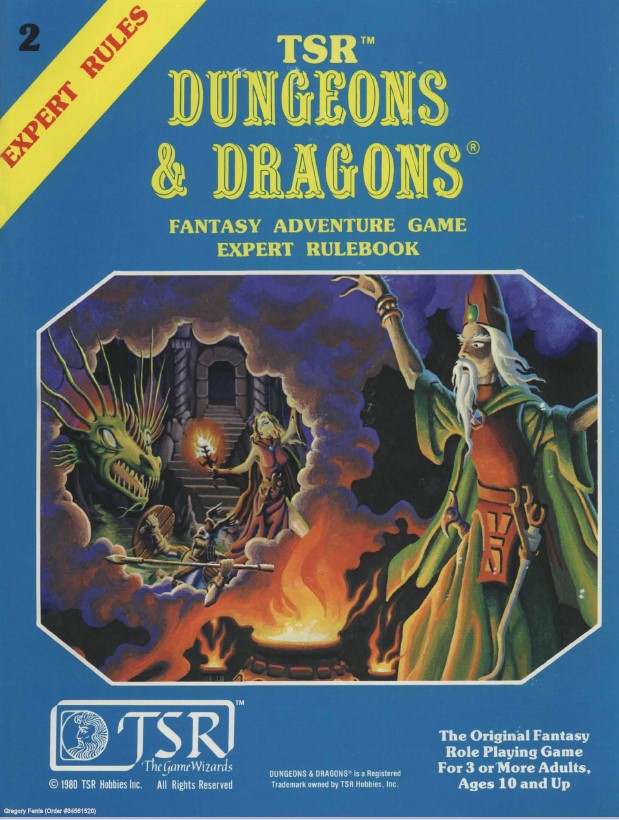
If you are reading this, it’s quite likely that you are well-versed with the module already. Released in 1981, I received my first copy of the David “Zeb” Cook & Tom Moldvay adventure inside the Dungeons & Dragons Expert Set.

D&D Expert Set rule book from 1981.

As the adventure is largely a wilderness exploration, this will be a perfect opportunity to shift my game a bit. Some of our other friends have been eager to join, while a couple of my current players are going through a hectic period at work. Exploring The Isle of Dread will allow me to take more of an episodic approach to my game, with somewhat of a West Marches style.

After making contact with a group of islanders on the southeastern peninsula, the party will establish a base camp. My sessions will then start as one-shots, with different groups of PCs striking out each week to explore the mysteries of the island. This will hopefully keep us nimble and allow us to get through the winter without any canceled sessions due to the lack of players. As we progress a bit, it’s likely that the group will find another location suitable for a forward base deeper within the island.

Hex version of my map. Click for full image.

These days I derive as much fun from making maps as I do from running the games themselves. This practice seems to fill the void created when I stopped painting minis years ago. While the original hex style map for The Isle of Dread will always be dear to my heart, I wanted to make my own version. I settled on the Annual Spectrum style for Campaign Cartographer and took a stab at it.

While I have a lot of fond memories of The Isle of Dread, the adventure as written does not really lend itself to the story I am looking to tell. I will still introduce the island as a location by allowing the party to discover a secret page from a ship’s log and partial map (I created a new version of this as well). However, aside from these details I’ll be changing quite a bit.

Ideally, I would like to hit my players with a number of stand-alone adventures, while also sprinkling some bread crumbs of an overarching story. To do this, I plan to steal liberally from a couple old guilty pleasures of mine.

Inspiration

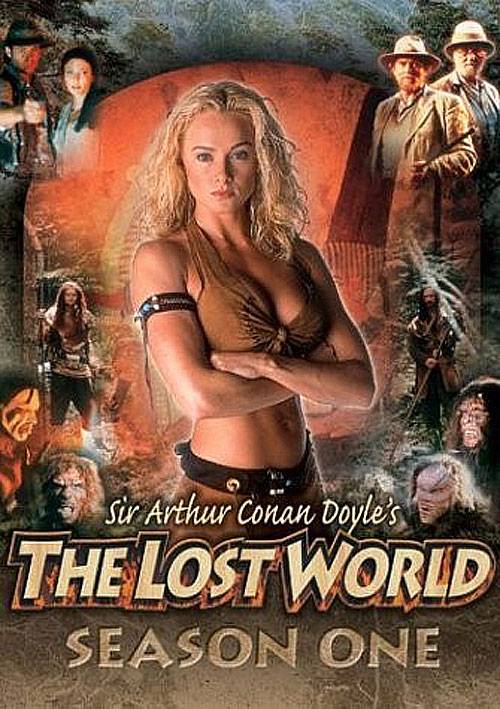
The Lost World promo shot.

Sir Arthur Conan Doyle’s The Lost World was a syndicated television series, very loosely based on the 1912 novel. The book itself was likely an inspiration for The Isle of Dread in the first place. It premiered in 1999 and ran for three seasons. The show follows a diverse group of early 20th century adventurers after their hot air balloon crashes on an uncharted plateau where prehistoric creatures still exist.

It was a cheesy production; I suspect owing much to the previous successes of shows like Hercules: The Legendary Journeys & Xena: Warrior Princess. Like these predecessors, each episode loosely followed a “problem of the week” format, while also occasionally touching on the larger story of who the characters were and how they might get off the plateau.

I am not here to claim that this was great television. However, it crossed my path at a time in my life when I was about as far removed from the hobby as I had ever been. I suspect this is why it stuck with me. Something about turning on the TV and seeing these silly stories play out really stoked my imagination. It brought back memories of my youth and playing D&D with my friends. I started to daydream about a time in my life when I might have the time to start gaming again.

The entire 66-episode run is currently available for Amazon Prime subscribers. I have been binging it while I doodle on my maps and making notes. Despite the fluff and gratuitous cleavage shots, I am mining a number of good ideas for one-shot adventures.

The other source that I will be looting for ideas is The Land of the Lost. To be clear, I am not referring to the Will Ferrell movie but rather the 1974 children’s adventure television series by Sid and Marty Krofft.

Land of the Lost title card.

The show’s 3 seasons tell the tale of the Marshall family, who while on a river rafting trip, end up in an alternate universe. Rick Marshall and his children Will and Holly become trapped in a land that time forgot, a place inhabited by dinosaurs and other strange creatures.

The Land of the Lost was every bit as cheesy as the Lost World and was clearly aimed at young children. However, despite all of this there are some elements that I think would make compelling additions to my revised Isle of Dread.

The Sleestak were a race of reptilian bipedal humanoids native to the Land of the Lost. Covered mostly in green scales, they have claws on their feet and hands which can function as pincers. Typically armed with crossbows and nets these unique creatures captured my imagination as a child and will make for great reoccurring villains.

Scheming Sleestak

The remnants of a dying race, the Sleestak reside in a Lost City with subterranean tunnels built by their ancestors. All of this sounds like a great fit for the caldera location in the center of the Isle of Dread.

Finally, scattered about throughout the Land of the Lost are numerous pylons. These futuristic constructs contain matrix tables filled with crystals, each serving as the power source to control different aspects such as the weather or passage of time. The World of Warcraft paid homage to the pylons & crystals in the Un’Goro crater zone, and I think they will be a fun addition to my game as well.

Final Thoughts

That is my plan. Do you ever go in and add your own touches to classic adventures? If so, please share in the comments. I would love to hear what has inspired you and what sources you use for inspiration. I would also like to hear from anyone else who may have been inspired by either of these properties in the past.

Thank you for stopping by. Please take a minute to say hello and if you’d like to read some more, here are some convenient links

For the Village of Cross Tree, go here.

For maps & plot hooks, go here.

For my Idea Chest posts, go here.

For some random tables, go here.

Finally, for a bit about me and some general stuff, this is the spot.

Good Gaming!

My version of the incomplete map found by the characters.

The Isle of Dread is owned by Wizards of the Coast. All of my work on this post is strictly non-commercial, on a voluntary basis as unofficial Fan Content permitted under the Wizards Fan Content Policy. Not approved/endorsed by Wizards. Portions of the materials used are property of Wizards of the Coast. ©Wizards of the Coast LLC.

Lost Worlds Fantasy Combat Book Game

Earlier this week I wrote a post about vintage ads from the pages of Dragon Magazine. While taking that stroll down memory lane I came across one game in particular that had held a special place in my heart for a brief moment of time.

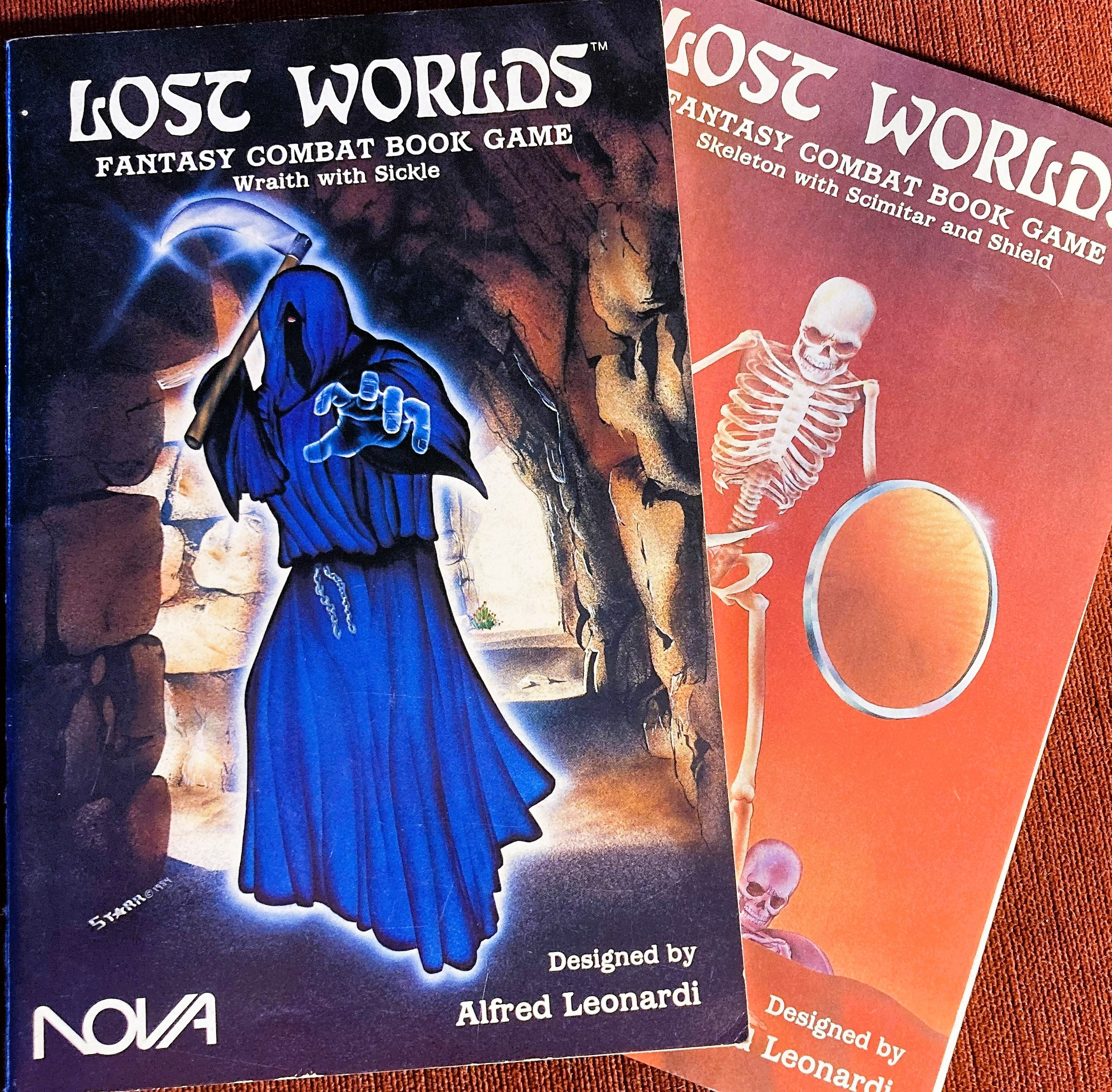
My original two game books

Designed by Alfred Leonardi and released by Nova Game Designs, Lost Worlds was a fantasy combat book game that debuted in 1983. Leonardi had already had a considerable hit with Ace of Aces, a WWI dogfighting game from 1980. Lost Worlds capitalized on the explosion of interest in fantasy games at the time and delivered a fun little diversion.

The game itself revolved around individual game books, with each game book representing a particular character. The characters themselves ranged from the fairly mundane “Man in Chainmail with Sword and Shield” or “Woman in Scale with Sword and Shield” to the more fantastical like “Skeleton with Scimitar and Shield” or “Giant Goblin with Mace and Shield.”.

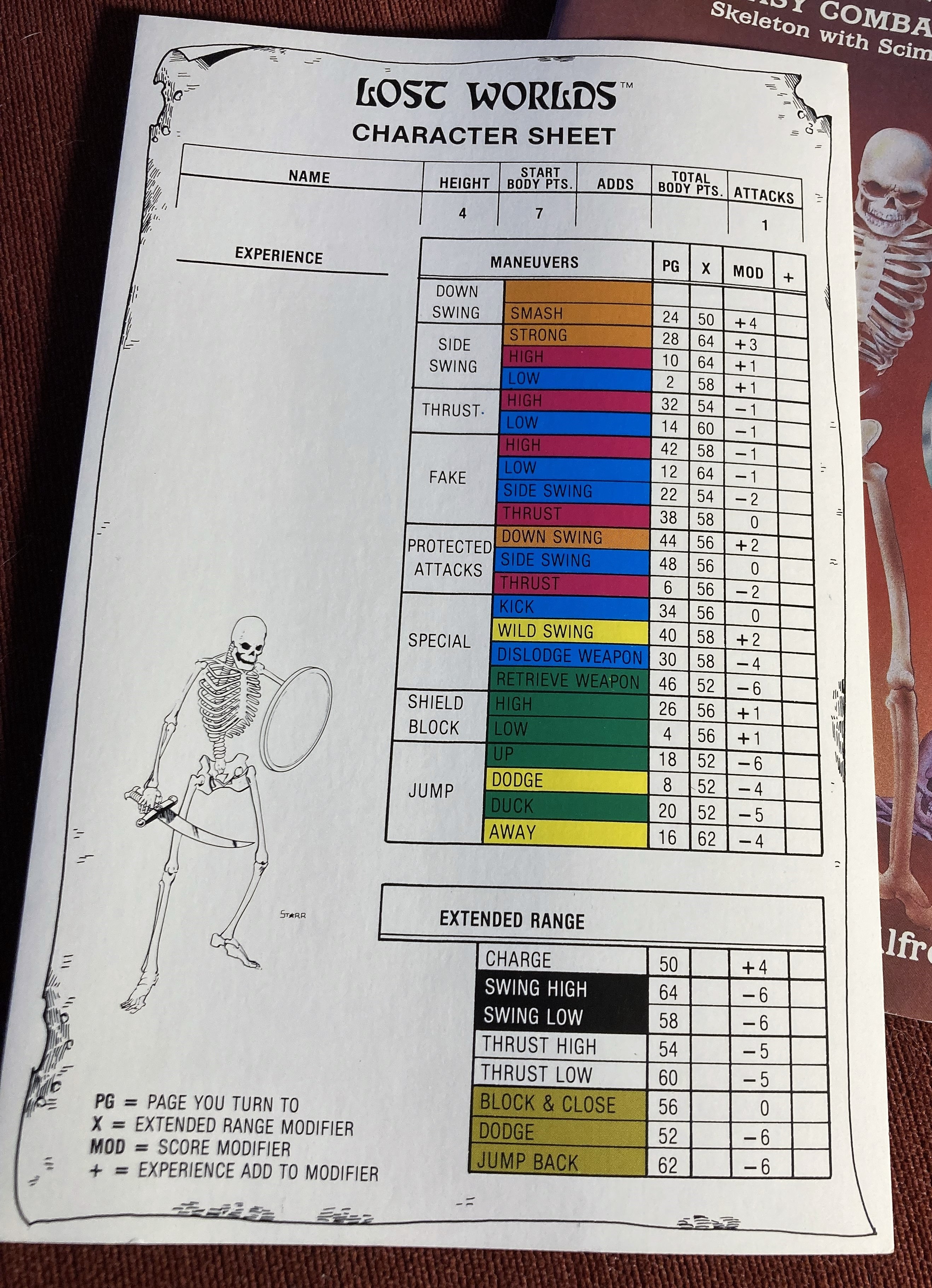
Character Sheet

Each book contained a removable character sheet (listing various maneuvers that the character was capable of) depicted the character in various poses. Essentially a dueling game, the idea was that both players would come to the table with their own book and then fight it out until one was victorious.

At the start of play, you would remove your character sheet and then pass the booklet itself to your opponent. As the game commenced, you would turn to a pre-determined page in the book. The picture on the starting page would essentially give you a first-person view of your opponent’s character squaring off and ready to fight.

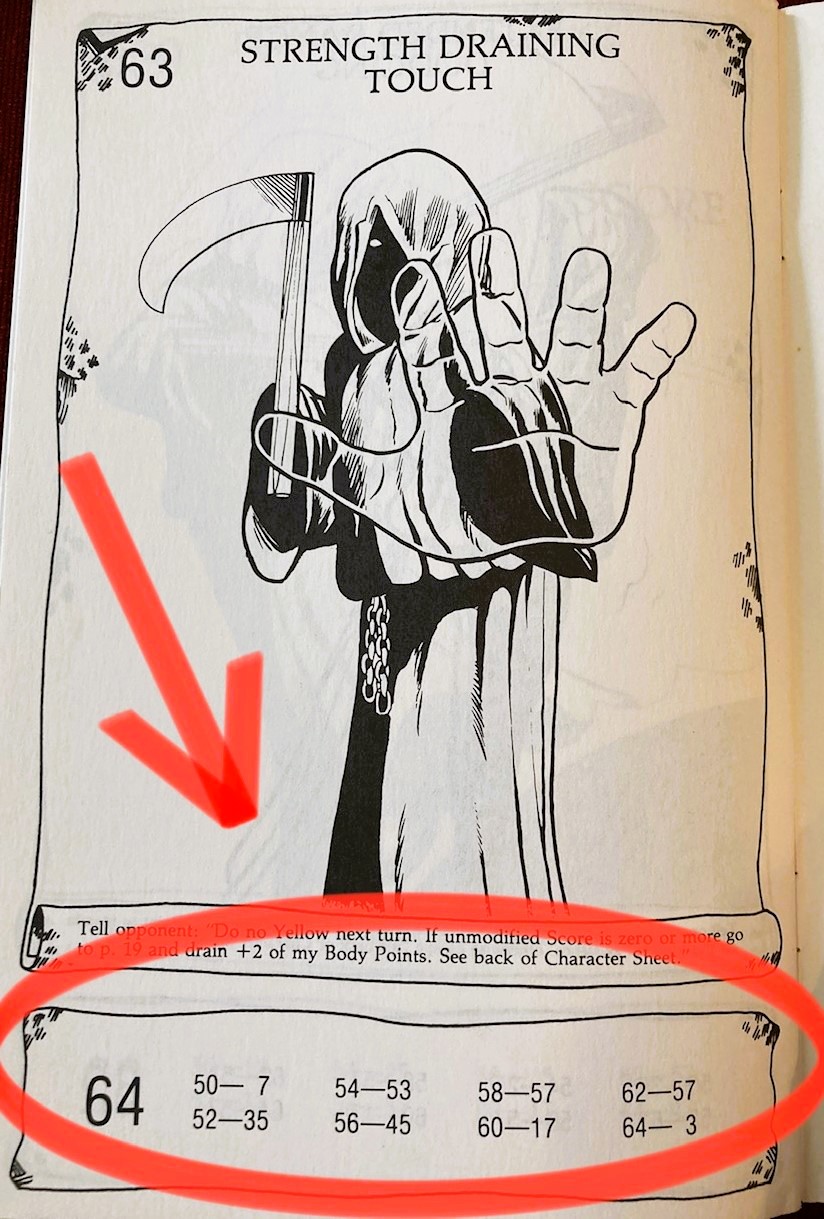
Looking at your character sheet, you would select the maneuver you wanted to carry out and them flip to the page with the corresponding number. Once both players were ready, they would exchange the number of their maneuvers, consult the matrix at the bottom of the page, and then proceed to the page that they were directed to.

Dragon magazine print ad ~1983.

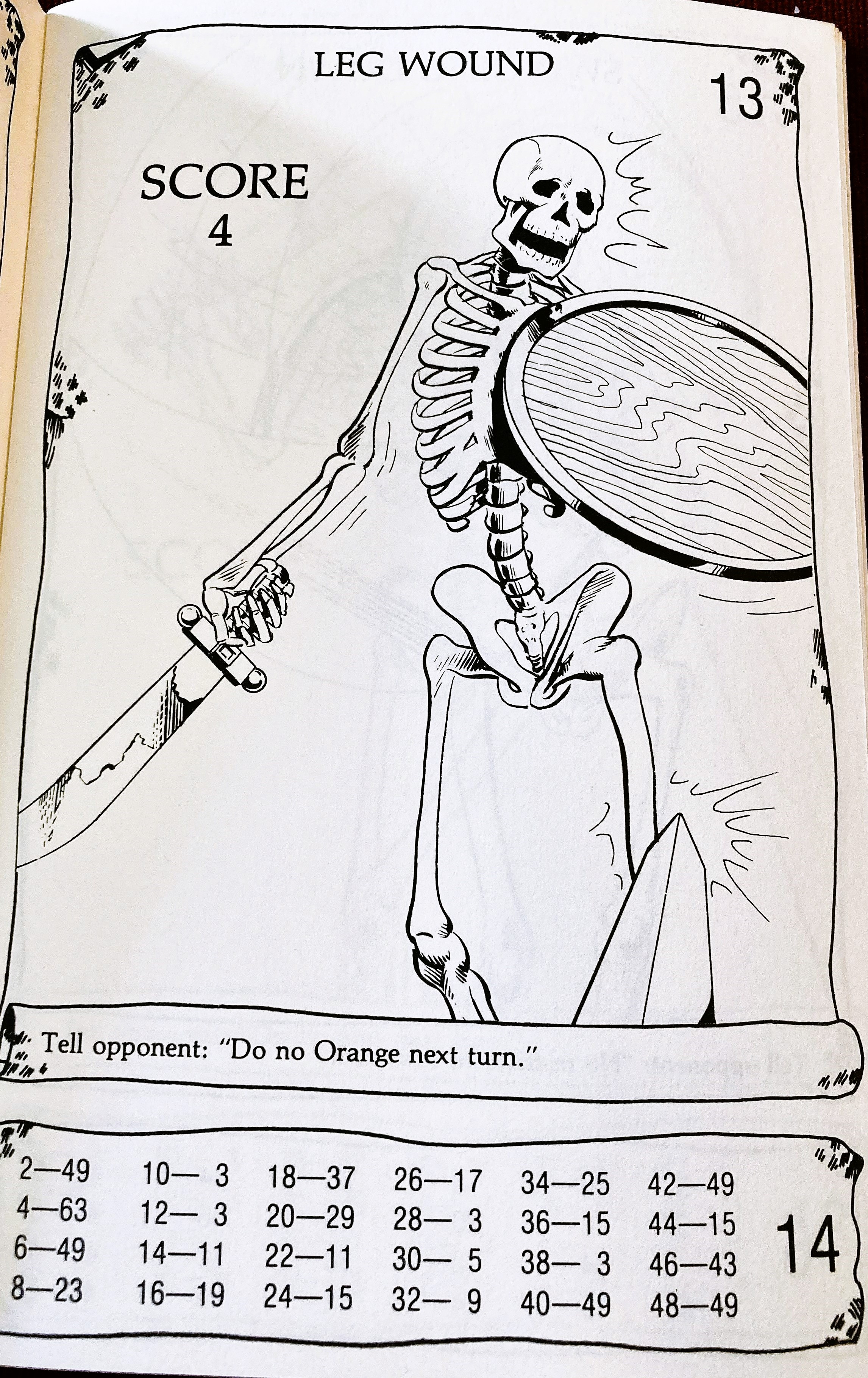
Every time that you would turn to the results page you would be treated to a view of your opponent. If your attacks happened to land, you might see a damage amount and depending on the circumstances, you might be given specific text to read to your opponent (often limiting his/her actions for the next turn). The game would continue in this manner until one of the combatants lost all their body points and was knocked out of commission. Most fights would resolve in just a few minutes.

Skeleton takes a leg wound.

Early on, most of the game books were based on humanoid combatants of similar power levels. However, as years went on their ranks were joined by more monstrous characters like a unicorn, a drake, and even a manticore.

I played it in my teens, so I can’t provide a great deal of commentary on how balanced the system was. Certainly each book wasn’t of equal strength (but I don’t think you would want them to be). A skeleton fighting a hill troll would be in for a bad time. However, for the most part I seem to recall any two like-sized combatants having a decent chance of winning against the other.

Certainly other bits about the mechanics largely made sense. If I happened to do a wild swing maneuver at the same time that my opponent jumped back, there was a good chance that I would be spun around, leaving my back exposed to my opponent. Things like that were a nice touch and really made it feel like your choices were impacting the outcome of the game.

Here you can see the matrix at the bottom of the page.

I first encountered Lost Worlds at Gen Con in 1983. This was back when it was still being held at the University of Wisconsin Parkside. Nova Game Designs ran a tournament that year for anyone purchasing a game book. Along with your game book you were given a badge depicting the character from the book that you had purchased. You were asked to wear your badge, allowing other convention goers to see you as you wandered the halls. Then, when you saw someone else with a badge, you could challenge them on the spot and fight it out.

Due to the brief play time, Lost Worlds wasn’t really something that a group would sit down and play for hours. However, I remember it fondly as something we would often break out on our regular game day, while we were waiting for the rest of our RPG group to arrive.

I lost track of the development of the game in the late 1980s, as real life started to pull me further away from the hobby. It appears that the game has ha many publishers and occasional resurgences over the years, though it has been ages since I’ve come across any mention of it.

That’s all for now. Did you ever experience these Lost Worlds game books, either back in the day or in a more recent incarnation? Hope you have a good weekend!

Vintage Ads From Dragon Magazine #55

Earlier in the week I was flipping through the pages of some old copies of Dragon magazine. I found that I really enjoyed reminiscing and perusing all of the old advertisements. At any rate, I thought some of you might enjoy taking a peek at these as well.

This batch is from Dragon #55 (November 1981). Perhaps these were before your time or perhaps you remember them better than I do. Either way, I hope you enjoy.

St. Regis Dungeons & Dragons Notebooks & Binders

These were entirely lost from my memory until I saw the ad. St. Regis must have acquired the D&D license from TSR (probably not terribly costly in 1981) and produced a line of notebooks, binders, and folders. I’m getting old but it feels like notebooks, binders, & folders were a bigger deal in the 1980s than they currently are.

I’m not sure how wide of a release these had but I suspect it was fairly minimal. I remember finding them at the bookstore in my Jr. High School and wishing I could buy the lot. As I recall, I ended up buying a folder and calling it a day. You do what you can when you’re 11.

I remember the artwork on all of these as being quite striking and I do not believe I ever saw the artist work on any official TSR products. Apparently these were done by a fellow named Alex Nuckols. If you’re curious to see more, a quick Google search will yield some results. In particular, I’d suggest checking out this post from Scrum in Miniature.

One final note on this one is to notice the mention of “Free 28 sheet pack of gamers graph paper!” Graph paper wasn’t that easy to find in 1981. I’m sure adults managed to track it down. However, to kids my age it was a prized commodity.

Full Page Iron Crown Enterprises Ad

Most products from Iron Crown Enterprises (I.C.E.) were out of my reach as a kid. Nobody stocked their line close to me and my meager allowance wouldn’t have been sufficient to delve into their products even if they did.

Since I’d love to hear from someone who knows better than I do, I’m not going to go into a great deal of research here. Instead I’ll stick with my recollection.

Spell Law is the main product advertised here. It was a generic magic system, built to plug into the RPG of your choice. The was preceded by Arms Law (Martial combat) and followed by Claw Law, which I believe dealt with beasts and such.

As I recall, much of this line was eventually rolled together to become Rolemaster, a percentile based fantasy ttrpg. Rolemaster was one of those games that was always around but never end up directly crossing my path. Looks like later iterations of the game are still available on DriveThruRPG.

Their product that I did spend some time with was Middle-earth Role Playing (MERP). At least loosely built on the Rolemaster system, I believe this was the first officially licensed ttrpg based on Tolkien’s works.

Dragonbone

Another item in the “blink and you would miss it” category was Dragonbone. This electronic dice roller was a plastic wand that allowed you to select your desired range (d4, d6, d8, d10, d12, d20, or d%). Once you made your selection you would be provided a randomized “roll” via a little red LED.

I will say that when I was 11, I may very well have had some Dragonbone envy. That said, I think they missed the fact that people really dig rolling dice.

I believe I saw them in real life at the Gen Con exhibitor hall, back when the convention was held at the University of Wisconsin Parkside. However, I never saw one at the gaming table.

Closing

That’s all for now. Drop me a comment if I’ve left anything out of if you have a favorite product that’s largely lost to time.

For more maps & plot hooks, go here.

For my Idea Chest posts, go here.

For some random tables, go here.

Want to help me to compile a list of TTRPG conventions? Click here.

Finally, for a bit about me and some general stuff, this is the spot.
Gaming Conventions

When I first started this blog, I delved into a few posts about my background and how I found myself immersed in the world of tabletop role-playing games. I’ve always been fascinated by origin stories, and one of my favorite things to do is learn how others were introduced to this hobby. In honor of the Gen Con game convention happening in Indianapolis, IN this week, I thought it’d be fitting to revisit an old post about gaming conventions.

I’ve previously shared how I received the Holmes edition of Dungeons & Dragons as a birthday gift in the late 1970s, as well as my eye-opening experience when I first stumbled upon a game store and realized that there was actually much more to the hobby than I had ever dreamed.

In the following years, I developed a keen interest in the game convention listings found in Dragon magazine. Though I wasn’t entirely sure what to expect from a gaming convention, the concept intrigued me. Encouraged by my supportive parents, in the spring of 1983, we made the journey from Rochester, NY to St. Catherine’s, Ontario, for the Niagara Gamefest & Computer Show.

To my young eyes, the convention was a wonderland. Having played D&D (and possibly AD&D by then) with my neighborhood friends for a few years, we were somewhat isolated in our gaming adventures. But this small, weekend gathering revealed to me just how popular this hobby was becoming.

Everywhere I looked, I discovered new RPGs that I had never even heard of before. And then there were the wargames. While I had some exposure to miniatures from Campaign HQ, a tiny gaming store in downtown Rochester, NY, I had never witnessed the grandeur of the massive miniature armies on display at the wargame section of the convention.

Yet, the most significant impact on me was the warm reception I received from other gamers, most of them older than me. As a 12-year-old, I was treated as an equal by everyone I encountered. It was an incredibly welcoming environment, and it didn’t matter whether I was joining college kids in a Car Wars event or testing my skills with seasoned veterans in a Napoleonics game – I felt at home. I was completely hooked.

Old article about the Niagara Gamefest & Computer Show.

Later that same year, I attended the granddaddy of them all – Gen Con, held at the University of Wisconsin-Parkside that summer. If my first convention amazed me, this one simply blew my mind. It was everything I had experienced before but multiplied tenfold.

The campus, nestled in a rural setting near Racine, felt comfortable enough for my parents to drop me off in the morning and pick me up in the evening. While I had been late in registering for specific events, it didn’t matter, as the concourse of the campus was brimming with open gaming sessions anyone could join.

Not a single minute was wasted during my time there. Groups of gamers gathered on the floor, spontaneously embarking on game sessions. People were playing Ogre just a few feet from a Champions group, while across the hall, an engaging Ace of Aces match was in full swing. Yet again, my age was irrelevant – I only had to stand there for a moment, and someone would invite me to join their game.

The epic miniature battles in the wargaming area left me in awe. The largest among them was a multi-day reenactment of one of the crusades. I spent hours marveling at the intricacy of the models and the meticulously crafted terrain.

The dealer’s room at Gen Con was nothing short of massive. Games, dice, miniatures, apparel, and every other gaming-related item you could imagine were on display. I’d wander from booth to booth, eagerly listening to the enthusiastic pitches from vendors.

Many of the vendors set up “mini-games” for attendees to try out their systems, which filled even more of my time. During one such demo for Gangbusters, I was fortunate to meet Mark Acres and Tracy Hickman. Mark, one of the game’s designers, and Tracy, who would later co-author the successful Dragonlance series, left a lasting impression on me.

Those early gaming conventions left me with cherished memories. I returned to Gen Con the following year and attended Origins the year after that. Although gaming has often faced social stigmas, which have lessened over time, the shared experience of a large gaming convention has always been refreshing to me.

These days, I try to seek out conventions that take place further away, and in 2018, I was fortunate enough to attend the UK Games Expo in Birmingham. Exploring gaming events in different parts of the world has added a new layer of excitement to my hobby. It’s fascinating to see how gaming brings people together in a shared passion for adventure and imagination.

Nowadays, I find myself living in Indiana, and I frequently roam the halls at Gen Con in Indianapolis. While things may not feel exactly the same as they once did, the allure of the convention draws me back year after year. Having returned to the hobby after so many years, I’m happy to witness the incredible diversity it has now embraced.

And what about you? If you’ve made it this far, something must have piqued your interest. Have you had the pleasure of experiencing game conventions? If so, which ones have you attended, and what aspects did you enjoy the most? I’d love to hear your thoughts, so please share in the comments.

My first gaming store

Over the following years, I graduated from that original D&D boxed set to the hardcover AD&D books. I also acquired my first set of polyhedral dice (while they were included in later versions of the boxed set, mine merely came with laminated “chits” which you had to cut out and select randomly).

Photo by Alperen Yazgı on Unsplash

I was loosely aware that there were other products made by TSR Hobbies, because of the ads in the back of some of my rulebooks. As I recall, “Boot Hill”, “Dawn Patrol”, & “Gamma World” were all featured. Despite living in a decent sized city (Rochester, NY), I had never come across any of these products in any of the few bookstores where I had been able to find gaming products.

I am not certain when it opened but at some point in the early 80s, my parents took me to visit “Campaign Headquarters”. It was an actual, dedicated gaming store and was quite eye-opening. I was like a kid in a candy-store, just filled with wonder. Thinking back, it was just a single, dimly-lit room but it was fascinating, nonetheless.

The walls were covered with blister packs of lead miniatures. Most of these were of the historical sort, though I believe there were some Grenadier fantasy miniatures as well. It was clear at that point that there were far more role-playing, and wargaming games than I had ever imagined.

While I certainly could have spent days in the store, my parents were ready to roll shortly after our arrival. I ended up using my allowance to purchase Dragon Magazine #55. It was the first time that I had seen the publication and it was very exciting to me at the time.