Whether we are running published adventures or using a world of our own creation, I suspect most gamemasters want to feel that their players are invested in the game. There is nothing quite as nice as wrapping up a session and listening to players discussing how they can’t wait to get together next week. Ever have a player tell you that they were daydreaming about the game while stuck in a meeting or commuting to work? It’s the best.
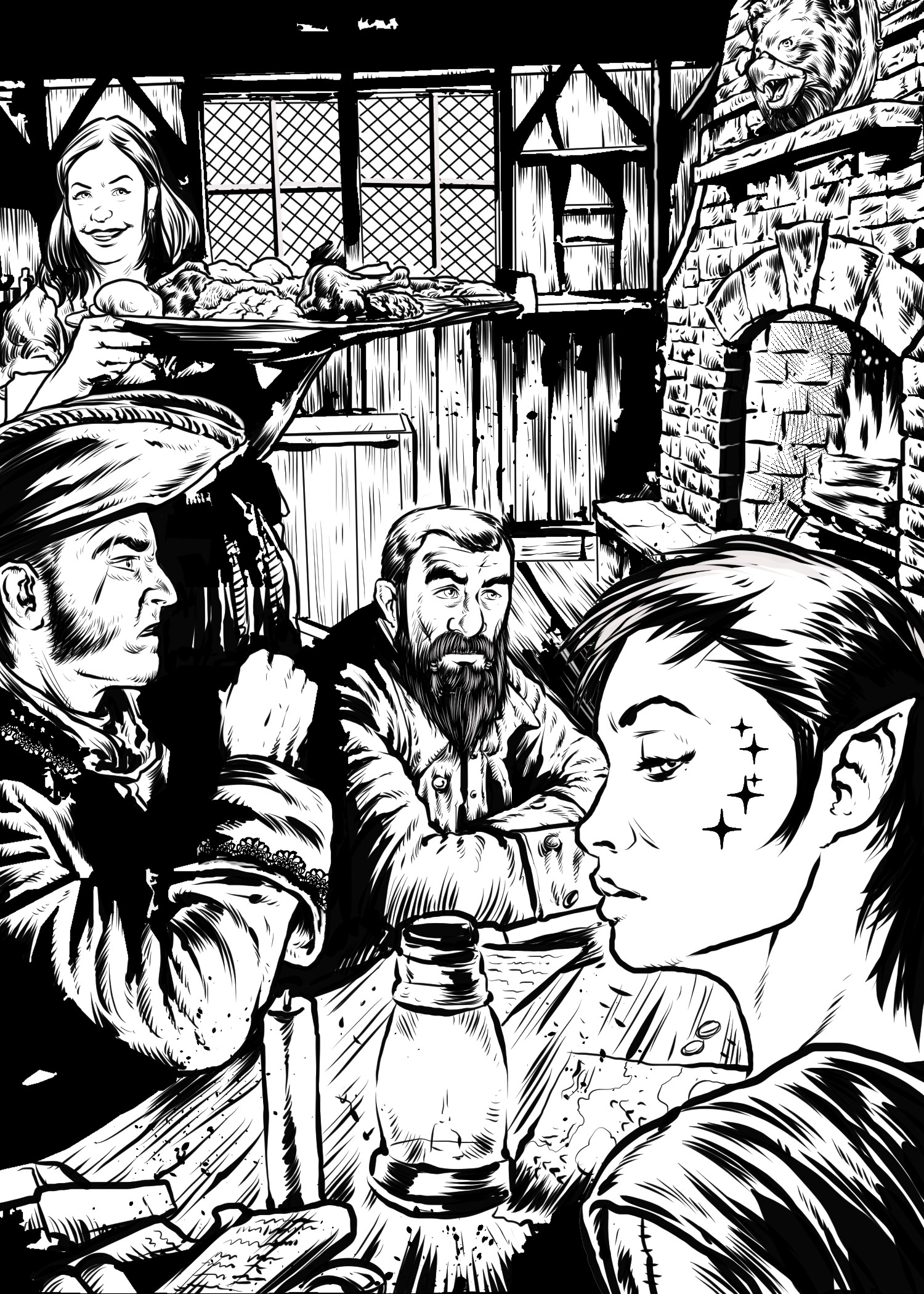
Populating your game with interesting and believable characters is key to hooking your players. That’s not to say that every character in your world needs to have a dossier complete with birthdate, star chart, and defined goals. Sometimes Wilbur the fish monger, is simply Wilbur the fish monger. Having said that, the more fleshed out your NPCs appear to be, the easier it will be for your players to escape into your imaginary world.
Who’s Who?
I believe that creating a “Who’s Who” for your campaign is a great tool for building rich NPCs that your players will want to engage with. I was first introduced to this concept during my friend Mike Capron’s Fantasy Hero campaign in the late 1980s. I’ve been doing this for over 40 years and the practice has served me well. The process is simple enough and until recently I just assumed that everyone did it.
While I’m doing my prep for each session, I just keep a notebook or Word document open. Whenever I come to an NPC who the players are likely to meet, I jot down their name and maybe a line or two. If you want to go crazy, you can do this for places as well.
If you’re someone who struggles with names, there are countless name generators floating around online. Just plug in what you’re looking for and you’ll have something in a pinch.
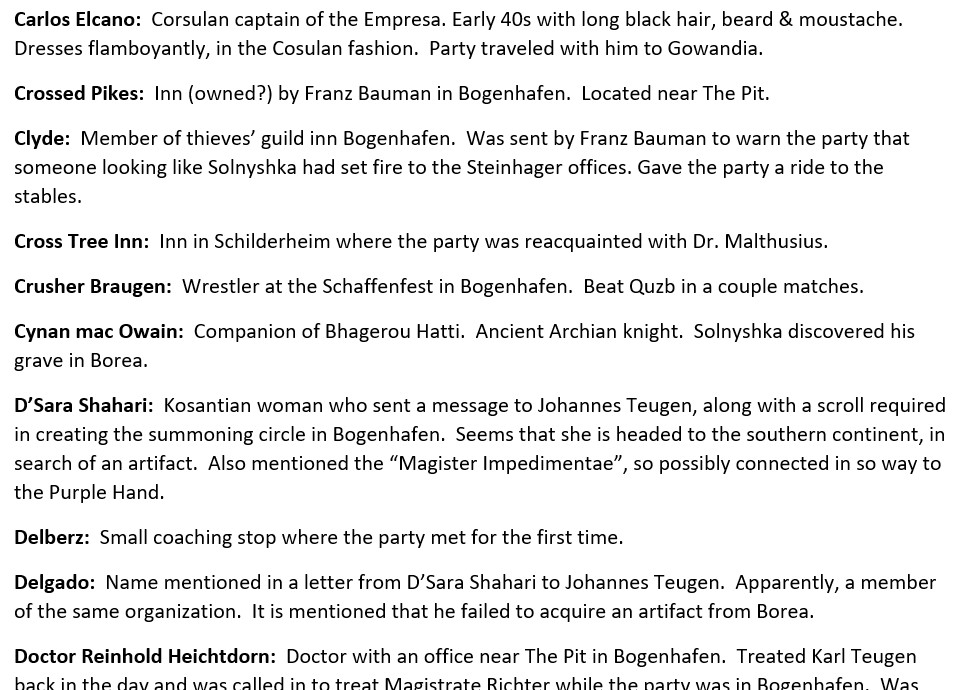
By adding no more than 10 minutes to my prep time, my players no longer meet the dockmaster, city guard, and innkeeper. Instead, armed with this information they encounter Buckeye Crabcracker the halfling wharf-keeper, Sgt. Atheld of the city watch, & Suleiman the Kosantian owner of the Blushing Siren Inn.
Coming up with names for NPCs is pretty basic but it’s only the first step in creating a Who’s Who for your campaign. The next part is up to the players. I visit this after every few sessions, at the end of an arc, or whenever it seems convenient.
Our game nights usually start with players arriving one by one. It can be a bit chaotic. Everyone is usually chit-chatting and I need to get them to switch gears and focus on the game. During this time I announce that we’re going to update the Who’s Who.
I go around the table and ask all of the players who their characters have met during the sessions since we last updated the list. At this point everyone chimes in with the names of NPCs that they remember, as well as what they remember about them. I document all of this as they do, including only what the players themselves remember. The whole process takes no more than 10 minutes but it serves to both center the players on the game, as well as offer an interactive recap of recent sessions.

I will usually reward the player who contributes the most with some small boon. For OSR games this might be an XP bonus, 5e players might get Inspiration, Savage Worlds players get a benny, and so on. I find that this really helps to get everyone to participate.
After every session, I send the revised document out to all players. However, I only share the version with the names of people and places that the group remembered. If the group as a whole missed any NPCs, those do not get passed along.
Over the course of time, I find that having access to this reference document really engages my players. When your cities feel like they are populated with living and breathing people, it increases the chances that your players will interact with them.
It’s satisfying to see the group break out with the Who’s Who as they are heading back to town following an adventure. Often each player will be flipping through the pages, deciding who they want to go see first. Maybe they know the perfect buyer for a piece of loot or perhaps they’ll seek out an old contact for important information.
On the flipside, the document acts as a tool for me during session prep. I can briefly scan through and pick different NPCs to drop into different scenes. Do I need someone to pass along a juicy tip? That sounds like the perfect job for young Jacob, who the party saved on their first adventure. Do I need a victim for the big bad evil guy? Hearing that Fletcher Orlem was slain while out hunting will ratchet up the tension more than some nameless villager.

Since we update entries for NPCs after every time the players mention them, they really start to take on a life of their own. Over the years, some of my most mundane NPCs (like Wilbur the fish monger) have ended up playing important roles in my games.
Finally, the Who’s Who gives me a nice souvenir from each campaign. Whether we run for years or a handful of sessions, having this document gives me something fun to look back on. Sometimes names and sub-plots get recycled and that’s all part of the fun.
Recap
That’s it for this week. Thank you for stopping by. If you do something akin to this or even something more elaborate, please drop a note below and let me know. Have a great week!
For the Village of Cross Tree, go here.
For maps & plot hooks, go here.
For my Idea Chest posts, go here.
For some random tables, go here.
Finally, for a bit about me and some general stuff, this is the spot.
 Talaraska
This is honestly a really good idea, and I’m surprised no one’s told me this before either. When I make important NPCs, I give them a whole separate file where I describe them in 2 sentences, then in more detail add their species, work, allies, enemies, plothook, history with the party, etc. But I still need to go to all those separate pages. With this, it’s all on one page.
Getting the players in on it is an excellent way to engage them and get them to remember the NPCs as well. I can already think of how I’d implement this. How often do you update the list with them?
In any case, thank you for sharing this, I’ll definitely see how I can use this myself.
LikeLiked by 1 person
Thanks for taking the time to write. Sometimes I’ll update it on back to back sessions, though usually I’ll save it for natural breaks in the story.
LikeLike
We have something like this on our campaign wiki: http://saltghosts.wikidot.com/npcs
But I really like the idea of going round the the table to have the players contribute to it! Gonna try that.
LikeLiked by 1 person
Thank you so much for taking the time to write. That wiki is fantastic! That’s just for your home campaign? That is awesome!
Yes, absolutely try looping in your players. I find that even when I only offer a small boon for the one who participates the most, it really changes the dynamic. Most GMs have one player who is the “note taker”. However, when I do this I find that everyone gets in on the action.
I hope you have a great week.
LikeLike
I actually have another one for another instance of the same campaign with other players. I do most of the work on it these days but at different times I have had multiple players contribute. Everyone is responsible for keeping their character page up to date (and thus why only one is actually up-to-date 😉 )
LikeLiked by 1 person
Ah this is cool, thanks. I particularly like that it helps identify the people (and presumably plot threads, by association) that the players remember session to session, which I think would be a great help for future planning and an indicator of which ongoing threads/arcs to keep and which to drop.
LikeLiked by 1 person
Thank for taking the time to write. Yes, often when I’m planning for future adventures I’ll be looking through to see who I haven’t used in a while or who is likely to get a reaction out of one of the PCs.
LikeLike
There are few things as satisfying as watching the party ‘adopt’ a minor NPC and make them into a strong part of the campaign!
LikeLiked by 1 person
Absolutely. Sometimes the minor NPCs end up being some of the most memorable parts of the campaign. Thanks for taking the time to write! I appreciate it.
LikeLiked by 1 person
Nothing worse than building a rich, in-depth environment, then stumbling when the first player asks the name of the person they’re talking to.
This is a great idea and one I’m definitely going to incorporate.
LikeLiked by 1 person
Thank you for taking the time to write. I’m glad that you found it useful.
LikeLike
Pingback: Consider Creating a Player’s Guide for Your Campaign World | Talaraska
Pingback: 50 Urban Encounters for Your Fantasy Campaign | Talaraska
Pingback: Consider Polling Your Players Before Creating Your Campaign | Talaraska
Pingback: A Who’s Who for the Village of Cross Tree | Talaraska
Great idea/post.
First off, people actually ran Fantasy Hero?! I like Champions, but the record keeping for that game was something else. I picked up Fantasy Hero as well, but never attempted to run it. That’s pretty awesome though!
We had a practice of making up NPCs/personalities on the fly in our games. My brother and I are both pretty good at improv, so that was never much of a problem. However, keeping things consistent was challenging. I remember quite a few times returning to the same NPC sessions later, and one of the players saying ‘Who is that?! No, Biegrom had a raspy voice!’. So we (or at least I), started taking more notes. Typically I do an end of session of journal. What the players did, people they met, etc. I might use it as reference at the gaming table occasionally when I forget something.
However, when making those quick improv NPCs, they often lack the finer details (especially if you forget those things later). Every NPC tends to end up a little more samey, which means players can care less about them. Especially my young players who are used to dealing with NPCs in video games. So two things stood out to me while reading this.
One, you can make interesting NPCs but the players are unlikely to care much unless there is something in it for them. You mentioned plot hooks, selling goods, recurrence, etc. and I think all those things are pretty crucial to making NPCs important. Something I’m going to keep in mind more often in the future.
The second, getting the players involved and sharing the Who’s Who is a great idea. Usually in the games I played, you were expected to take your own notes and remember things or you’re out of luck! The DM wasn’t your friend. But with my younger players, they don’t take a lot of notes or remember things that well. Giving them an incentive through a boon, is a great way to encourage them to remember NPCs. Plus help me if I forgot a detail or two. Though I initially bristled at the idea of handing them a player’s copy of the Who’s Who, it really makes a lot of sense and provides them with a handy resource. Though…I wonder if they will come to expect me to do all the note taking for them, if I give them something like that? Might have to mull that over a tad.
Lots of fun things to back about though! 🙂
LikeLiked by 1 person
Yes. We not only played Fantasy Hero but stuck with it for the longest campaign I was ever part of. I was able to hang in for about 7 years before moving away from the area. I believe the GM carried on for another few years after that. I know what you mean about the record keeping. I was lucky enough to have an amazing GM for that experience. I dearly love the system and still have all of my old materials but the thought of bringing it to the table is rather daunting.
I generally agree with the thought that the players should be taking their own notes. When I’m lucky enough to sit on that side of the table (exceedingly rare these days) I’m usually the one furiously jotting things down when the GM drops some new names or bit of lore.
That said, as a GM, I often end up running with folks who are either brand new to the hobby or perhaps sat in on a game or two in college. With those type of players, I find that providing them this tool works kind of like training wheels. Session by session I’ll see more of them start to lean toward note-taking on their own. I always get a great deal of satisfaction when I start to describe an NPC who hasn’t appeared for a while, only to see a player’s eyes go wide with realization.
Thanks Faust.
LikeLiked by 1 person
I’m going to take a wild guess that it was the GM and group that made that Fantasy Hero game last so long?
I’m always trying to fix rules that bug me, especially right now in 5e. But at the end of the day, it’s not the system that the players are going to remember. It’s the story and interactions.
Same here with either teaching new people or kids how to play. It’s been over a decade since I last played with anyone who knew RPGs before they met me.
Thinking about it more, I think I will begin to introduce a Who’s Who for players. If it doesn’t work out like I thought, then I can explain to them what’s not working and what my expectations are (management 101, haha!). If it’s still not, then I can always stop doing it. But I think there is a lot of benefit to the idea. My youngest did start taking it upon herself to write down notes the last couple session. Which is very impressive.
One clarification. When you give the Who’s Who to your players, is it still just a summary? e.g. you might have an entry “Sven Jorgensen, the smith. Has the best prices in town. Is looking for a piece of armor that went missing.”. Say the players remember that he is severely in love with Geilda and he used to be an adventurer. Does Sven’s Who’s Who entry start to become longer and longer as time goes on?
LikeLike