
Earlier this week I wrote a post about vintage ads from the pages of Dragon Magazine. While taking that stroll down memory lane I came across one game in particular that had held a special place in my heart for a brief moment of time.
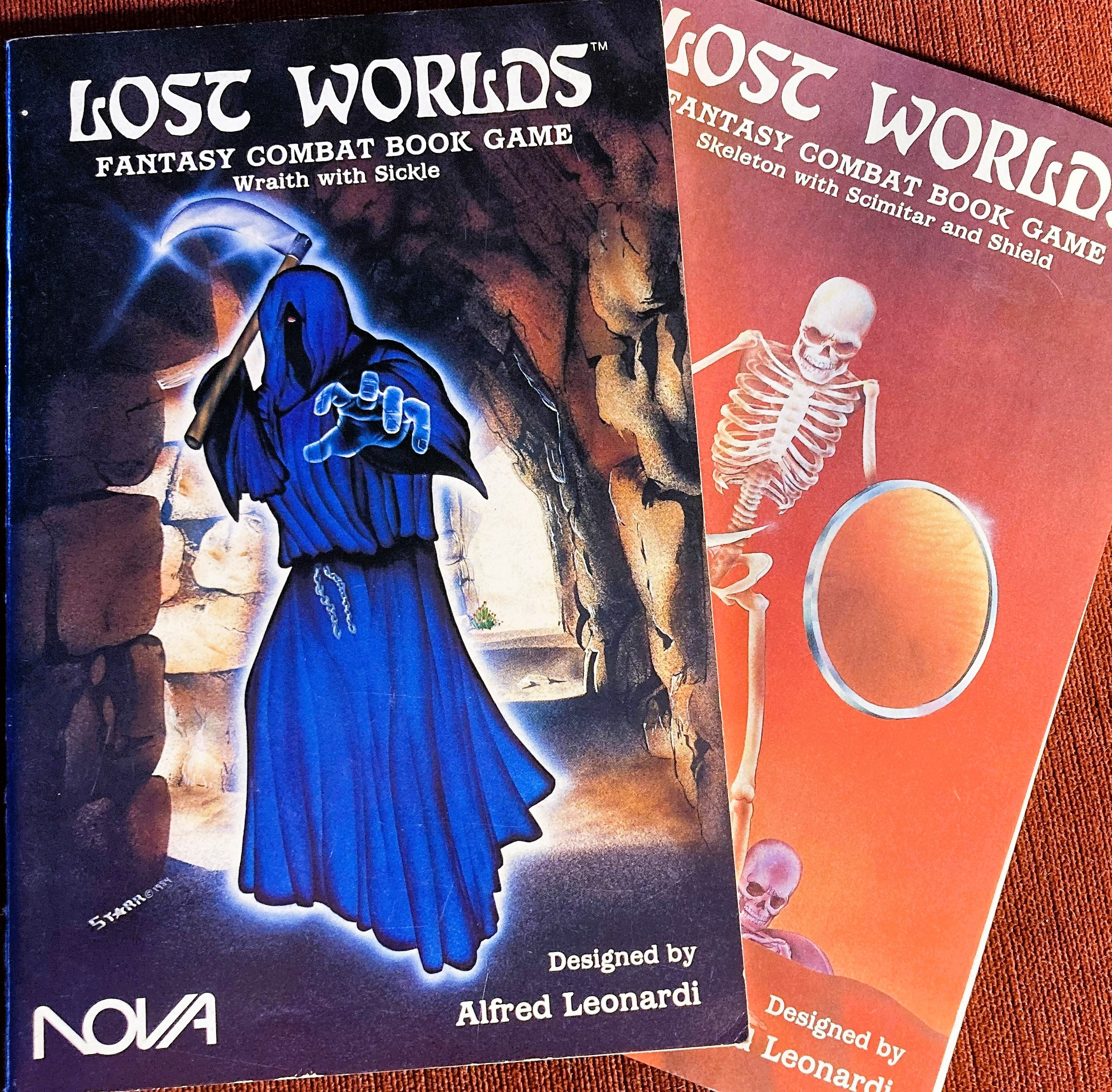
Designed by Alfred Leonardi and released by Nova Game Designs, Lost Worlds was a fantasy combat book game that debuted in 1983. Leonardi had already had a considerable hit with Ace of Aces, a WWI dogfighting game from 1980. Lost Worlds capitalized on the explosion of interest in fantasy games at the time and delivered a fun little diversion.
The game itself revolved around individual game books, with each game book representing a particular character. The characters themselves ranged from the fairly mundane “Man in Chainmail with Sword and Shield” or “Woman in Scale with Sword and Shield” to the more fantastical like “Skeleton with Scimitar and Shield” or “Giant Goblin with Mace and Shield.”.
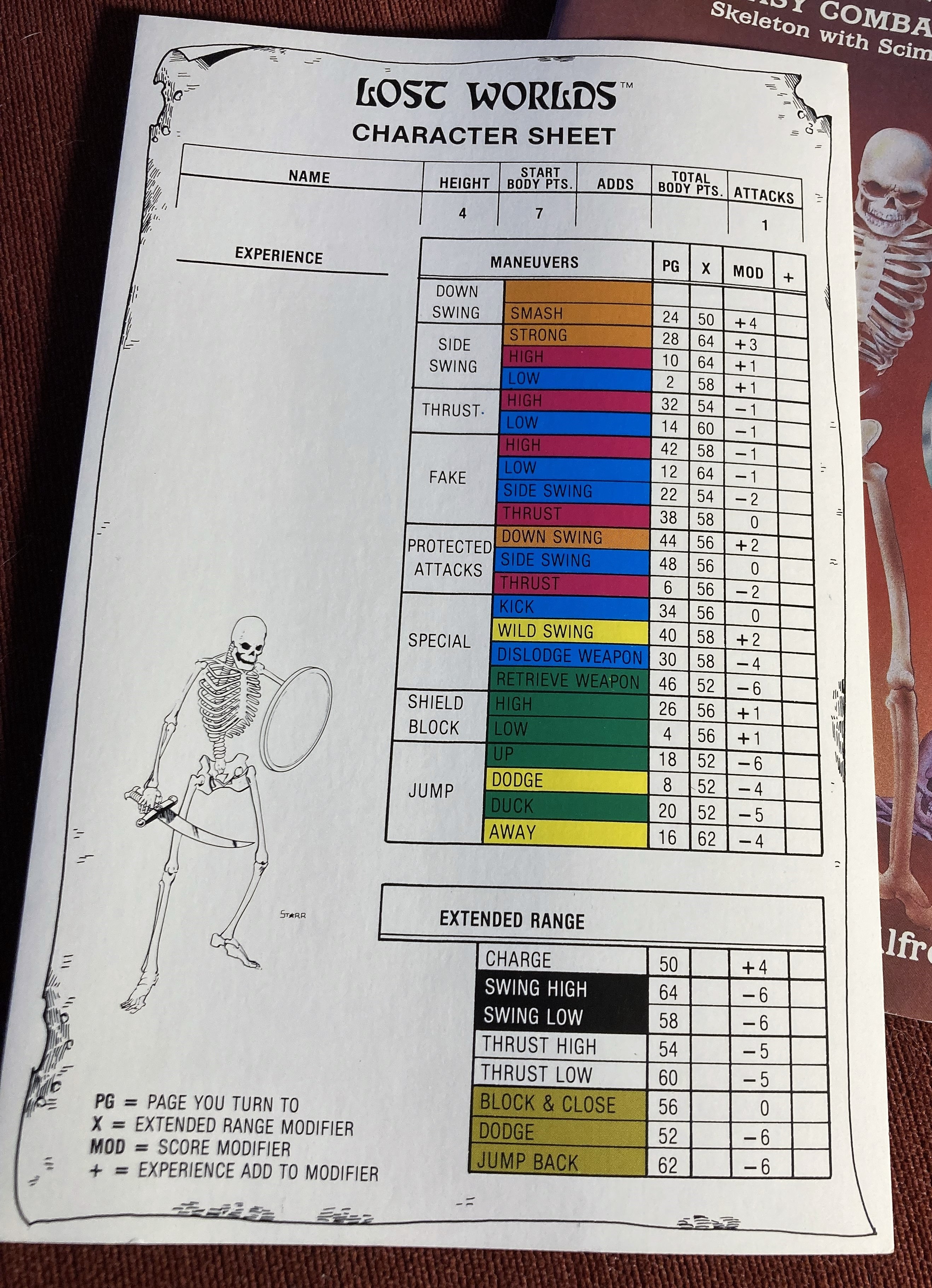
Each book contained a removable character sheet (listing various maneuvers that the character was capable of) depicted the character in various poses. Essentially a dueling game, the idea was that both players would come to the table with their own book and then fight it out until one was victorious.
At the start of play, you would remove your character sheet and then pass the booklet itself to your opponent. As the game commenced, you would turn to a pre-determined page in the book. The picture on the starting page would essentially give you a first-person view of your opponent’s character squaring off and ready to fight.
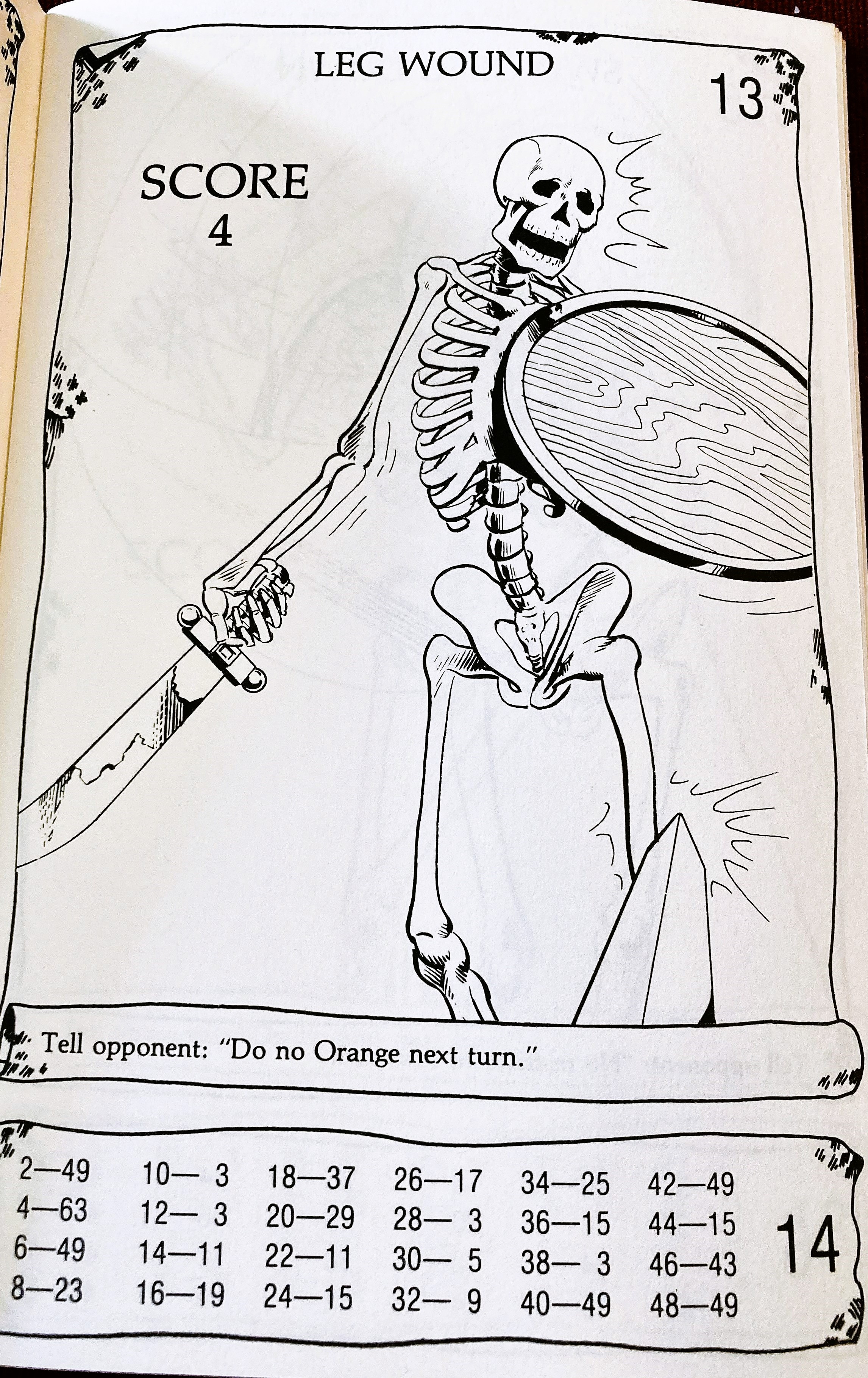
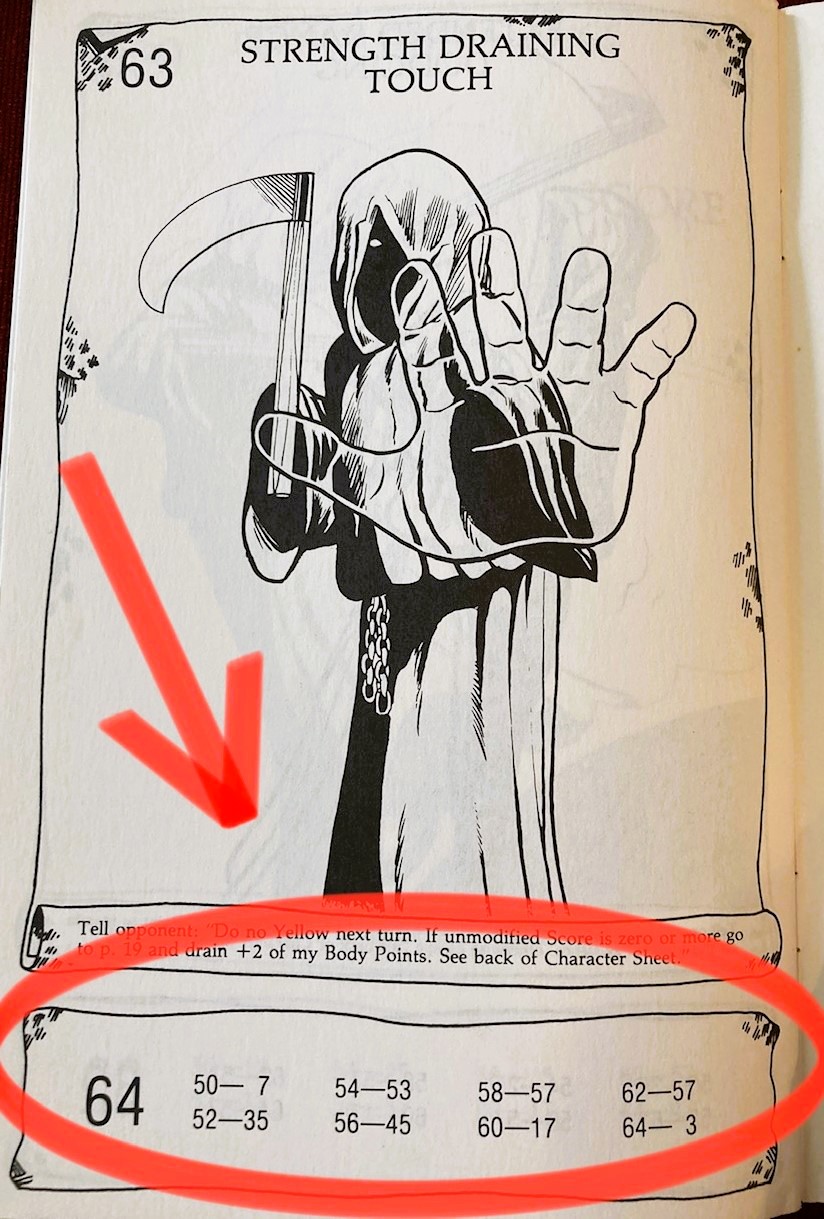
Looking at your character sheet, you would select the maneuver you wanted to carry out and them flip to the page with the corresponding number. Once both players were ready, they would exchange the number of their maneuvers, consult the matrix at the bottom of the page, and then proceed to the page that they were directed to.

Every time that you would turn to the results page you would be treated to a view of your opponent. If your attacks happened to land, you might see a damage amount and depending on the circumstances, you might be given specific text to read to your opponent (often limiting his/her actions for the next turn). The game would continue in this manner until one of the combatants lost all their body points and was knocked out of commission. Most fights would resolve in just a few minutes.
Early on, most of the game books were based on humanoid combatants of similar power levels. However, as years went on their ranks were joined by more monstrous characters like a unicorn, a drake, and even a manticore.
I played it in my teens, so I can’t provide a great deal of commentary on how balanced the system was. Certainly each book wasn’t of equal strength (but I don’t think you would want them to be). A skeleton fighting a hill troll would be in for a bad time. However, for the most part I seem to recall any two like-sized combatants having a decent chance of winning against the other.
Certainly other bits about the mechanics largely made sense. If I happened to do a wild swing maneuver at the same time that my opponent jumped back, there was a good chance that I would be spun around, leaving my back exposed to my opponent. Things like that were a nice touch and really made it feel like your choices were impacting the outcome of the game.
I first encountered Lost Worlds at Gen Con in 1983. This was back when it was still being held at the University of Wisconsin Parkside. Nova Game Designs ran a tournament that year for anyone purchasing a game book. Along with your game book you were given a badge depicting the character from the book that you had purchased. You were asked to wear your badge, allowing other convention goers to see you as you wandered the halls. Then, when you saw someone else with a badge, you could challenge them on the spot and fight it out.
Due to the brief play time, Lost Worlds wasn’t really something that a group would sit down and play for hours. However, I remember it fondly as something we would often break out on our regular game day, while we were waiting for the rest of our RPG group to arrive.

I lost track of the development of the game in the late 1980s, as real life started to pull me further away from the hobby. It appears that the game has ha many publishers and occasional resurgences over the years, though it has been ages since I’ve come across any mention of it.
That’s all for now. Did you ever experience these Lost Worlds game books, either back in the day or in a more recent incarnation? Hope you have a good weekend!
 Talaraska
Oh, yeah. I remember having great game sessions with my group playing Lost Worlds back in the 1980s. They started publishing in 1983 under the Nova Game Designs banner but Nova went under in early 1990s.
These were fast paced sparring games with visual moves. I lost track of them in the 1990s until I saw a Tunnels & Trolls character book in a game store and saw that other publishers had made dozens more characters and bought them all through Flying Buffalo Games.
The inventor of the system never intended them to be stand alone games. He was playing D&D with friends and pondered why character actions had to grind to a halt as results came from never ending dice rolls mixed with random results. He devised a system of flash cards for DMs that would give certain results to actions and damage results for positive moves by the players. They were rejected for being too complicated and generic to incorporate in sessions but the idea of a diceless combat system for fantasy games never left Leonardi’s creative thoughts.
That’s where he devised the core of the first Lost Worlds books. Never intended to be stand alone games, the were meant to be a visual combat system that used no dice and gave characters visual person to person conflicts with more certainty to their moves. They never took off as such but did build a cult following of players who liked the unique idea.
Alfred Leonardi spent lots of time hanging out at renaissance fairs and LARP battles studying players moves and equipment. He followed how many blows from a cardboard sword it took to split a foam rubber shield, how lighter armored fighters moved more nimbly than more heavily armored ones and things like that while developing his matix results system that is the core of the combat in his game. From there it was just character drawing, damage results for different weapons, and opponent limitations reactions to incorporate into the fighter books for it all to start. From the first few characters he grew the catalog to multi-player opponents, flying characters, magic users, mounted fighters, ranged weapons and the list goes on. None of Leonardi’s games ever took off well, even the Luke Skywalker/Darth Vader dueling pack and the Battlebooks line which allowed readers to fight comic book characters against each other by fighting in the comics. But I always keep an eye out for something new because for 40 years the idea never really went away and there is always enough fan interest for minor revivals.
LikeLike